Archives for November 2015

November 30, 2015 - No Comments!

Einstein to Eminem: The Secret to Greatness

by Geoff Gouveia

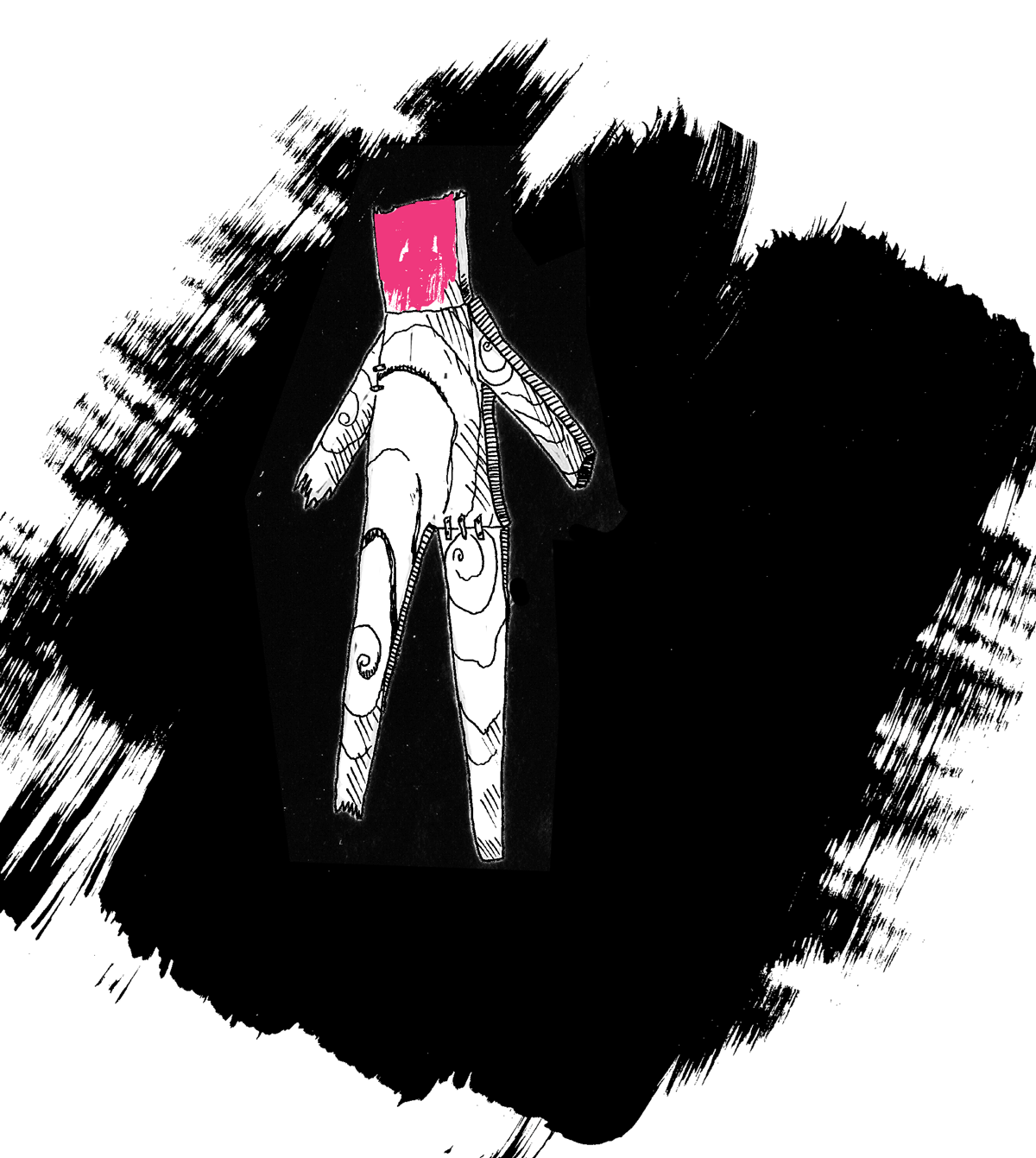
illustration by Geoff Gouveia

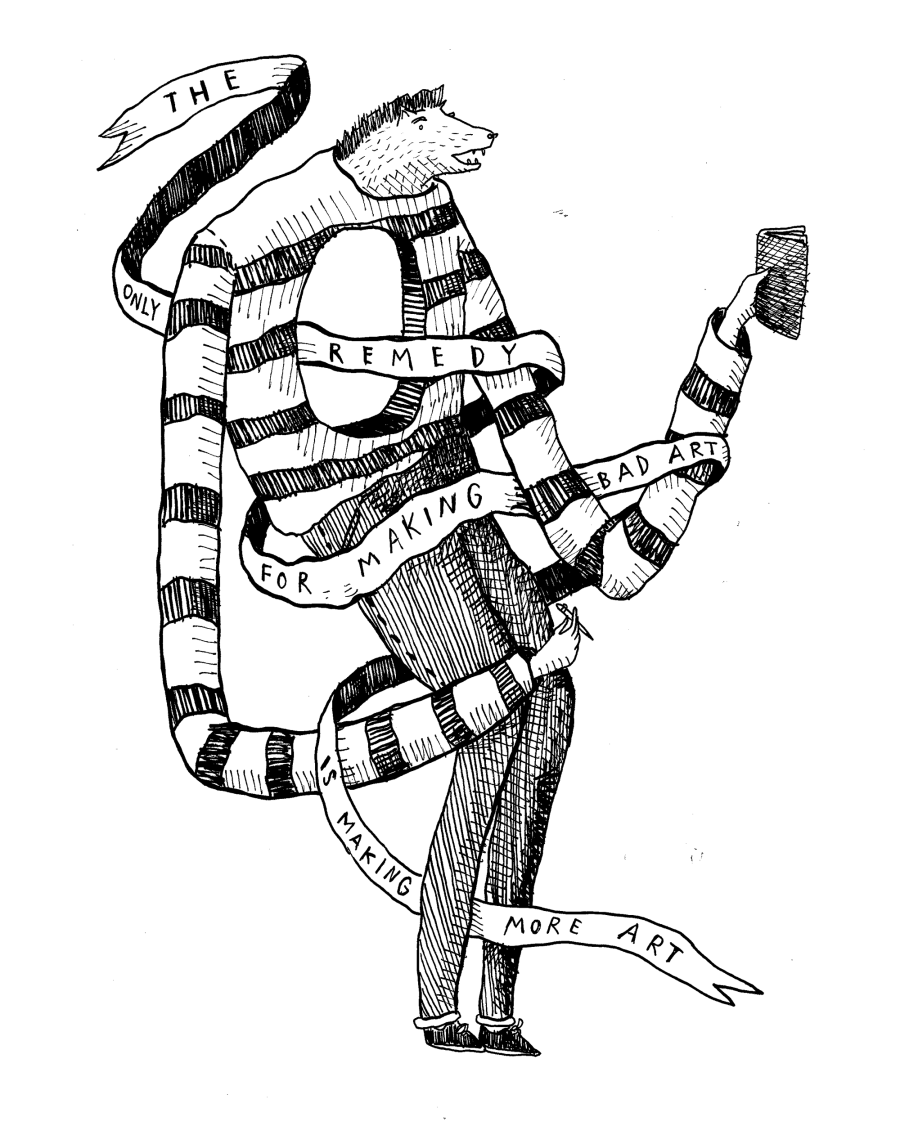
illustration by Geoff Gouveia

In the 2008-2009 school year (my senior year in high school) I was in AP art class. AP meaning advanced placement or more accurately, Geoff Gouveia should probably not be in this class. I was terrible at art and the only reason she, Mrs. Anthony, let me in was because I finished assignments quickly. I also happened to be student number 15, or the beating heart that met the minimum requirement to keep the class available for the truly gifted.

Within the first week I noticed how out of my league I truly was. When everyone took out his or her nice art supplies, I clicked my mechanical pencil and drew very small on lined paper. I saw how the other students prepared one piece diligently for the upcoming critique and I too began to copy their preparations. I worked on one single piece for the duration of a month and made it ‘perfect’. The critique came and I got slaughtered.

“Colors don’t make sense, composition is off, what is that? (me: a girl) oh, looks like a tiny boy.” They might as well have taken a revolver to the piece. When the smoke cleared, I realized I couldn’t compete with the other students by playing their game.

The realization that followed enabled me to overcome that disastrous critique and lead me to paint for Facebook, internationally and recently illustrating for New York Times Bestselling author Jon Acuff (below).
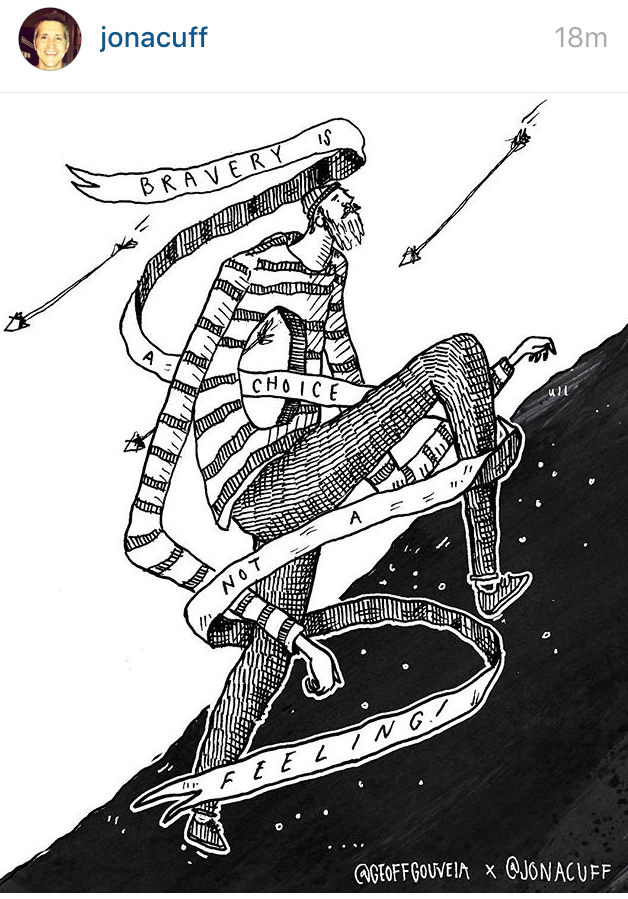
illustration by Geoff Gouveia for Jon Acuff

illustration by Geoff Gouveia for Jon Acuff

The realization? A switch in tactics.

Instead of preparing one piece at a time, I switched to drawing with ink on sheets of paper. At the beginning of each class I took out 3 sheets of paper and the pen and ink (think of a quill to dip into the ink, fancy) and proceeded to draw for the entire hour and a half.

Little did I know then that I was tapping into a technique that Keith Simonton, Phd. explores in his 1997 research paper Creative Productivity. Unknowingly, I stumbled into accessing my potential as an artist using the same technique that important creative figures, from Mozart, Monet and Picasso to Einstein and Eminem, used to achieve greatness.

The technique and the extreme cliff note version of Simonton’s jargon profuse paper?

Make a lot of stuff.

Simonton argues that “one of the best predictors of success in science is the number of publications a young scientist makes before earning a doctoral degree.” Expounding upon this idea in his book Creativity in Science: Chance, Logic, Genius and Zeitgeist, Simonton proposes with his idea, the Equal Odds Rule, that the merit is not in the quality of the work but in the quantity produced. “The Equal Odds Rule says that the average publication of any particular scientist does not have any statistically different chance of having more of an impact than any other scientist’s average publication.” The difference? The more tickets bought, the higher chance of winning the lottery.

Researchers from both the Psychology and Neurology departments at the University of New Mexico sought to replicate this idea in a recent 2015 study. 246 subjects were given abstract objects to look at and told come up with as many things they resembled under an allotted amount of time. “Subjects who produced more descriptions of abstract visual designs produced more creative descriptions of the designs as measured by judges who were blind to subject demographics.”

The Equal Odds Rule is important because it levels the playing field. It destroys the idea of genius. It does not, however, say that making equates to greatness. The implied aspect of creating is the ability to progress in production. Those who produce more, learn more. As their production improves so too does the quality. By the end of the production their pieces or works are the best because they’ve put in the work.

How does this play out in real life?

Einstein produced 248 publications during his lifetime. As a result, he earned the right to be celebrated as one of the most important figures in the realm of modern physics. Instead of relying on his genius to churn out a few great papers, he kept creating until he became great.

Let’s look at hip-hop. (Yes I jumped from physics to rap, any questions?)

Eminem has been featured in 505 (depending on the day of the week) tracks. He is also one of the highest selling artists in the 2000’s and one of the best selling artists of all time. Whether or not you like his music is irrelevant- his consistency and tenacity in creation is a whirlwind worth emulating. He certainly reaps the benefits of having put in the work now.

Not convinced that more works equals mastery?

Mozart created over 626 pieces of music before dying at the age of 35. I did the math: Every 16 days from the time he was six years old to his death he produced a new piece of music. Let that sink in.

Monet is attributed to over 2,500 pieces of art. If Monet were to start his artistic production from birth and continue until his deathbed at 84 years of age, he would have made 1 piece every 12 days.

The number of works Picasso has created varies from source to source, but many agree the number is over 20,000 drawings and paintings.  Picasso lived to be 91- if he painted the day he was born up until the day he died he would have kept a pace of producing a work every 36 hours.

These are all masters at their craft and will subsequently be remembered for their important contributions in their given field. The amount of work they produced is staggering but comes with an important caveat:

They also produced the very worst.

Simonton warns that with the blessing of greatness comes a curse as “scientists who publish the most highly cited works also publish the most poorly cited works.”

It is hard to criticize Mozart, Monet and Einstein because of the length of time that has passed. Instead we have to focus on more recent triumphs. Check out Picasso and Eminem.

My brother Nolan recently went to LACMA and sent me this text.
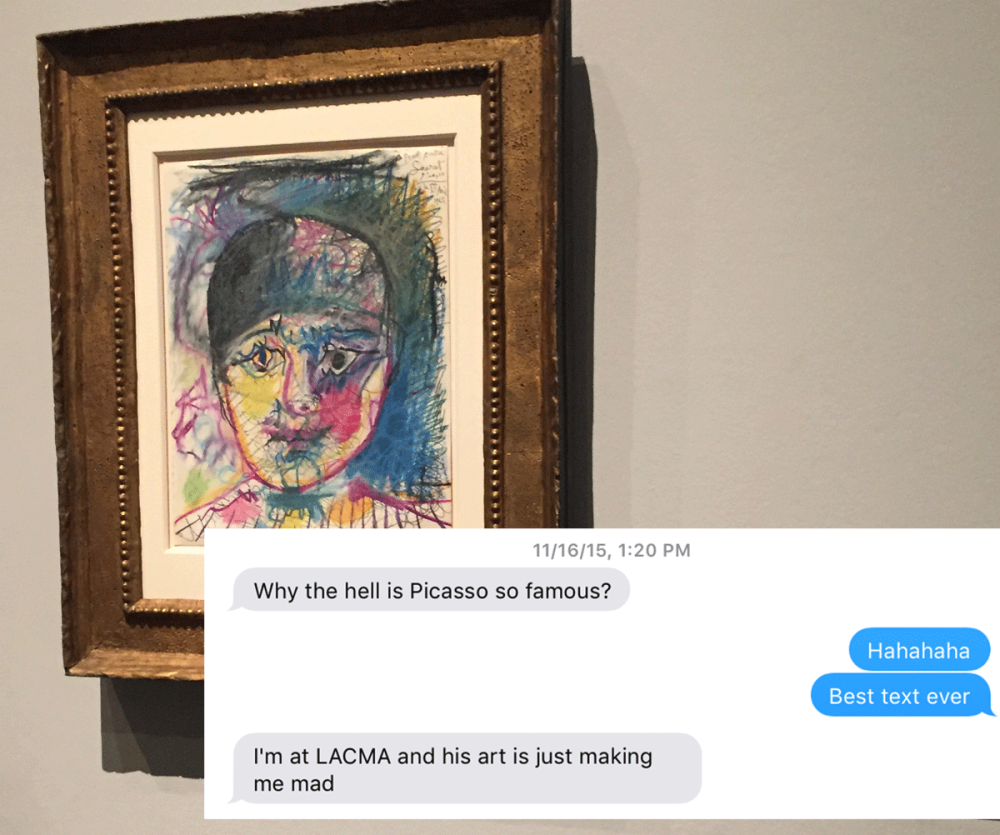
My brother Nolan's critique of Picasso

My brother Nolan's critique of Picasso

I’d have to agree. I think my mom has a drawing that I did back when I was 4 that looks better than Head of a Boy, 1965. Where’s my spot in the museum, LACMA?

Back to Eminem- the masterpiece that is Recovery comes on the heels of his worst album, Relapse. Check out his own lyrics:

And to the fans, I’ll never let you down again, I’m back
I promise to never go back on that promise, in fact
Let’s be honest, that last Relapse CD was ‘ehhh’
Perhaps I ran them accents into the ground
Relax, I ain’t going back to that now

And finally let’s point the marks back at me.
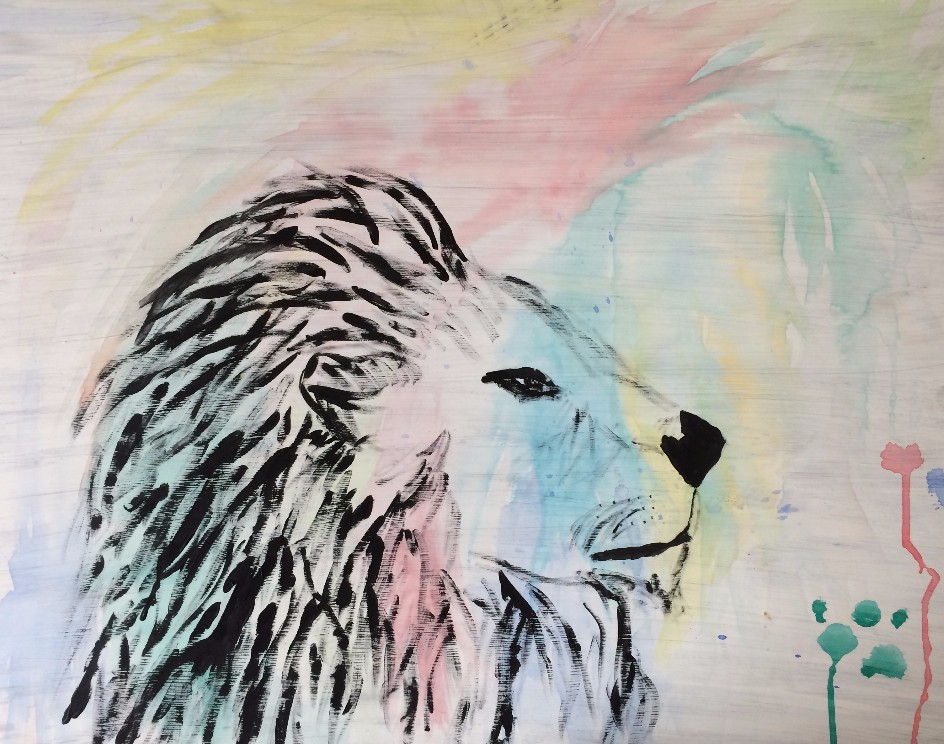
One of my first paintings...

One of my first paintings...

Above is a photo of painting I did in 2010 for my then-girlfriend and now wife. It was still hanging in our bedroom until about 8 weeks ago. I finally snapped it in half after taking this photo. What can I say? At least it’s cooler than Head of a Boy.

This above picture should prove that I haven’t reached my full potential but I do know this: I’m on the right track.

I’ve noticed that I’ve progressed more than my peers because of drive and commitment as opposed to raw talent.

I don’t believe I was born with the talents to draw.

But that doesn’t mean I don’t have the confidence to become something great in this field. Why? Because I was born with the ability to weather the storm and to produce something every single day.

Simonton’s Equal Odds Rule is a bittersweet pill. Greatness is a number, not an inherent character trait. Greatness also has pitfalls on its path. Simonton’s rule should prepare you for the onslaught of absolute garbage to come from your fingertips. And that’s ok.

So get out there. Make a lot of stuff.

This originally appeared in my weekly newsletter.
November 24, 2015 - No Comments!

Melon-Cali Monkey

by Geoff Gouveia

illustration by Geoff Gouveia

illustration by Geoff Gouveia

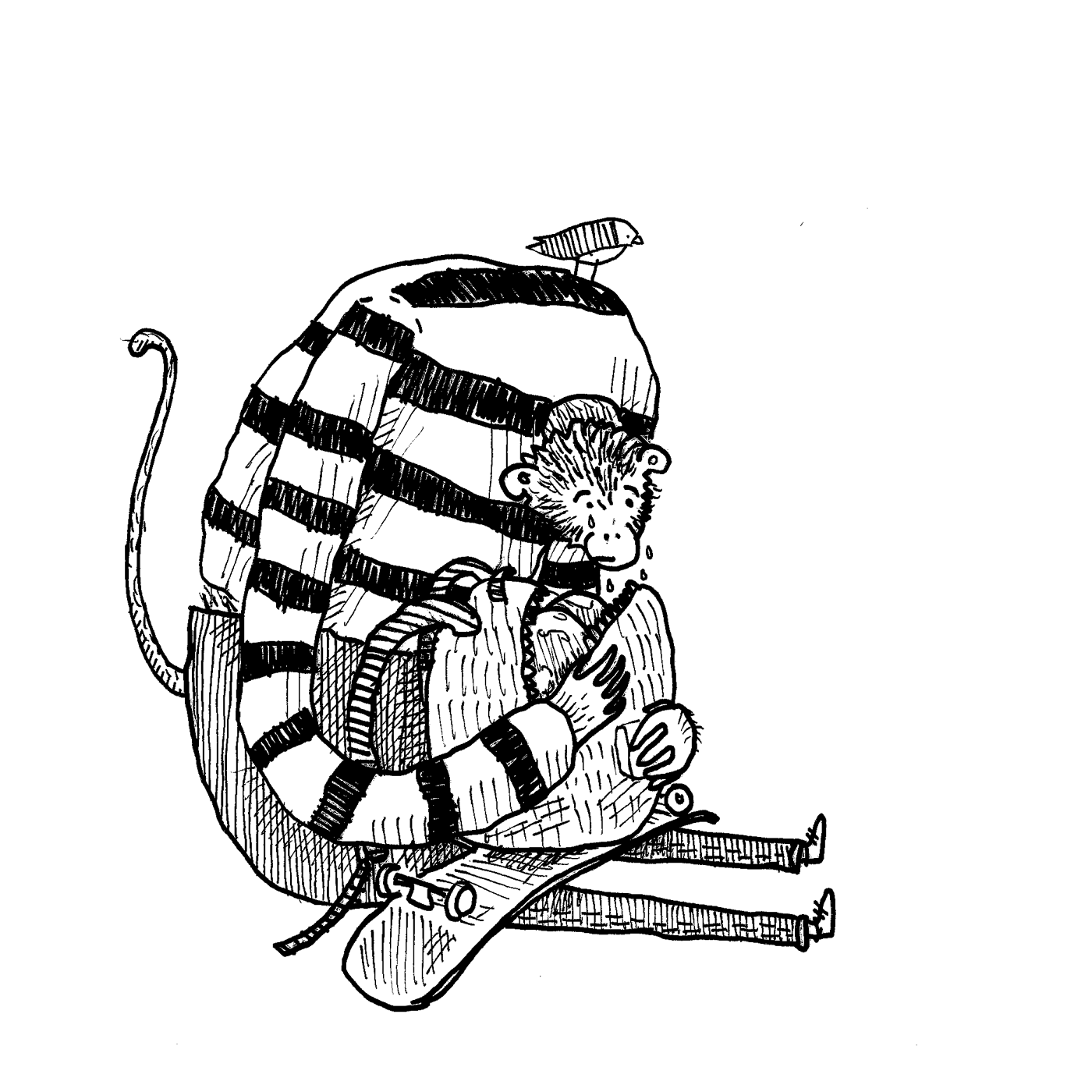
Monkey was a boy, and like all boys who rode skateboards, he was in love and overwhelmed by that fact. He had met the girl the spring of ‘96 and she was beautiful. Her blonde California sun hair bounced with vibrant swirls on top of the magenta scarf she wore everywhere. They ate melons on the corner of Fifth and Market next to the train station before parting ways for the night. Monkey caught a striped bird and named him Fernando before he gave him to the girl. The girl loved the bird but always asked about the feathers, to which Monkey lied about for fear of looking dumb in front of a pretty girl. The day of her round-trip train to San Louis Obispo, the girl and Monkey argued over Fernando’s feathers true origin. She exited the platform in a huff and hurry after discovering Monkey’s lies. She boarded the train before yelling out the window she’d be back on a Tuesday.

When the first Tuesday passed and she had not returned, Monkey became confused: he didn’t know which Tuesday she meant. He then rode his skateboard to the train station every Tuesday with a full backpack of melons, perfect for an immediate picnic after his love disembarked the train. Each Tuesday he went and each Tuesday she never came.

One Tuesday as Monkey sat on the platform he saw stripes fluttering towards him. When Fernando landed on his shoulder, Monkey sobbed as he bit into a melon. His tears overflowed into the rind and spilled onto the remaining melons in the bag. A hungry passerby tapped him on the shoulder and asked to purchase the remaining pieces of fruit. Monkey sold the fruit and walked away. Before he could walk out of earshot, the passerby squealed in delight, asking Monkey what his special sauce was in the melon. Monkey apologized for the tears but the man waved it off, claiming the melons were the most delicious he’d ever had. In fact, he said, if Monkey met him next Tuesday with more of the same, he’d bring his friends in a hurry.

And thus began the most profitable melon business in the history of Monkey’s tiny California town. Every Tuesday Monkey rode his skateboard to the station and sat on the same bench, watching all the train’s passengers leave for their destinations. When he didn’t see his blonde-haired, magenta-scarfed love, he sobbed into the backpack while Fernando flew to his post on Monkey’s shoulder. The people clapped at the sight of the bird and licked their lips in anticipation of tasting the melons their friends had told them about. With every passing Tuesday, the line grew longer and longer, until the train station stopped taking trains on Tuesdays all together.

Monkey became a multi millionaire selling the melons every Tuesday for ten years. His customers never understood why he still sobbed when they bought his last melon.


Did you enjoy that story? How about I send you a postcard as a thank you?

November 17, 2015 - 2 comments

Stone Skin Boys

by Geoff Gouveia

illustration by Geoff Gouveia

illustration by Geoff Gouveia

As a small boy in the field near my childhood home, I mistook my skin for stone and only noticed that as I grew, so softened my flesh.

The field provided an expansive sanctuary for three young brothers. At the end of the field was the base of the mountain, the steep slope slid off water into various creeks to cut with liquid chisels into the canyon.  On our excursions we noticed piles of rocks lining the creeks. My Italian father told us the English word for these rock formations was cairn but was more proud to tell us the word his people gave it: ometto or little man. These little men held their positions in complete stoicism near the banks of the creek.

Young boys, in their bouncing and rambling, love to destroy anything the opposite of them. Our energy fed us destruction and the three brothers ran along the slight slopes to abolish the formations. As we shattered the purpose for their stance, the rocks tumbled into the stream with splashes of water and giggles of boys. One time we spied an elderly man in action of stacking the stones. He collected them on his hip before placing them one atop the other, standing back in admiration of his creation. We hid in the bushes far off, chuckling at his limp and watched him struggle over the terrain to the base of the mountain. Out of sight, we sprung from behind the bush and executed the stone man, his head crumbling into the slow moving creek.

That day was the first day I didn't enjoy knocking the omettos down. Looking back, it was the beginning of the end of my childhood. The end didn't happen until a few years later, on the same day my older brother married.

The morning of the wedding I sat in his room. The mix of protein powder and deodorant combined to make the scent of my brother. I sat on his bed staring the sheets taken away and the walls empty, the bookshelf with nothing in it. The only qualities of the room that gave hints of memory were accidents, small pebbles overlooked as the formations themselves shifted. Holes where I’d made him mad and then he punched the wall, the stain on the carpet I spilled my juice as a kid. I looked down at the spot next to the bed where he’d let me spend the night when I was afraid. Those were memories but until that point I thought it was brotherhood. Brotherhood never ends, life forced me to learn, it evolves. I knew it was time for new but I wanted the old, a familiar hug or to have him yell G one last time in frustration.

At the wedding, I tried holding onto our moments as kids. When you hold anything past its expiration, something releases in its place and it was tears when I gave the best man speech. Our giggles over toppled cairns rang in my ears, the crumbling stones each a different memory of boyhood.

My younger brother and I went into the field after the wedding. Stubborn stone men lined the creek. Two brothers pushed them into the water and the stones clanked without satisfaction. No laughter or surprise attacks on unsuspecting elderly hikers. Only scattered stone men, mirrored in fragmented memories within us. I roamed with the younger brother to protect him. He slipped when he was a small boy, busting open his chin and giving me (by way of Ma) the duty of looking after him. That job ended when I watched him drive off the first day to university.

It was a warm summer morning. I had woken at the usual time to go to work and then class. My mom made breakfast for the both of us; my father said his goodbyes the night before. I helped my young brother load his belongings in the car. When his back turned, I slipped a note in a painting I gave him, tucking it behind the backseat: a message in a bottle for one. When he got behind the wheel, my mother and I waved. The car door closed with a thump that resembled two stones knocking together. He backed out of the driveway, the music blaring with a slow turn rolling him up the street.

We watched him venture out, the wheels picking up speed. He turned left onto the familiar road towards the freeway. My mother leaned into me. She mistook me for a pillar; my confidence a skin sheet over jumbled stacked rocks. She sobbed into my shoulder, asking will he be ok: I didn’t know what to answer. I’m sure he would be, he always was ok, but I wished she’d asked about me.

I was the ometto and I wasn’t made of stone any longer.


Interested in reading another on boyhood? Here you go!

November 10, 2015 - No Comments!

Blue Corduroy Jacket

by Geoff Gouveia

illustration by Geoff Gouveia

illustration by Geoff Gouveia

The old man strolled silent and confident on the sidewalk. Wearing his signature coat, the blue corduroy with brown button one, he walked the same mile everyday to his favorite coffee shop. The people he passed whispered or yelled out his name; familiarity gave Richard notoriety in the small town he returned to. Richard walked by each day, chipping away at the layer of rubber on his shoes. His stilted walk was slow and chunked with a limp that wore down his left shoe faster than his right. He leaned left after his fall. It was then his children pleaded with him to yield for a wheelchair. Walking is all I have to combat the shake he told them with his thin lipped mouth. His wife had passed ten years earlier and his children were encouraged to get on with their own lives. Richard carried in his right hand a black notebook filled with sketches of days past. His ancient knuckles warbled against a diary of drawings that marked the days as much as the lines on his skin did.

At the café Richard sat and drew everything his mind processed. If he tired of thinking, he drew the customers in line. Richard used to be paid for his drawings, before the galleries flipped with new owners and sought fresh talent. The old man packaged his framed pieces and put them in the same room in the back of his one story house his wife lived the last few months of her life in. He let his artistic aspirations die with her but Richard deepened his craft by staring down his own mind with the pen in hand, examining his own psyche. Because of this he knew himself and because of this he shook and in California it was not cold. To curb the shake he had an ounce or two or six of Jack Daniel’s Honey, a poor mans scotch. He used to drink the good stuff, the stuff everyone glinted their eyes at when he had company. His wife would shine and scoff her rose cheeks at his attempt to become more of a man by drinking courage. Richard did not drink too much, he drank just enough. He drank at night but in the morning he tried warming himself with the coffee the shop served him.

The baristas called him Captain, though no mention of his lack of military and boating experience ever shied them away from his nickname. To them, Captain was their grandparent and unlike their real grandparents, they came into harmless contact with him everyday. They loved his jacket that was worn smooth at the elbows and the buttons he buttoned to the top though they never noticed him rocking in small shaking rhythms. On hot days he wore the corduroy coat but Richard donned the faded blue shorts he bought from his trip to Argentina in the late 90’s, his wife’s last goodbye to her family. The true reason he loved to visit the coffee shop was to walk by the barbecue restaurant and smell the cooked meat. It brought him back to that final trip, the smell from the asados wafted into his nose and transformed into the physical warmth his wife had provided.

It had been this spot that he spotted his young wife back in his twenties. There he sat near the court with crystal fragile eyes that searched the crowd. When he saw a girl who looked like his wife, a younger stronger alive version of her, he smiled.

And then he didn’t shake, nor did he feel the chill.


Hungry for more? Here's another story like this one.

November 3, 2015 - 2 comments

Enter Magenta

by Geoff Gouveia

illustration by Geoff Gouveia

illustration by Geoff Gouveia

In the backyard of their desert California home Tyson made his creations in the shack near the small cactus that grew alongside the fence. From the backdoor the wooden shack looked empty, save for the tools and various gadgets needed to keep the lawn trimmed. Father agreed to let Tyson use the shack in any capacity as long as the tools were accessible. Tyson complied and kept his belongings behind the tools against the old timbered surface.

The shack erected with much help from Gran-Papa's stubbornness when Father was a child. Light blue painted chips fell off the sides near the doors and the cement cracked in the back from uneven placement and do-it-yourself wear and tear from projects Gran-Papa and Father and Tyson assembled. Father was a man with sturdy forearms and now owned the restaurant supply company Gran-Papa started. The forearms bulged when he picked up the loads and placed them on the truck, bulged still when he used a dolly to carry the supplies into the restaurants. Entering by way of back doors that opened when chefs in white coats with slim, muscular forearms yelled at boys in black shirts to open them, the smell of cooking made him smile. Gran-Papa had worked Father’s aspirations of becoming a chef out of him. Delivery was his business now and this did not dismay Father, he only wanted to work.

Tyson grew up working under Father, into the age that he was now, 17, and learned the ways from his Gran-Papa before he passed four years back. Now on their own, Father and Tyson fought over trivial issues with the shack being the principle of them.

Once, after skipping a time to help him with the business much like Gran-Papa had required of him at that age, Father confronted Tyson about the shack.

“Why do you spend so much time in there boy?”

“My work is important.”

Father grabbed Tyson’s arm and held it to his, comparing the forearms. Father’s dwarfed Tyson’s as it threw the slender arm back.

“Work? You don’t work.”

Tyson looked at his hands. The cuts and scrapes from the days prior felt they had lifted and known work, only not the work that defined his father.

Tyson desired to work with wood. Piecing the broken shards from the shattered palettes that held the supplies in the warehouse, Tyson took them home and assembled new creations inside of his personal factory. When the dry wood entered the shack, it soaked in ideas, saturated until they meshed into new lives. Tyson painted these and then hid them around town. The tiny figures he created were not pretty but they were unique and they were his.

Tyson never shared the space with anyone, never knew why he never shared and never questioned that of himself. He only knew to protect it from the outside world because the very notion of an outside perspective would, in his mind, foster mildew to seep into the wood in the stacks in the corners, bowing the pieces until they warped into unusable refuse. For this reason, he kept the creations covered when he wasn’t using or tinkering with them. He left a small piece of wood on the corner of the tarp that covered them, a sign of trespass should it stray. He made it up in his mind that if the piece strayed he’d destroyed what he’d made and start a new. But the piece never departed from the corner though the tools had regular use from the front of the shack. His heart skipped a beat when he heard his father open the creaking lumber door to retrieve a tool. This is the time, this is the time Father finds what I’ve done. When he went to hide the next figure, the muslin remained untouched.

Around town the figures began to create questions though Tyson never heard them. The children walking from the grocer to the parking lot had the distinct advantage of a new perspective, one no one could see and with it they found the figures half tucked near curbs. The faded magenta painted tribal faces on the figures mystified the children, how could treasure exist here in this arid dry place? Their parents knew from its placement it was set as opposed to forgotten. This gave the figurines untold importance. Tyson never saw this, he set the figure and walked away, checking back days later and found nothing nor the smile of the child holding the item above a seat in the car.

Despite his solitude Tyson created day after day in the shack. Often times at night he used a small lamp that bled light between the boards on the sides and out of the small window near the front of the shack. Father settled on the couch, resting his cold beer on the coffee table now that his wife had passed and couldn’t correct him. In between sips he peered out the sliding glass door, at the side of the shack. The soft glow from the lamp inside flickered when Tyson moved past it. His father never stirred higher than that look, returning back to the sporting event on the television.

After some time Father drifted to sleep in his chair. The alcohol helped him sleep but his interior alarm clock gave him confidence to drift into slumber untethered. Tyson waited for these moments, peering out through the shack’s boards and into the sliding glass window. When his father leaned back Tyson knew he had a chance to hide a new batch of the creations. The lamp switched off with a click and the door to the shack clumped closed with a muffled thump.

Slipping out the back gate, Tyson carried a gray satchel with wooden figures that bumped hollow in the night with his purposeful trot. The magenta paint on their silent faces reflected stray lights, eager to find a new home in the desert town. Nestled close together like paratroopers before the release of the bay door, the wooden soldiers were ready to embark on a new mission. Tyson felt proud sending them into the world. A small piece of him wished he could keep them but a greater part of his mind knew they were never his to begin with. From outside the shack they began, the shack assembled them and Tyson completed the cycle by spreading them back it into the world.

After the final placement Tyson returned home. Humming while he opened the gate, he sucked his breath in before it billowed out between his teeth in fragments: a slanted ajar door spilled light out of the shack. Tyson held in the doorway, his face illuminated in a three inch wide beam that went from head to toe, watching his father pick up the pieces on Tyson’s work bench.

A tiny pot of magenta paint sat next to a cup of water with a brush sticking out of it. His father swirled the brush with his right hand while he eyed the different mix matched wood fragments. Half built figures stood erect and scribbled sheets of paper gave away secrets for new creations. Tyson stood frozen, waiting for his father to turn around and confront him. While he waited his heart expanded and the breath in his lungs felt hollow. He watched his father trace with his index finger a scribble on a page to his left while touching the corresponding half finished figurine on the table. A slow tear rolled down Father’s face when he looked at his own hands, the puffed up parts at the end of meaty forearms, arms that looked different than the chef’s arms he thought he’d have by now. Before Father covered the table with the muslin and switched off the lamp, he scribbled a note on the scrap of paper. He stumbled through the door into the house. Tyson crept from the side of the shack, feeling his way towards the table.

In the moonbeam that shot through the window, the frail paper read in staggered capital letters:

Make Me One


Thank you for reading this short story! Please comment below what you think Tyson did next...