Archives for December 2015

December 29, 2015 - No Comments!

Covering Your Mark

by Geoff Gouveia

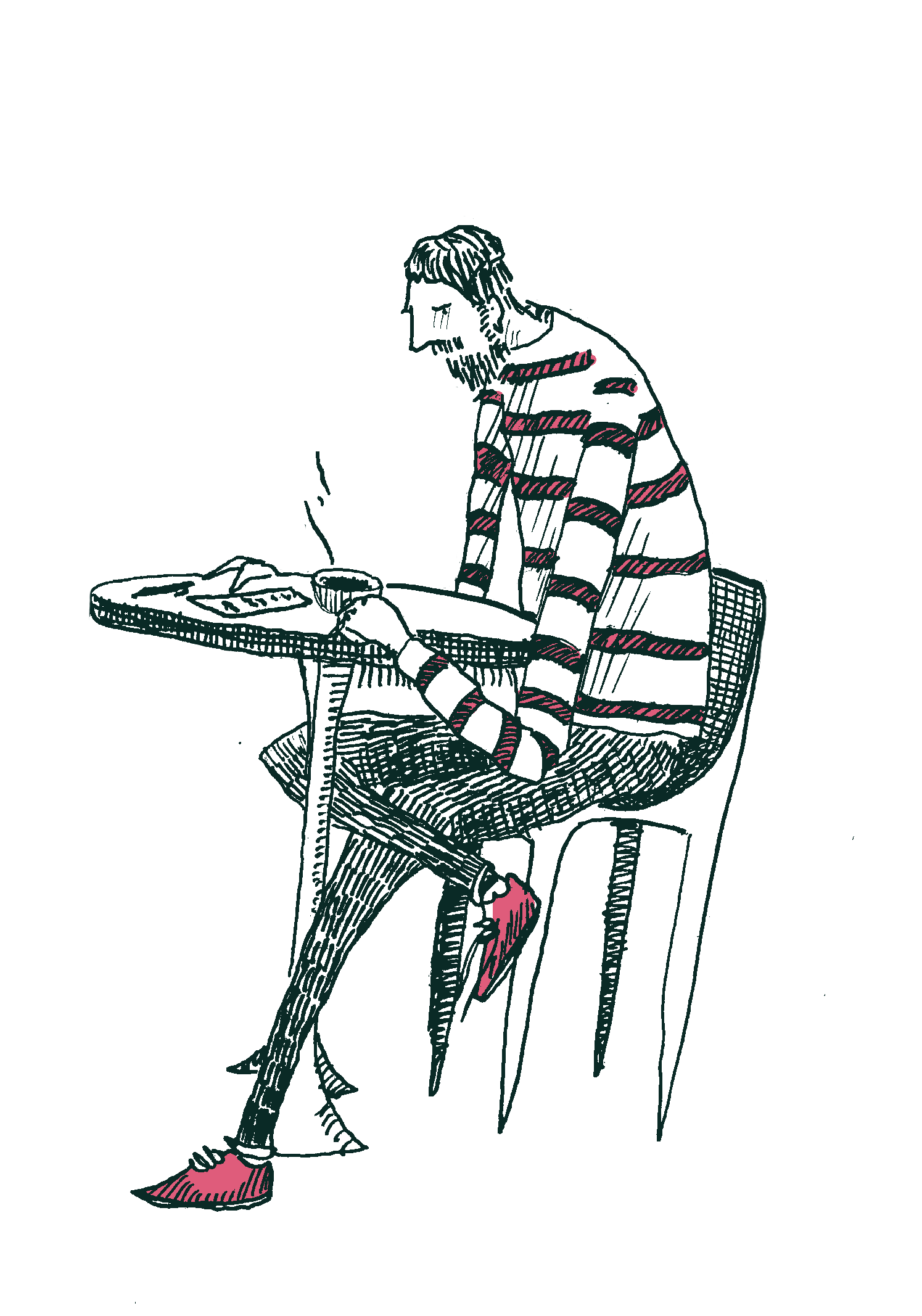
illustration by Geoff Gouveia

illustration by Geoff Gouveia

I'm sure you've walked past us before, the little girl and I sitting at the table - no? We sit there Monday through Friday.

The coffee shop is right next to a Mexican bakery off Seventh. When I see Juanito, the owner of the bakery, we greet with a handshake and a hug. Most days the weather lets me write and I order a coffee and then take my seat at the table that straddles both the coffee shop and the bakery. Juanito delivers one of his bagels and after wiping the cream cheese from my lips, the muse joins me in the opposite seat while I write. The seat remains empty but I used to never let anyone take it. Although no one can see her, she exists and she helps me write. She protects the writing from the world and allows me to make it, no matter what the criticism it faces once birthed into black and white.

You have to have seen me - I’ve been doing this routine for seven years and I will continue to do it for the rest of my life. The first year the coffee shop stood alone with a vacant sign next to it. Juanito came and bought the place in the naïve, tenacious way immigrants defy the odds and starts something. Juanito knew his pan dulce would find a home in my neighborhood. The risk transformed into reward as the inhabitants of the community came alongside Juanito, supporting his delicious treats and providing him with ample business. In this brave act, my writing began to pick up again.  A year into their new business Juanito’s wife Rosa Marie gave birth to their daughter, Mira. When they brought her to the bakery for the first time, I paid for a pastry with a hundred dollar bill and smiled after I walking away without the change.

Mira was born early with a gaping smile and a small brown mark under her nose. As she grew, so too did the mark and it became synonymous with her laughter round the bakery. One day while writing, Juanito asked if Mira could sit on the chair across from me. Her brown mark scrunched under her nose when she smiled and melted my refusal. To my surprise the words ran unrestrained from my fingers with her near. I named the muse Mira and she and the fictitious being became one. From that day forward Mira and I shared the table- me writing and her playing. Her laughter was the cadence to my typing, the giggles pressing me forward in my prose.

As the years wore on, she became taller and taller, losing her baby voice and gaining young confidence in the way she spoke. She didn’t play as much but she kept laughing and I kept writing. I didn’t see her as often as I needed (these words won't write themselves, you see.) My writing waned as Mira stopped coming by the table. The day the writing grinded to a halt was the day she asked to use the chair opposite of me.

Instead of her normal laughter and confidence in taking the chair, she asked with a tilted face, the mark away from my line of sight. I couldn’t understand what she was asking and asked her to repeat it facing me. She obliged while covering her mark with her hand. I stared at her hand covering the mark, questioning the purpose of the placement in my mind when she started to cry as she backed away, covering her whole face as she ran into her father’s bakery.

The next day the scene played out the exact same way: her asking to use the chair for another table to draw on. I understood her desire this time and was careful not to look at her hand. I tried to write that day but no words came as the table felt unbalanced with the missing chair. Mira’s self consciousness reflected in my own work and my own flaws stuck out like ink blots from a messy pen. The writing stilted for the next week before I had had enough.

When Mira approached me in her small, child footsteps with a hand covering her face- I asked her why she hid her beautiful smile. As her eyes widened her hand dropped for a moment and then returned to guard the mark. She took the chair and left but not before leaving me a few words to write. Paying for my bagel after eating it, I asked her father why Mira covered her face.

A boy asked her about it… he began and shook his head as an answer to his inability to restore her worth. I gave him a weak smile and then waved goodbye to Mira and the family.

The next day, before setting up to write, I placed a piece of paper and a pen opposite of my station on the table. When Mira came to ask for the chair, I declined. Her stunned look dropped her hand. I told her that if she wanted to draw, she could use the table. The chair made a rusted squeak when she climbed up. Children draw with two hands and while she drew her mark met the world uncovered, allowing me to write. At the end of my writing session I asked to see her drawing but she covered it. I smiled at her transfer from covering an external mark to internal creativity.

We wrote and drew like this for months, each helping the other unblock creativity and self-worth. It wasn’t in what we created, it was that we were willing to share what we created, if only for a moment before our insecurities choked them back into our interior.

You have seen us, haven’t you? Tomorrow then, when you walk by and see me eating a bagel and sipping my coffee while writing with a young girl drawing across from me with two hands, do stop and compliment her. It’s not the drawing, it’s her. And when she’s alive, so too does my writing flourish.


Thank you for reading this short story. Would you mind sharing it with your friends by tapping one of the social shares below?
December 22, 2015 - No Comments!

Painting Critique, Part 2

by Geoff Gouveia

This is part two of four. They stand alone, but the greater narrative runs through all. Read the first.

illustration by Geoff Gouveia

illustration by Geoff Gouveia

Every year in March the colors present two opposing views of life. To those who notice the soft pastel pinks, the month is about life. Seedlings pop through black branches, the winter scorched trees begin to tint towards green as spring appears on the horizon. To those who notice the black destruction of winter, it reminds them only of what was and how the black replaced it. The new life breaking through is a cause for mourning as the world spins again and again despite the loss of life. What once was is no more and those who try holding onto the past mark themselves doomed as gravity pulls them the ever changing seasons. March, below the surface in each person, reveals what they experienced the year before.

The March I am in smells fresh. A deep-breath-in-the-chill-and-the-freshness-fills-the-lungs-and-straightens-the-posture fresh. The buds I pass on the way to my meeting are the lightest hues of rose pink, fuchsia and peach with greens underneath them to illuminate the undertones in nature’s harmonies.  A beautiful Southern California sun warms a yellow glaze over the greens, popping the colors like an Impressionist’s painting. March mornings are too delicate for the naked eye to process and my view bounces from art to art as I walk nature's gallery.

When I walk, the steps are light and they dance around black branches that stick into the path. One of my paintings snags a branch but the blackness hides its false interior strength and it snaps with a hard tug. The back of the canvas rips as rough as scraped flesh and my smile fades as the door swings open with a gentle nudge.

Small student paintings pasted over unfinished sketches and postcards from past shows adorn the cluttered office. The desk backs against the wall, paintings and paintings lining the wall next to it, boxing in the small office even further. Thompkins huddles over the desk, his nose casting shadow over his notebook. Small scribbles of dates on the calendar filling up as his mind unwraps its contents into the lined boxes.

I tap his shoulder.

“Professor Thompkins?”

He shakes for a second, answering with a startled, “Yes? Oh hello, George. Come in.”

I set the piece on the easel in his office. The natural lighting is weak and the studio lights buzz in anticipation of what the piece I’ve brought holds.

“How’s your week been?” I attempt break the stillness.

“My week? Oh. Well not too great. Patricia isn’t doing too…” his voice begins and then recedes into his chest as his eyes close, “…well. God gives, God takes, right?”

I search his eyes for context. Unfound, I shrug the statement off. His shoulders are drooping and I can't see what's pushing them down.

"Should I come back another time?”

Thompkins hands fold on his lap with his eyes staring through the small natural light source in his office. Outside the window, the branches are black. There are no buds on them and the beginning of something new hasn't evidenced itself yet. His eyes are gray, the blue they had beginning to fade. He looks like someone who's been carrying a weight for a long time and the exhaustion one feels after letting the weight go, setting it down and reflecting on how hard the journey has been.

His head turns on a slow swoop. “Today is fine. What did you bring me?”

My lips purse towards the pastel flavored canvas.

“I’m proud of the piece, I took the advice given last time and worked well on my preparation. I felt I held the piece in tact while painting it, focusing not on feelings but on technical craft. I like this one. I thought-”

“Well. First off its too much local color. What is this pink here? Straight from the tube, no? It doesn’t fit. You see the vibration here, against the green? That won’t do. It confuses the viewer.”

“I like it though. I like the green.”

“What does it matter whether you like something if it is wrong? What are your intentions?”

“To be harmonious.”

“See there, you’re wrong again. Stop forcing the work, make the work unfold naturally.”

I haven't seen this side of Thompkins before. His eyes move from the piece and then out the window. At the point he would normally close his eyes and voice soft concerns, today it switched with wide eyed gray orbs that sat above tired lips spewing curt sentences.

“I’m sorry, George. I’m sorry about my mood. Perhaps it would be best to follow up next time, maybe next two weeks or so?”

“Sure, not a problem. Everything alright?”

“I can’t say yes. She’s not going to pull through it this time.”

A third of his age, I can’t comprehend my own future marriage falling apart with me remaining long after her. Sorry sounds trite and pointless but I offer it regardless.

“Thanks, but this is another test. Just another trial. God gives, God takes.”

His voice loses its volume and then his eyes find the branches outside the window.

“Nothing seems to be growing this year. The branches are dead still, they don’t have the life I remember them having. Everything is like that. I’m tired. I’m sorry, George. I’ll talk to you real soon.”

He stands up and hands me the painting. I offer him a smile as a condolence but I wish I had something he needed. The door shuts and his chair creaks on the other side before a slam breaks the silence, the way a fist would on a desk followed by papers hitting the ground in a jumbled mess. My hand balls up to knock but a sigh precedes the statement “What next?” from inside the office.

My voice rebounds against the door, “See you soon Thompkins.”

Outside the office, the branches do look dead. More black than they are near my apartment. Perhaps the sun doesn’t shine on them like they do near my home. Time choked out the buds and I wonder if the trees will ever grow back, if branches have it in them for green to ever replace black.


If you enjoyed this post, please share it with your friends by tapping the social media button below 🙂


December 15, 2015 - No Comments!

Croatian Coffee

by Geoff Gouveia

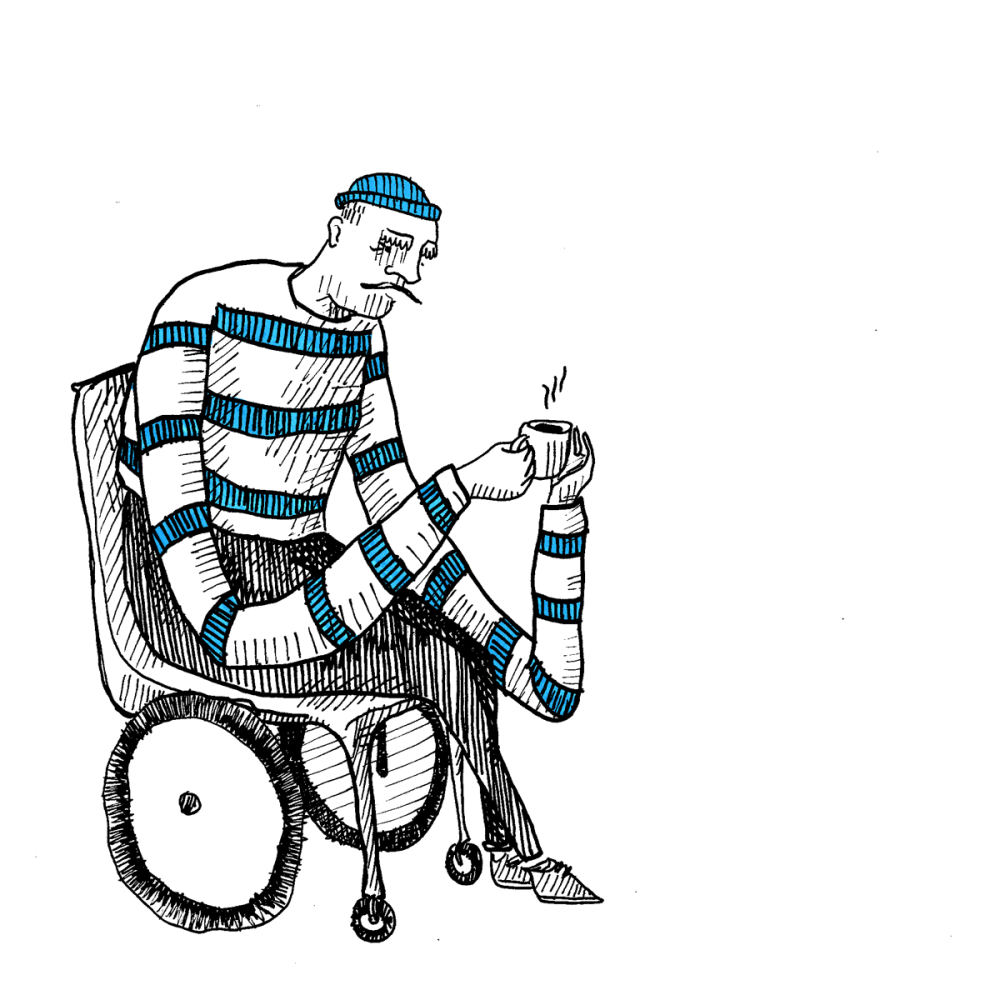
illustration by Geoff Gouveia

illustration by Geoff Gouveia

Grandfather Luca told me the best coffee in the world comes from Croatia. “Croatian coffee,” he said, “is the kind you drink in the morning right before creation.” Grandfather Luca explained that he wrote the most magnificent stories after drinking his Croatian coffee. He called me in as I walked by the hallway and asked me to pour him a cup.

“What’s so special about this Croatian blend?” I asked the old man.

“Well, let me tell me you son. And before we get any further, it’s not a blend.” Grandfather Luca had a wispy Croatian mustache, white and curled on the edges like most men from his town of Hučhen (“Pronounced who-can,” Grandfather Luca loved to say, setting himself up for his own Croatian village jokes. “Like Hučhen get me some more coffee? Eh!”).

I scooted closer and the old man leaned in. His breath hit me in the face but he told me it was the Croatian coffee and I should learn to love the smell.

“So you want to know about Croatian coffee, eh? It begins in the town I’m from. Little Hučhen. Have I told you my Hučhen joke?”

“Yes Grandfather Luca.”

“Anyways, it begins in Hučhen. Along the western hills that roll with yellow leaves all year round. Everyone knows that yellow leaves mark the greatest areas to grow the best coffee. Look it up on your Google, I dare you to defy me.”

“Grandfather Luca I believe you.”

“Google has nothing on my Croatian coffee- why? Because I’ll tell you. Sit down, sit down.”

“I’m pouring myself some water Grandfather Luca.”

“Water? No one needs water. Only Croatian coffee. Under the yellow leaves that never turn green or red because Croatia is in the tropics you see.”

“Now wait a minute Grandfather Luca-“

“No- you listen here, sonny. Your Google will verify the geo-coordinates of my Croatia. Type them in. No service here? Ah too bad. No Google, just Grandfather Luca. Same thing. Listen up. It’s hot in Croatia, burning hot, but the leaves are yellow because they hold the moisture. You don’t believe me?”

“Grandfather Luca I’m not questioning you.”

“Ah yes. That’s right because you shouldn’t. I’m from Hučhen and Hučhen can question me! Ah ha ha-” Grandfather Luca trailed off into a wheeze that he extinguished with a quick Croatian coffee rinse.

“Where were we?”

“The yellow leaves, Grandfather Luca.”

“The yellow leaves…the yellow leaves ah yes - the yellow leaves that never turn anything other than yellow.” His silver eyes lit up, his hands revealed the effects of the Croatian coffee by fidgeting with the knobs on his wheelchair. “They are the tell tale sign of some strong coffee growing underneath the soil. Now the soil in Croatia is not like the soil here, the soil here is brown. Nasty brown. There the soil is clay red and that’s because it is clay-"

“Croatian coffee is grown in clay, Grandfather Luca?”

Grandfather Luca snorted and his eyes widened, the thin wispy mustache dangling on edge, teetering towards the ground. I almost reached to save it before he reprimanded me.

“Of course Croatian coffee is grown in clay- how else do you suppose it takes on the reddish brown when you pour it from the special Croatian coffee tin?” Grandfather Luca held up a silver tin with the words Croatian Coffee splashed across the side. He popped the plastic top and whiffed the dust. The dry fragrance wafted into my nostrils but disappointed me.

“Smells like all coffee.”

“Smells like, smells like all coffee?,” Grandfather Luca nodded his head up and down, the eyes slitting in anger. A crooked index finger rose to strike me down. “Smell here. Smell closer. You smell that? That’s the stuff. That’s the Croatian clay molding the molecules to the perfect coffee honeycomb. Google it. You see, Croatian coffee isn’t just beautiful, it’s a science. Croatian coffee, I tell you, is the secret behind my stories. It wakes me up, keeps me up and allows the ink to flow. I write stories, you know?”

“Yes Grandfather Luca, I know. I do enjoy your stories.”

“Well I’ll have you know that the first time I tried Croatian coffee was not in Croatia but right next door, in Haiti. Right across the bay, right on Haitian soil. Haitians make a mean sweet Hawaiian bread. I’ll tell you that the first sip of my Croatia coffee as I sat on the beaches of Haiti was delicious. Then we shipped out. Cucumber shippers, I tell you-"

“Grandfather Luca, you’re making this up as you go-"

Grandfather Luca swiveled his head with such a violent shake that I thought his mustache would spin from its fragile resting place and land on my lap. The piercing silver eyes were too much to bear and I relented, retracting my statement. After all, I didn’t have Google to prove him wrong. There was never any reception at work.

“I'm telling the truth, the Croatian truth. Croatian coffee is the best coffee in the land. I’d like another cup. I feel another story about to burst from these-” he wiggled his fingers “and they are itching to tell the truth.” The blue knitted beanie he wore had been slipping towards the right, but I reached out to push it back towards the proper perch. A knock at the door came before a young woman in muted blue scrubs walked in. My coworker greeted me with a smile as she pushed a cart of supplies into the room.

“Grandfather Luca this is Nurse Rebecca.”

Rebecca waved at Grandfather Luca.

“How are you today Mr. Luca?”

“My name’s Grandfather Luca.”

Rebecca smiled. “That’s right. Grandfather Luca, I’m sorry.”

“Nurse Rebecca here will take you to your appointment.”

I gave him a sheet of paper with a pen and then poured a fresh cup of the Croatian coffee. Back in the kitchen, I removed the labels on the new tin cans of coffee that Rebecca brought. The Croatian Coffee labels I printed earlier were then fastened to the side of the tins with glue. I restocked his pens and paper and tidied up the eating area. A small bit of Croatian coffee spilled on my scrubs as I lifted the pot to wash it. Mechanical pops came from the other room as Rebecca prepared the wheelchair for Grandfather Luca’s next destination.

The pen rested on the paper and his chin on his chest as I tapped Grandfather Luca’s shoulder though the silver eyes wakened and then sat back, eager to talk with me.

“Grandfather Luca, I’m leaving. Nurse Rebecca will be here tomorrow. I’ll be back the next day, please do take your medicine.”

“Medicine? I don’t need medicine. I need Croatian coffee. Do you know where Croatian coffee comes from? It comes from Hučhen.”

“That’s right, you’ve told me that,” I said as Rebecca began to push Grandfather Luca out towards the hallway. They disappeared in a slow aging parade of two.

From out in the hallway I hear, no doubt emanating underneath a wispy white Croatian mustache, “Have I told you my Hučhen joke?”


If you enjoyed this story, would you mind sharing it with your friends on facebook or twitter?

December 8, 2015 - No Comments!

Blue Upon Blue

by Geoff Gouveia

illustration by Geoff Gouveia

illustration by Geoff Gouveia

The morning Xavi died he spent it like he always did, painting on two large canvases in his tiny Los Angeles apartment before leaving for work. His coworkers wondered why blue paint splattered on his fingertips when he manned the register at the local taco shop. His customers’ faces tilted with puzzled glances when he didn’t tell them the reason for the small flecks of blue on his knuckles. He painted in part to satisfy the creative desire but also to release the struggles that gripped him in his sleep. When he woke, early and on time, he painted and painted, keeping the paint wet while working at a feverish pace.

Xavi worried, like everyone who paints, about money. He kept his money bundled in stacks under the mattress and tucked in the small bookshelf that held his paint brushes upright. He swore the landlord knocked twice a month but it was the timelessness that occurs when work and passion and life overlap, the passing of days retreats into the passing of hours and then seconds. Before he knew it, he had managed to live more than seven months in this new city. The first weeks had been difficult for him.

An equal mix of anticipation and nervousness gripped Xavi as he flew to see his cousin in the new country that brought promise. His cousin, Edgar, had been living there for the past 5 years, carving a small piece of real estate in the form of a smoke shop on Spring and Sixth. When the wheels to his plane touched the ground, Xavi hadn’t spoken with Edgar for a month. The plan had been set but the trail had gone cold. Xavi shrugged this off and decided to venture out anyways.

Xavi walked to the smoke shop after taking the bus from the airport. The corner read Sixth and Spring but the smoke shop located there had plywood boards covering the windows. Graffiti sprawled over the loose boards and the metal bars rusted alone. A homeless man with a fire-red ball cap sat outside the shop but Xavi couldn’t communicate in English well enough to ask about Edgar. The family next door that owned the taco shop, Jorge’s Taco #3, told Xavi the news: Edgar was gone. Gone from this earth in a mistaken shootout. One night after counting the till, a man burst through the door focused on his own need for a fix. Edgar refused and the man shot him in the stomach. Xavi's hand still clutched the ticket that cost him everything.

Jorge and his family found Xavi a studio to move into above the taco shop. The second day in the country Xavi had a position at the cash register working for Jorge’s Tacos #3. By Xavi's request, Jorge pointed him towards a place to buy paint at discount on the edge of Little Tokyo. In addition to the small air mattress and food essentials, Xavi purchased two large canvases with three buckets of blue paint the same week he arrived.

Xavi painted in all blue paint, the varying values and hues spiraling over the surface in a fitful frenzy. Layers upon layers of the blue paint built up until the canvases themselves were heavy and unresponsive. The color blue had taken its toll on the months he painted with it, the hues mirroring his interior as he struggled to compete with the cold city. The swirls on the canvas became like the infinite loop of working nonstop that distorted Xavi’s view of himself.

Money seeped into Xavi's new warped soul and forced him to choose.The choice was either new canvases or new paint and he sided with the latter. His never-ending layers erased his own mistakes and he became better and better without proof. Xavi only saw what was on the canvas and it was never what started in his mind.  The lack of recognition coincided with a vanishing confidence in his talent.

Xavi had battled the city’s frigid realities with his paint brush up until the day he died. Do my paintings even matter? Why do I even try? he thought after a painting session and it was during one of these thoughts that the gun metal blue Suburu clipped his leg as it made a quick left turn, pushing his body into an oncoming gray Yukon. The paramedics pronounced him dead at the scene.

Jorge knocked on Xavi’s door the third day he didn’t show for work. Jorge and the entire #3 shop thought Xavi skipped town. The cash register rang the following day with slender hands with clean, unpainted knuckles. After ordering his tacos, Xavi’s landlord asked Jorge if he had seen the man, noting the rent was due. Jorge shrugged when he handed over his meal.

The landlord, a short Romanian man with hair everywhere except the top of his head, unlocked the door after he knocked twice. The landlord found nothing except for the bed, expired milk in the refrigerator and two large canvases with thick layers of blue paint on them. No sign of life for the next week forced the landlord cleared out the room, placing the canvases behind the building near the dumpster.

Later that evening a shivering man in the February chill found the two canvases propped against the wall. He moved one to a hidden side of the building to create a roof. He broke the frame of the second canvas and ripped the layered blue surface off. The canvas fit in the space between the wall and the building, thick enough to keep the man’s warmth from soaking into the earth. Before laying his head to rest on the canvas, he removed his fire-red ball cap. That night he slept the best he had in years and when he looked up at the canvas in the morning, he thanked the Lord for whoever painted blue upon blue upon blue upon blue upon blue upon blue...


Thank you for reading this short story. If you have a moment, why not read another?

December 1, 2015 - No Comments!

Pomegranate Hands

by Geoff Gouveia

illustration by Geoff Gouveia

illustration by Geoff Gouveia

I learned awhile back that best way to turn her back into my grandmother is through her hands. She has glass mosaic hands. Fragile, the translucent skin reveals tracks of red and blue paned veins. If I give her something to touch, another part of her comes to life as the mosaics shuffle over the item. Sometimes it works though I have nothing to lose if it doesn’t as she’ll forget I even came. I bring pictures of my father and my brothers and our family and we look at them. She recognizes the faces but not the names. We don’t worry about particulars. She asks me if I remember visiting Spain with her and my brother (she’s now transitioned into telling something I would remember if I were the correct person in the story. I’m not, it’s my father.) I hold her hands and tell her I loved visiting Spain with her.

Last visit I helped her make Spanish rice. She laughed with me and told me how to make it. I followed along and didn’t care whether it tasted good or not. I liked the talking and watching her remember mastery. She didn’t move well but at least she moved and remembered why she was moving and kept moving. This week, I want to watch her hands prepare pomegranates from her yard with her breakfast.

When I was a young boy I visited my grandmother’s house every week. She cared for us when mom or pop had work. The three boys ran around the yard and played with each other. There were tears most of the time but my grandmother wouldn’t punish us unless someone was bleeding. The only times she became upset were the times in which we damaged her fruit.

The yard we played in sits between an aging wooden red fence that has always sagged. The yard extends on a diagonal line from the right, starting near a grapefruit tree on the side of the house. Next her roses lined the fence, taking their time adjacent to the old oak tree. Across the cement were the neighbors’ lemons that hung over  the fence near the orange tree. These all circled our favorite fruit-bearer as boys: the pomegranate tree. It was a tiny tree that provided seasonal sweetness from hundreds of little juice capsules contained in a hard shell.

My brothers and I learned to revere the purple-red fruit. We fought over who’d help my grandmother assemble the pomegranates when it was time for a snack. This season was our favorite; the tiny sweet pops of pomegranate bursts in our mouths. We took care not to stain the carpet or the bed sheets but although we were young, we were not naïve- any wasted fruit would be our loss.

I tell her in a loud voice I’m going to pick her a pomegranate from the backyard tree. She smiles, the word of the fruit alone helping to bring back the woman I knew. Walking past the orange tree and the rusting metal shed, the pomegranate tree sits tucked back in the corner. I cannot remember the last time I tasted one on the property as I peer upon the fruit adorned tree from afar. The leaves are yellow save for speckled greens throughout. Thin branches are visible in between the tired tree’s dying leaves. The tree slouches tired like someone trying to recall a word or a thought and it won’t come and the shoulders of the tree bend. Nearing the aged tree I begin to panic as my nostrils fill with a sour fermented warning. The red-purpleish pods reek.

The withered fruit that litters the ground, too heavy for the thin branches to hold up any longer, reveal spilt innards darkened by the passing days. I circle the tree, peering at each pod. I tiptoe around as to not startle the tree, fearing that one harsh brush against the fragile leaves will send all the remaining fruit crashing to the ground. Some of the pomegranates transformed into desaturated oblong pears. Others wilted like overgrown strawberries, mushy to the eye and malleable to the touch. Still others are false spheres, my hands close around the side that looks perfect and sinks into the other side, the thick juice oozing over my knuckles. Another pass around the tree confirms my suspicion that I am too late. With time the vivid pomegranates have mutated into muted, gray purple shriveled imposters.

The bag I brought out to carry the pomegranates with fills with wind instead as I turn to face the neighbors lemon tree. I told her I’d bring the fruit. And one by one the bag fills with premature lemons. The door back into her kitchen is a heavy wooden one that I push with my back. She remains seated, eating her breakfast.

Oh Hello! she says, startled. When did you get here?

Just a moment ago, I say with a kiss. I was picking lemons.


Thank you for reading this story. If you'd like weekly updates (as well as different stories) please sign up for my newsletter here.