by Geoff Gouveia
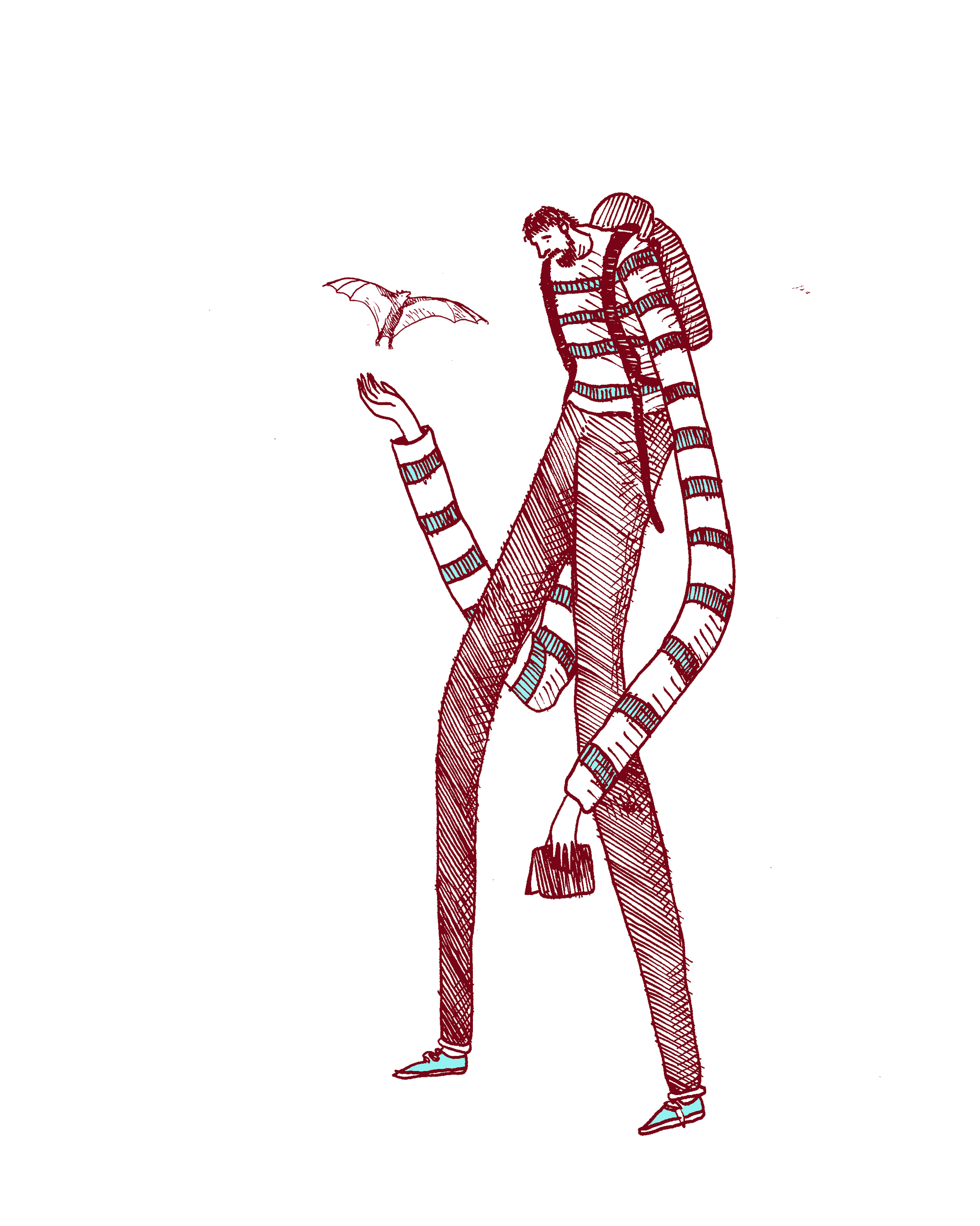
illustration by Geoff Gouveia
Swahili crackles on an intercom before bursting English to end with the number 213. My terminal reads the same number and the flight is on time. Around me, every ethnicity sits sweating. Fanning himself, a plump Indian man sweated heaviest, each pound exacting more liquid. To my right, a dark Nigerian reads his newspaper. My skin glistened from the moisture and when I move, so too does the Nigerian as if to avoid the glare off my Caucasian body. Only the hum of the crowd held white noise above the silence as we waited for the call to board the plane alone.
The call came for first boarding; I was in second. A large family with a light complexion lined up to seat first. A tiny fish necklace dangled from the youngest boys’ neck. Behind the family, a woman stood with a waddle of clothes and flesh against her shoulder while a curly black haired child tugging on her soft dress. The child whined in Arabic, begging (I’m assuming) to board the plane to leave the country. From afar I wished the same, to be on the plane and out of the humid terminal. Dipping her vermillion hijab to the boy’s level, she pleaded with him in their ancient language. The hijab itself did not sweat, an effortless vibrancy amongst the dullness of the terminal. Baby on her hip and child fussing the woman holds her place in line looking nervous forward.
“She must hate flying,” I mutter under my breath. The Nigerian caught it and commented back, "Don’t we all.” We lock eyes for a second but he broke it by lifting the paper. Spread across the front cover was a picture of the bombing in Kampala - an act by an extremist tired of the lifestyle Africa had to offer.
“How terrible!” I said in search of interaction.
The Nigerian lowers his paper, “It is what it is.” Raising his paper, our conversation finishes. Swahili before I hear Second Boarding, my leather bag creases on my hip. I thought of the lady in the hijab, but my mind switches as I hoist the pack. A lady with braids takes my ticket and her hand stops near a lone teal stone on a gold chain hung round her neck. The teal contrasted with the darkness around it but her neck swallowed the stone. It was her. She stood staring at me, in turn staring at her stone, holding the ticket out back to me, the number 11 facing upwards.
At the eleventh row a well-dressed businessman sleeps against the window. A lady with hair in a loose bun discovered her aisle seat next to mine. Stabbing the inevitable, she introduces herself as Claudia and I return the favor as George. Claudia’s striped navy tank top with light yellow pants strike me as optimistic. Why is she here? Almost as soon as she arrives, her head finds the headrest and her hands produce a small black mask before fixing it over her eyes, adjusting her head with slow lateral movements.
I peer out the window, everything in reverse as the plane taxies off. Alone now, I close my eyes and drift.
The van’s bottom half was soft yellow with a light green striped band above that. White on top, the roof reflected the brilliancy of the sun. Our driver, Godfrey, knew the roads well. He sped down the slopes to break only for herds of goats to pass. This was the wild Uganda. Past the miles of beggars and trash-laden roads, Uganda dropped off into well-traveled hills.
The rains and brush beat back against man to create roads impossible to maneuver alone. Each vehicle able to carry five loaded with ten and the weight sagged into deep, deep ruts that frequent ten-minute rainstorms burned into the ground. Stains rose as tires spun with futile traction on slopes of sliding mud, the hills of dark mud shaded with the hill's descent. At the top the sun tinted the dirt white while the soil ran downhill darkest with the torrential downpour. Only an expert could navigate here.
I had hired Godfrey to take my team to the remote village of Gulu. “Gulu? Two hours away,” Godfrey promised. Six hours in, the van passed another stalled out vehicle. The sun beat the black paint back into gray and chipped away the color on the roof. Four Ugandans looked at one tire, the other three sank with hopeless abandon into the soft black mud. Riley next to me admitted her queasiness as a pale green overcame her. The airline logo pulsed as it expanded on the bag and filled the entire van with the sour stench of fresh regurgitated mango and sugar cane. Godfrey smiled into the rearview mirror, “Two more hours, Gulu is two more hours!” And the roar of the engine revs against the dirt.
With our traction on the muddy road, our white roof climbed the hill. Below, the paint chipped black gray truck had seven men, black bodies against yellow shirts motionless on top of it. Villagers peered for a moment before losing interest in this familiar sight - one car with knowledge, the other with despair- and then looked away to corral children running amuck. The dirt road cleared ahead as dust coated huts lined the sides.
A high-pitched screech from the exhaustion of the brakes signals our arrival in Gulu. The hot air punched me like an unknown assailant with a brightness that blinded and a humidity that suffocated. Sounds measured my steps and I could sense that many surrounded us as I heard the customary tongue flicking and shrill screams of the women welcoming us. As my eyes acclimated, the village had come to watch and whisper though I could not hear what they conversed about. We loaded onto an old fire truck, converted with the red emergency sign paint still on. The back had enough room for fifteen men to stand. We loaded eight as Godfrey slid behind the wheel before we left again.
The truck trickled slow past the huts, the pace crawling to a point when a small boy could jump on the back bumper. One did just that and he held on with huge joy and a laugh that rang out. It was a loud, African laugh that started the rain again. Light cobalt blue drops hit his face and ran into his mouth. The pure blue mimicked the waterfalls this land possessed in abundance. Seeing the child on the bumper, others ran towards it, hoping for a free ride. Some reached out but the truck gassed ahead and hit a bump. The laughing boy on the bumper clutched with a frail grip and too wide of a smile: he was not prepared for this trick.
The boy’s body flattened parallel to the ground as he landed in a mesh of gangly limbs. Looking up, our eyes locked again and for a second I saw my reflection- the distance at once covered and then forever separated us. Swirling clouds cut vision and I was off into the brush. In the distance the village came alongside him. An elder consoled the boy, advising against the act as the boy sobbed into his shoulder.
Out back of the truck, back towards the boy, the scenery calmed my nerves about Godfrey’s driving. A voice asked if I liked Uganda. No, I replied but watched as it escaped into the dust behind the tire, floating on the cloud as we left it behind. He assumed I said yes and replied me too. I turned to face the voice and it was Jon. His arms are paler than mine and his eyes squinted past the wind thrashing his face.
“I want to see an elephant!” he said stupidly.
I pretended not to hear him, smiling weak and hoping for him to stop the conversation. The wind provided an artificial distraction from the heat. One of the group began to sing a song I heard back home on a Sunday morning. They sang loud over the engine to preserve unison. In my head I wished it stopped, to them it was an adventure. We looked like a traveling band as we passed people walking with heavy loads on their heads. In the chorus, a sudden torrential rain broke the sky. Thunder clapped and granted my wish to pause the choir. That brief silence- between the music and the thunderclap - was louder than any moment in Uganda. For that moment I had clarity to process without external distraction until the distant rumble progressed into a crescendo of two clapCLAP-
Two taps precede the question water, juice, soda? My hand wipes the sleep from my eyes as my lips decide water. Claudia and the man next to me sleep while the flight attendant pushes her cart past my row. Why did she wake me? The air on the plane is thin, like I'd been climbing a spiraling staircase for hours. White noise – the whirring of the engine - creates a sense of separation in this flying tin tower of Babel. I sit in an area near individuals thinking many different thoughts in as many languages. Proximity should yield to community but in this cabin at 30,000 feet our tower has scattered.
Here loneliness breeds like vermin in the ancient sailing ships. No one will hear my thoughts above his or her own. Children sense this on flights. When the absence of community is loudest and the silence pierces like the popping of an eardrum: they respond.
They retaliate with weeping and wailing. I remember yelling into a canyon, screaming to break the silence and the emptiness that ensues after only my voice returned. The boy who cries out in our flying tower is the same on the hip of the vivid vermillion hijab lady from the line. The hijab works to hush the child. Fear of the unknown grips his revolting body before rhythmic shushes from the fire cloth source close my eyelids.
The truck halted near salesmen adorned head to toe in African knick knackery. Swarming the truck, they pushed their colorful wares into our hands. They competed and pleaded, undercutting the other by a smaller margin. Disembarking from the truck, the twilight muddled the landscape and I couldn't make out the city in the confusing location.
Forced into a sour smelling restaurant, the plastic tables accommodate the team. The electric zapper clapped constant to help the inhabitants relax. We ordered our food and began to talk about the journey. I sat on the edge of the table ripping a napkin into smaller and smaller pieces. A boy with no shoes entered the restaurant and asked people for their phone number. Godfrey shooed him away with his hand.
Godfrey leaned into my ear. “You must not give your phone number to anyone. They will expect you to save them from their poverty.”
I nodded and bit into a slice of pizza. The texture of the cheese made me gag and my chair squealed with a violent push on the plastic against the ground. Outside the restaurant, fresh air calmed my stomach. Shrill shrieks from a colony of bats flew overhead like covert night birds, unnoticed nightmares in the twilight. From the street wafted a sweet smell - the scent of a fresh made tortilla - and my nose followed the trail like I’d known it all along.
A woman sweated above a stove and I asked her what she was making. Her teeth flashed stark white in the night, “Chipati.” I lifted two fingers. Chipati tasted like a quesadilla; chipati tasted like home. I thanked my African mother and walked back towards the restaurant. In the street, a door slammed behind me. The African mother disappeared and a plastic sliding door floated in the street, a door that resembled…
…the ones on airline bathrooms. Groggy, I turn my head back towards the rows of seats. A tiny head bobs down the rows between the sleeping cargo. His dark hair leans forward and then twists, checking each row for his kin. He passes my seat and we lock eyes in the aisle. His disheveled hair matches his dark brown round eyes. A long nose meets his pouting lips and they collapse into a fragile neck. The neck descends into a young figure, the body of a boy yet to earn muscle.
He pushes on with the determination young boys have in finding their mothers. This is his mission and I am in the way of completing it. Leaning out of the seat, I see him make it to his destination. The vermillion fire cloth dips down towards him. Its vibrancy clashes against the cool, apathetic cabin sea. The cushion bounces then reclines as I tilt backwards, back to my trip.
Sitting in a ring, the elders of the town have gathered to discuss the future of the community. My team brought the money for the wells. Having seen the wells themselves, the team mentally boarded the plane. Sipping their mental Cokes and telling their friends what work we did, what a difference we made in their minds. The talk in the circle of people was congratulatory but my vision gazed toward the kids playing soccer in the dusty field nearby. They tied trash together in a tight wound ball, trying to panna each other and proclaim dominance. I excused myself, breaking a code of conduct acceptable for the meeting. In my pack I brought a proper ball to the field. Children swarmed and chanted “Mzungu! Mzungu! Mzungu!” to identify my ethnicity and the gift I’ve brought. I both smile and regret having come over. Their dark bodies the yin to my yang, our closeness separated by what I have and they do not. The ball released from my grasp and I am all alone again.
I shed my pack, the years of my youth playing the game flood my feet as I ran out after the ball. Africa is home to the individual within the pack, the futbol played like the economy. One versus all with the common good thrown to the sidelines. Such harsh competition is fun on the pitch but deadly in the real world. While I worked to steal the ball from my latest competitor, I forgot about their reality. I didn’t care. Why should I? We now had a common goal- to be the best. The ball disappeared into the crowd of bodies while laughter and frustration dispersed equal amongst the children. When it was time to gather the ball, the children grabbed my arm and asked for it back. I shake them away with small, stifled smiles and a quickened pace back to the truck.
Godfrey drove past the pitch and down countless winding roads to our accommodations. They were concrete structures with concrete walls around the exterior. Smashed bottles glued to the top of the wall kept the Africans out and the visitors in. My team filed into the structure and I veered right, walking towards the market over dusted roads.
The people on the street stared at me. Some wave, others whisper Mzungu. A few more steps and I’ve arrived at the only shop in town that sells a piece of home. The words read ice cream on the door but the heat turned the consistency into gelato. I ordered chocolate, paid my due and walked out the door into the heat. Outside to the left under a large yellow striped umbrella sat a woman wearing navy smoking a cigarette alone.
She ashed out the cigarette on the ground, knocking it against the chair as she stared into the dusk. The sky was blue up highest, then faded down through purple into orange. The shriek of bats haunted me like my own memories do, unable to show themselves in the twilight as I yawned. I wondered, after watching the bats and listening to their shrieks echo in my head, why the woman is there- sitting, smoking in Africa as if it is a Parisian café. Was she like me, eager to board a plane in naivete to contribute something half way round the world? I wonder if it took her 3,000 miles to realize she had nothing to offer this hot country.
My ice cream sweltered in the heat, dripping over the side. As I watched her smoke the cigarette, she noticed me with a subtle wink while she took a drag. “It’s hot as hell in here, eh?” she said with smoke billowing out her lips. She was a good ten feet away but her voice felt right next to my ear.
“Sure is.” I responded with a grin, hand cold with ice cream running over it.
“You’re dripping.”
My grin faded as the ice cream slipped from my hand onto my lap, the coldness freezing my thigh.
“You’re dripping,” she repeated closer to my face now.
I feel a nudge and Claudia leans over, “You’re dripping.” My leg is damp to the touch.
“We’re about to land, anyways.” She helped napkin the water on my tray and placed the trash in the pocket in front of her. The plane dipped forward and my stomach did a minor flip. Down to earth, back to reality. Over the intercom, an electric buzz before a metallic authority, “Flight attendants, prepare for landing.”
I wish the pilot said my name, diagnosed why I couldn’t sleep and told me why I could not prepare for landing. The lady in the hijab bounces her vermillion head, coo cooing her beautiful boy into forced laughter under the roar of the engine. His stomach felt the lurch, too, and he would not let it hold him back from expressing his true opinion.
If only we could all be so brave.
Thank you for reading this story. I would really appreciate it if you'd share this story with your friends. Tap one of the social share buttons below 🙂