by Geoff Gouveia
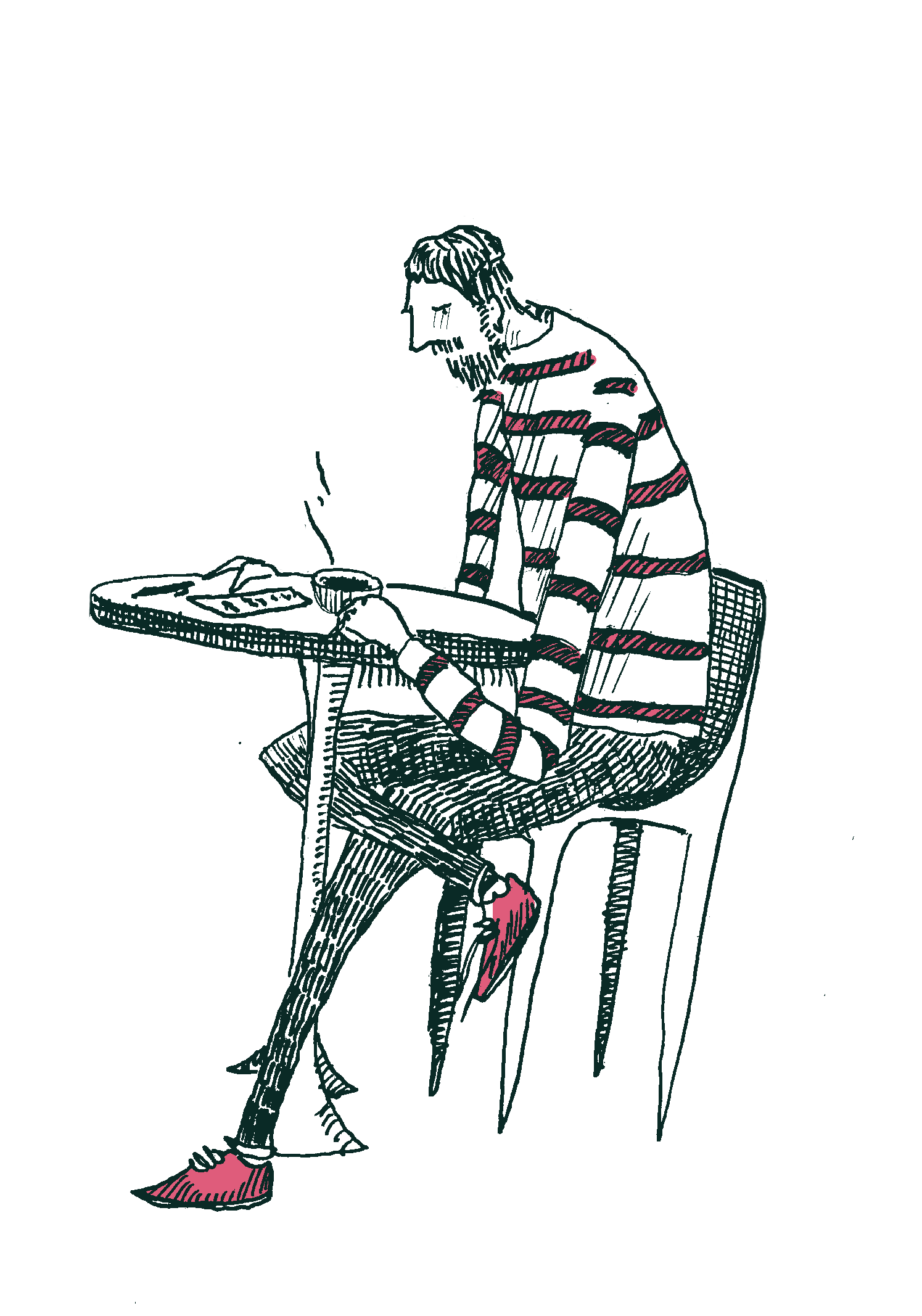
illustration by Geoff Gouveia
I'm sure you've walked past us before, the little girl and I sitting at the table - no? We sit there Monday through Friday.
The coffee shop is right next to a Mexican bakery off Seventh. When I see Juanito, the owner of the bakery, we greet with a handshake and a hug. Most days the weather lets me write and I order a coffee and then take my seat at the table that straddles both the coffee shop and the bakery. Juanito delivers one of his bagels and after wiping the cream cheese from my lips, the muse joins me in the opposite seat while I write. The seat remains empty but I used to never let anyone take it. Although no one can see her, she exists and she helps me write. She protects the writing from the world and allows me to make it, no matter what the criticism it faces once birthed into black and white.
You have to have seen me - I’ve been doing this routine for seven years and I will continue to do it for the rest of my life. The first year the coffee shop stood alone with a vacant sign next to it. Juanito came and bought the place in the naïve, tenacious way immigrants defy the odds and starts something. Juanito knew his pan dulce would find a home in my neighborhood. The risk transformed into reward as the inhabitants of the community came alongside Juanito, supporting his delicious treats and providing him with ample business. In this brave act, my writing began to pick up again. A year into their new business Juanito’s wife Rosa Marie gave birth to their daughter, Mira. When they brought her to the bakery for the first time, I paid for a pastry with a hundred dollar bill and smiled after I walking away without the change.
Mira was born early with a gaping smile and a small brown mark under her nose. As she grew, so too did the mark and it became synonymous with her laughter round the bakery. One day while writing, Juanito asked if Mira could sit on the chair across from me. Her brown mark scrunched under her nose when she smiled and melted my refusal. To my surprise the words ran unrestrained from my fingers with her near. I named the muse Mira and she and the fictitious being became one. From that day forward Mira and I shared the table- me writing and her playing. Her laughter was the cadence to my typing, the giggles pressing me forward in my prose.
As the years wore on, she became taller and taller, losing her baby voice and gaining young confidence in the way she spoke. She didn’t play as much but she kept laughing and I kept writing. I didn’t see her as often as I needed (these words won't write themselves, you see.) My writing waned as Mira stopped coming by the table. The day the writing grinded to a halt was the day she asked to use the chair opposite of me.
Instead of her normal laughter and confidence in taking the chair, she asked with a tilted face, the mark away from my line of sight. I couldn’t understand what she was asking and asked her to repeat it facing me. She obliged while covering her mark with her hand. I stared at her hand covering the mark, questioning the purpose of the placement in my mind when she started to cry as she backed away, covering her whole face as she ran into her father’s bakery.
The next day the scene played out the exact same way: her asking to use the chair for another table to draw on. I understood her desire this time and was careful not to look at her hand. I tried to write that day but no words came as the table felt unbalanced with the missing chair. Mira’s self consciousness reflected in my own work and my own flaws stuck out like ink blots from a messy pen. The writing stilted for the next week before I had had enough.
When Mira approached me in her small, child footsteps with a hand covering her face- I asked her why she hid her beautiful smile. As her eyes widened her hand dropped for a moment and then returned to guard the mark. She took the chair and left but not before leaving me a few words to write. Paying for my bagel after eating it, I asked her father why Mira covered her face.
A boy asked her about it… he began and shook his head as an answer to his inability to restore her worth. I gave him a weak smile and then waved goodbye to Mira and the family.
The next day, before setting up to write, I placed a piece of paper and a pen opposite of my station on the table. When Mira came to ask for the chair, I declined. Her stunned look dropped her hand. I told her that if she wanted to draw, she could use the table. The chair made a rusted squeak when she climbed up. Children draw with two hands and while she drew her mark met the world uncovered, allowing me to write. At the end of my writing session I asked to see her drawing but she covered it. I smiled at her transfer from covering an external mark to internal creativity.
We wrote and drew like this for months, each helping the other unblock creativity and self-worth. It wasn’t in what we created, it was that we were willing to share what we created, if only for a moment before our insecurities choked them back into our interior.
You have seen us, haven’t you? Tomorrow then, when you walk by and see me eating a bagel and sipping my coffee while writing with a young girl drawing across from me with two hands, do stop and compliment her. It’s not the drawing, it’s her. And when she’s alive, so too does my writing flourish.
Thank you for reading this short story. Would you mind sharing it with your friends by tapping one of the social shares below?