All Posts in Short Story

October 20, 2015 - No Comments!

Painting Critique, Part 1

by Geoff Gouveia

illustration by Geoff Gouveia

illustration by Geoff Gouveia

“Are you coming to my wedding?” I ask as I rifle through my stack of canvases. Outside the window of the small office we meet in a gray covering smothers the parking lot.

“I believe so. I have to check with Patricia, make sure she is doing alright.”

“That’s great, Professor Thompkins. How is she? I’d love to have you both there.”

“Thank you for the invite and the concern. She’s had better days. Lets talk about this piece right here.” Thompkins gestures with a long finger at the blue canvas. The oil paint is not dry and the smell of linseed oil settles amongst us like a familiar guest.

My hands fold in a fidget over themselves again and again in my lap. I clear my throat and start with sideways eyes to avoid confronting him straight on. “About that... I can’t say I like this piece. I lost it when I was painting.”

“You ‘lost it’?”

“Yes, lost it,” I reply while staring at the peaks and valleys of blue oil paint. “I had a vision, you know? I wanted the man to be seated, to be content. I started to zero in on him and the perspective warped. I didn’t stop, though, I kept painting.”

“As you should.”

The painting gives no relief to my shame in presenting it. Thin wooden strips hold together an easel that supports the painting on a thin wooden bar. The fragility of the scene weighs heavy on my back. I don’t see a painting - I see a failed attempt. I see a missed mark and a lack of redeemable qualities. My eyes shift from the blue to my lap, my question to Thompkins beginning in a faint voice.

“Even if it isn’t what I want?”

“George, you have to paint. It isn’t about intentions. You either paint or you don’t. There is no middle ground.” Thompkins held his face close to the canvas while his finger traced in the air the pattern of the brushstroke.

“Very Cezanne, no? The brushstrokes… Bang! Bang! They hit the canvas. Good internal rhythm but they don’t help the piece. It comes off as childish.” Thompkins begins his critiques with momentary praise and ends with a crash.

My eyes roll, but not at Thompkins. I know he is correct. The problem all young artists have is in knowing your paintings are wrong but not knowing why. When you peer at something for hours on end, it melts in your mind. It becomes nature and nature is never questioned. No one asks Why is that tree there? It is and has always been. But painting is not nature, nor second nature, and Thompkins had been teaching me this for two years now.

“I keep making that mistake. I start well. The piece is in my head and I know what I need to do. I begin and for the first fifteen percent, the piece is exactly what I wanted. Then I lose it. The finished product is something I never intended. It never comes out how I wanted it to.” The blue strokes hold my gaze. They are short and hurried, the mass tangles at the bottom before spiraling upwards. The composition centers the piece but the asymmetry of the colors throws the weight at an awkward slant. I knew I missed the mark when the trail went cold during the final hours of painting it. I brought the piece here to see if Thompkins could pick the scent back up.

“You paint with emotion,” Thompkins begins the hunt with closed eyes. “You are not calculated, yet you do not consider yourself experimental…” His voice trails off as his hands raise into the air. With eyes closed and hands like a conducting maestro, Thompkins searches his own mind in analog form. His eyes open and his head nods with a simple truth. “Sketch the piece beforehand, twice.”

My mind flashes back to my studio, the moment before the piece begins. Back to the ambiguity of the white canvas and the uncertainty of the first brush stroke. Painting with a heavy hand hides fear, but underneath the brush strokes are white canvas, and still deeper, anxiety about triumphing over thought. Thompkins revelation is simple, but like all truth, it pierces through to the core. Success isn’t an end product, it is a process.

“Painting is not a lottery. The only mark of a true artist is one who paints every day. Nothing more, nothing less. We will talk in a few weeks, bring your next pieces then as well.”

My head rises and falls, still distant in my studio, as the pieces slide back into my grip. Dainty fingers hold the edges, careful to preserve fresh oil paint on the surface. As my palm grasps the cool brass door handle, I stop in mid turn.

“Thompkins?”

“Yes?”

“Can I ask you a question?”

“Sure.”

“At what point in your career does the piece in your mind make it to the canvas?”

Thompkins closes his eyes in the slow fashion of a pondering man. The walking wisdom literature, he is calm and never reacts on my pace. The words are visualizing behind his eyes. Inside of my chest, the rib cage struggles to make room for both my heart and the holding of a breath in anticipation of the answer.

“What makes you think that ever occurs?”

The chest pressure subsides and the spell breaks, silence snaps and shatters a worldview. As I complete the turn of the handle while juggling the canvases, my smile overpowers the February gust.

“See you in a few weeks, Thompkins.”


Thank you for reading this story. This is the first part of a four part series. Tap here to read part two.



October 13, 2015 - 2 comments

New Duet

by Geoff Gouveia

illustration by Geoff Gouveia

illustration by Geoff Gouveia

The crowd at the bar orbited round the bartender, a conductor in front of a pulsing full orchestra. Those holding drinks edged to the perimeter after looking to the conductor, sucking back when the gravitational pull of the alcohol emptied. Pairs spiraled off together though from afar the choir became one, swaying and contracting, rising and expanding in unison.

Away from the bar, on the quieting outskirts of it, the tables sprawled against the wall. Booths for duet couples talking, singing close together with small lit lamps above their personal recording studios. Further off from the crowd, a figure sat silent in the dark. The light above his booth was not on but an iPhone painted his chin light gray blue. A ghost storyteller in the dark, the electric light halted against hard cut edges of a jaw. The light faded as it reached the top of his head, contrasting him against the wall in the faintest of muted grays.

George noticed the blue-lit jaw first. A square jaw that reminded him of someone he knew in the past, a familiar jaw he made fun of in college. The jaw in his mind returned fire against the mole on the top of George’s head because everyone had something. The memory back in college had a jaw that sat perpendicular to the long cigarettes it smoked straight in the middle of flat lips.

Was that him? George squinted through the dim light.

The man was still, very still, against the noise of the crowd. He sat with indifference to the activity, looking up only when the phone light dimmed. His thumbs scrolled against the empty glass phone, the quiet activity alone against a rising musical scene.

Back in the choir mass, a woman’s blonde hair bobbed away from the bar, a refilled mojito in tow. Alone, holding his rum and coke in hand, George pressed the drink to his face in combat against the body heat of the exaggerated attendance. When he sipped the drink through the tiny red straw the rum coated his tongue like velvet before the sweet syrup of Coke refreshed his palette. When the woman approached him with swirling mint leaves in her clear cylinder, he kissed her on the cheek and then yelled into her ear.

“Where are they?”
He dipped backwards and let her return the volume.
“I thought they were over to the left.” Mint escaped her drink into his nose.
“I haven’t seen them in a bit, Katie. We should make our rounds before we head out.”
“Head out? We’re celebrating!”
“I know, I know. But I’m tired. Besides, there’s only so much of an engagement you can celebrate.”
“Oh, come on. Just a little longer.”
“Fine, fine. While you were getting the drink, did you see him?”
“Who?”
Jaw-remy.”

The swirling mint leaves stopped and the smile from her face flattened. The ice chilled through her hand and into her voice.

“Really? How did he find out? Why would he come here?”
“Don’t know.”
“Where did you see him?”
He spun her delicate shoulders round and leaned to the right of her neck. Her skin smelled, like it always did, of vanilla.
“Over there, in the corner...well he was there. Or maybe it was someone else?”
“I hope it wasn’t that coward Jeremy. What’s his problem?”

His wife stirred her cocktail, the ice clinking below, well below, the music of the crowd. George felt the subtle sound inside his chest, the source coming near the metronome that regulated their relationship.

“No I can’t be sure. He was sitting over there and now it’s empty. Where’s Ray and Alexis? I hope Alexis didn’t see him.” Even when he spoke about the new couple, he couldn’t get his mind off his wife’s vanilla neck. He smiled at her though she frowned, distraught over the situation. In his mind, the matter with Jeremy and Alexis had finished. What had happened, had happened. He’d much rather dwell on taking a small bite out of the sweetness Katie’s neck emitted.

“She’s talking over there, near the bar.”
George shifted his eyes towards the direction of Katie’s finger, stopping when he recognized the bone-straight brunette hair. Her slender neck held the hair above prominent collarbones before sliding into a slim shoulder frame, packed tight by years of silent emotional burden. Tonight, Alexis’ posture elevated, she looked ready to begin another duet after taking time away from the stage. When she spoke with her hands they didn’t look as thin, unhealthy thin, as they had when she first dialed the police three years prior. Now they looked strong and nimble, artful and dedicated like those of a violinist. This was the first time George had seen Katie interacting with others as if she had given a performance moments prior, basking in the light of acceptance and love and support and fresh possibilities.

“She’s happy. It’s good to finally see that in her.” He mused to his wife.
She sipped her mojito and lost her frown. George loved how small her eyes were when she smiled.
“Yes- you’re right. Let’s make our way over there and say goodnight.”

They wound through the crowd, Katie pulled George by the wrist between talking members. Around them the music pounded in different beats according to the status in the relationship. High-pitched trumpet squeak laughs came from nervous first time dates that stood near soft, melodic jazz smiles from comfort-seasoned marriages. Terse, harsh worded snarls from pipe organ relationships drawn out and ready to close bumped against light, effervescent searching flutes, eager to start a winter fling. George heard the surrounding nonsynchronous music but the pull on his wrist kept his pace constant; Katie drove the rhythm like all good percussionists.

Arriving at the destination, they hugged while the music near Alexis drowned out their congratulations. George looked at Katie’s lips. He knew they wanted to mention his sighting, but she held back like one who protects a small child from knowing the ruining truth. Alexis could not pick up on the subtle cues from Katie’s face, the celebration clouded her mind with new beginnings. Katie and George kissed Alexis’ cheek, smiled and then exited. The brisk December air chilled their breath and stung their arms in a silent attack. Their ears stung as if headphones ripped out from them, the sudden muted reality of the outside world deafening them. Looking into his wife’s eyes, George felt a pulse, and his head bobbed to a rhythm they had set years ago in a park after eating ice cream.

George hugged his wife’s shoulders and helped her towards the car. Without the support of the crowd, her walking swayed. She laughed about the stumbling, laughed loud because she always laughed loud when her face flushed and the alcohol pumped through her veins. George’s eye closed at the corner as his grin lopsided. He looked left and saw a figure smoking under the stop sign at the end of the street.

The evening air was crisp and transparent and everything the smoke was not as it held above the figure in a spiral that began from a right angle set cigarette. A hand reached from near his waste to ash out his cigarette, a hand that looked clunky in the distance. The blocky hand was one that attempted to play an instrument and gave up, a hand destined to ponder silence after inept actions. George helped his wife into the car, careful to close the door not on her leg.

Katie leaned back into the seat as George drove towards the stop sign before turning. She lifted her head to adjust her seatbelt and slapped the window with an open palm.

“That was Jaw-remy!”

George nodded in agreement as the silence that memory creates expanded in the car. Katie looked back in the rear view mirror as the car picked up speed. Above the red sign the smoke rose like lonely petals from a lover’s flower stem in reverse. When Katie spoke, the words tumbled soft as notes from a piano as the alcohol gave her hidden truth.

“Don’t ever cheat on me, George.”

She stared out the window. George grabbed her hand and lifted it towards his cheek, warming the flesh with hers. He breathed deep the vanilla, widening his eyes as it blitzed his senses. The silence in the car disappeared as the beats of their hearts drummed faint thumps, soft consistent thumps.


Thank you for reading this story! If you enjoyed it, I would appreciate you commenting below your thoughts!


September 29, 2015 - 1 comment.

Train Track Therapy

by Geoff Gouveia

illustration by Geoff Gouveia

illustration by Geoff Gouveia

In the distance, a coyote howls against a yellow moon. Lingering clouds spread out like fingers groping the lunar orb. It is not high in the sky, looking deceivingly close for the true distance that separates it from the two figures walking on the train tracks. The gravel beside the train tracks grumbles under each step the two figures take in the night. Their silhouettes are nonexistent save for when one catches on the occasional stray moonbeam. They smell of cheap grapes, their clothes soaked in the smoke of the burning Swisher Sweets in their hands.

“I think that’s it, man,” the one on the left admits while blowing smoke out his mouth. “That’s it.”

The smoke drifts up into the air, a heavenward spiral that disappears forever. The night swallows the smoke whole.

“You’re done, then?” The other silhouette responds with a weak voice. He kicks into the rocks near the rail before sitting on it. “You’re giving up, George?”

“Giving up? You make it sound like I had a choice! You- You-” George shakes his head while tapping the cigar to release the ash built up on the end, “- you can’t say that.” Exhaling the smoke cuts his explanation short. “How could you say it? Don’t say giving up.” He slumps down 10 feet from the other figure towards Monroe street by the bridge. “I never had anything to begin with.”

The coyotes in the distance howl again. They ask the moon where their dinner hides. The moon complies, pointing them towards a small animal. The ensuing fight ends in the sort of blood scream let loose only in the last second of a life.

“What the heck is happening over there, Rick?”

“Coyotes. Getting the blood for the night, I guess. You done talking about it? I don’t understand.”

“I dropped it because there is nothing more to understand, dude. I’m simply done. I’m done creating. I’m done making things. I’m done.”

George finds another rock to grip. A small piece of him releases with the object and finds contentment in the loud smack against the wall running parallel to the track. The burning dollar cigar smolders in his free hand, idling awkwardly between forefinger, middle and thumb. It has been 3 months since his last smoke and it coincides with his last breakdown. He wasn’t addicted to the smoke but he was addicted to the train tracks. It helped him process, when his plan didn’t unfold like his last train track therapy session had laid out. At the train tracks, he would smoke because he knew that was what he was not supposed to do.

Rick and George had spent many nights here over the past 4 years. They watched the moon and discussed their aspirations. It was here the grand plans were hatched- how they’d make it, one in art and the other at writing. They’d arrive at 11:30 with their libations and occasional cigars. 45 minutes of planning would end in a few small piles of tobacco ash, a couple of empty bottles and the night train hauling freight back to Los Angeles. The night ended ceremoniously when they threw rocks at the train.

There was something in each rock. An aspiration, a dream, a thought, that when thrown became real. It would spark off the moving train and collapse near the track. The spark, a flash of hot hot red in the cold night was both on the exterior of the train and the interior of their hearts. It was soothing to partake in the barbaric act. Now in their young 20’s, the childish dependence on destruction for the sake of it fit them. While they aged, they never grew up. The dreams grew larger and larger until it dwarfed them. It wasn’t until looking in the mirror after a session at the train tracks, when their hair smelled like smoke and their eyes red tired from the day, that they knew how old they were, how much time was slipping away and where they were not headed. The next day in class they would only faintly remember the spark off the train.

This was college for them. The time that was supposed to solidify who they were actually made them ask the greatest questions. The answers never came, either. The rise of the Internet suffocated their ability to dream small. When they knew what was possible, it infected their minds and began to poison their dreams. It colored their vision and it was not an emerald hue, nor rose but more that of cheap sapphire. Sapphire blue like the ocean, expansive and ever reaching it touched all, like the sky, rising up even higher still into the violet of the starry night. This was what college gave them, not the paper diploma nor knowledge but the ability to ask the question.

“I don’t know the answer!” George yells.

Rick looks startled, but only by the volume. He feels it inside as well.

“What’s the point of dreams, anyways? Wouldn’t I be much happier if I never dreamed in the first place?” George hears the light screech building on the metal rails. He stands only when the light turns the corner in the distance down the track.

The rocks around him scatter and shake. Rick assembles his dreams to throw. George does the same, grabbing palm sized stones and storing them in his left hand. The train shoots a terrific beam out of its nose following with a blast from its magnificent horn. The beast stampedes down its pre-set course. The hunters close in for the kill. Familiar pops rock the side of the train, tiny sparks escaping like wounds from the beast.

Rick lets out a tribal yell into the night. The roar of the beast running by drowns out his yell. George’s heart pumps harder with each aspiration thrown at the beast. The last hope in George’s hand fits like a glove, a piece of him hardened for years. He arches his back and looks straight into the sky as his hair blows all around him.

“Screw art!” he yells and the stone sparks like the rest of them. It dies amongst the others, smoldering and waiting for another poor soul to pick it up and depend on it when thrown.


Sometimes you write and you hover over the "publish" button. This was one was of those, as well as this story.


September 22, 2015 - No Comments!

The Man in the Yellow Shirt

by Geoff Gouveia

illustration by Geoff Gouveia

illustration by Geoff Gouveia

“You’ve seen him around town, dude.”

“Seen who?”

“The Incredible Hulk. You’ve seen him.”

“Who are you talking about?”

“The homeless man, the one who punches the ground!”

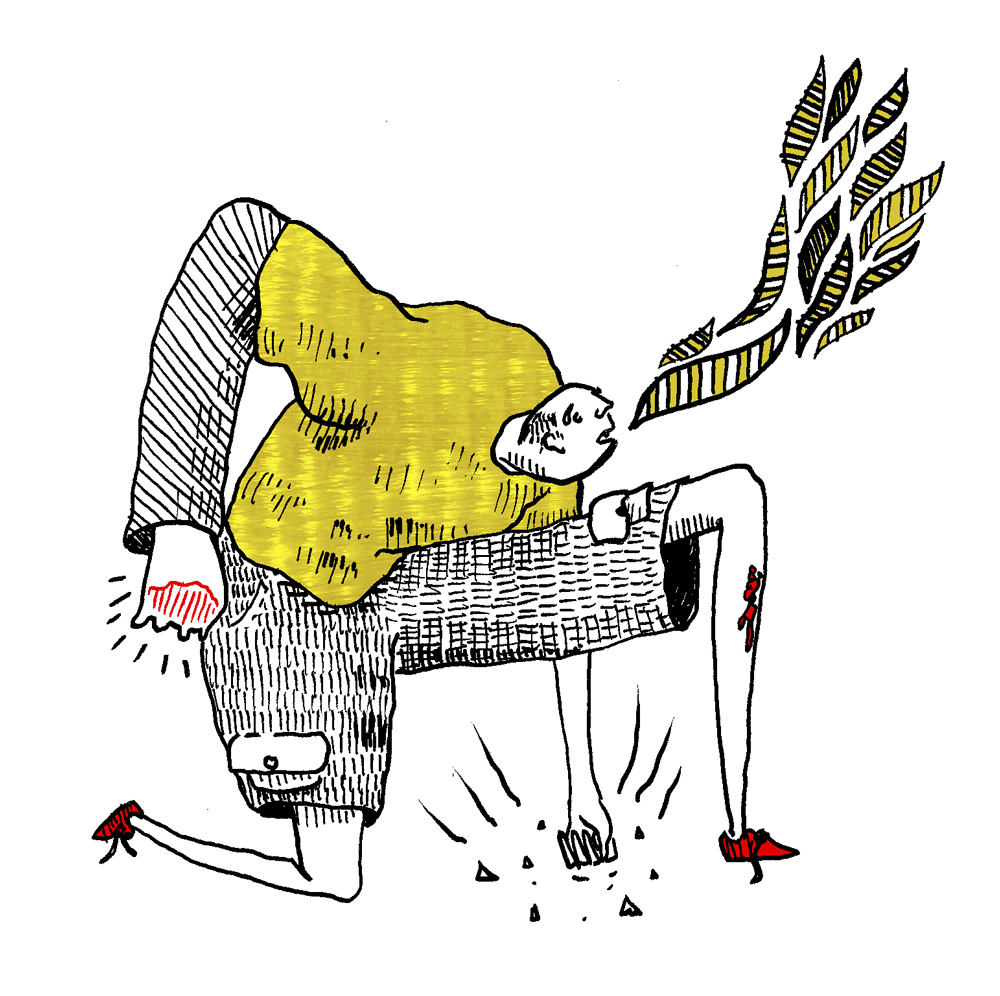
I have seen a man punch the ground while walking on Main street, past the antique shops and towards the Mission Inn right before a lunch meeting with my father. In the middle of the street, between Main and Mission, a bald man in a yellow shirt held himself upright, but only just. Swaying, he had no hold on his own mind and the eyes in his head roll, mirroring the flailing of his arms. At the end of his trance, the rolling of a head on a loose neck, the sunburned baldhead stooped low as his arms swung towards the ground. I guess he has a name... the Incredible Hulk?

“Brian, wait - you’re right – I have seen him! He’s got a nickname?”

“He’s crazy, right?!” Brian grins and folds a napkin over his plate.

“Sure is.” I sip the coffee I had laced with honey. Sweet at first, the tip of my tongue curls the coffee back, swirling it before letting the bitterness coat my throat.

“I saw him yesterday. I was sitting right there.” Brian points at the seat behind us, next to the window. It faces the street and provides a vantage point of the old courthouse. “He was walking towards the shop. Elizabeth was here with me. We were talking about… well, I don’t remember. But we were talking and the poor lad came along on the street. I remember trailing off my conversation and Elizabeth looked confused. I was staring straight ahead at the Incredible Hulk. He always wears yellow, have you noticed that?”

“Now that you mention it- like warning sign, no?”

“That’s right. Anyways- he was walking towards us. Doing his routine. Elizabeth said it and I busted out laughing. She said, and I quote, ‘he’s batshit crazy.’ A sweet mouth letting out a word like that. I near spit my coffee out.” Brian chuckles as he lifts the remnants of his cup into his mouth. His elbows make their home on the table as he shifted his weight forward. With a rock backwards, he gathers his backpack in one swoop and stands.

“I’ve got to go mate. See you tomorrow?”

“Sure. I’m gonna stay a bit, draw for a second.”

“You and your drawings. See you.” Brian turns on his heels and waves to the baristas as I place a headphone in my right ear and then my left.

The table I sit at wobbles when I apply pressure from the pen into my grey notebook. A heightened tempo in the music forces the ink to flow faster onto the page, my hand becoming the sounds in visual form. Time flows through the ink, track after track plays before I pause to rest my wrist. Staring into the distance to refresh the focus of my eyes, a flicker of yellow drifts like a buoy past the break.

Is that the Incredible Hulk?

In the distance, the figure begins his weird rituals in the street.

Why do you do this?

Zigging from the left of the street through the middle to the right, he walks with stumbling steps. The yellow shirt overlays a longsleeve black one that bunches on the right elbow. His left arm holds a wadded sleeping bag that is a dirty white. The kind of white that looks lived in: slept on, abused, travelled. On his right side, the arm swayed like a tree branch in the wind. The branch-arm ended with a swollen stumpy hand. Holding nothing, it remained limp as a bud on the end of a snapped branch.

The swollen hand drooped lower than his waist and looked lame. When he closed the distance, the shiny smooth skin that bubbled up around the knuckles gave away the condition: the hand was broken.

I had that same hand in the fourth grade. Broken when I fell off my bike, the hand swelled twice its normal size. Looked like a glove filled with water but burned to the touch, flushing blood to the surface in a shiny red ball.

The Incredible Hulk’s broken hand swayed violently over a jello foundation. The feet carrying him had gelatin properties in their awkward, fluid steps, forcing his entire body out of rhythm. The shockwave begins in feet covered by busted white shoes that lead up through bloody shins into cargo pants, swaying through a skinny torso into a flimsy paper-mâché neck struggling to support a balding head. The eyes roll like a broken slot machine and the mouth hangs agape in a puppet fashion, spewing jumbled words. Though the window separated us, I felt the spazzing words translate into a conversation in my mind we would never have in person.

How did this happen to me? he asks.

I don’t know. I don’t know.

The conversation plays with the music, but interrupts when I turn back towards my drawing and rip the left earphone out. The ear, now naked, picks up the real life banter from the couple sitting at the adjacent table.

“How do you get to that point?” The man in the black beanie asks with inquisitive eyebrows.

“What point?” The woman in ripped jeans returns with half enthusiasm over her phone screen.

“Walking in the street like you’re…like you’re… what’s his name? The super hero. The big one?” He points through the window.

The woman’s head peers up from the phone and catches the glimpse of yellow swaying in the street. At first her mouth opens, then shuts with a shrug of her shoulders. “I don’t know. He’s just crazy. Crazy is as crazy does…”

Music explodes into my ear. He wanders past and the white bundle looks gray. The black under shirt vibrates against the yellow, a cautioning tale to all who pass. The swollen hand needs attention but I’m not convinced an interaction would help. He snarls towards me and then snaps back, the words letting loose from lips that have no control. As he walks past the window, the yellow floating body is an unwanted lemon marmalade that sticks to my soul. In my head, I resume the conversation between us, questioning him behind the glass:

Why are you not me? I ask.

I don’t know. I don’t know.

September 15, 2015 - 1 comment.

Scream, the Pumpkin

by Geoff Gouveia

illustration by Geoff Gouveia

illustration by Geoff Gouveia

A black bandana barely conceals white bean sprout hair shooting out the sides. Clumsy hands tied the bandana. Hands that didn’t shake other hands because they belonged to someone who talked only to people he thought he saw around him. I sit here with my MacBook Pro bitten apple illuminating him, unable to see anyone other than those who exist. Here, in my temporary fenced-in electronic yard, I can stare at this new neighbor without fear of interaction. His features keep my attention as I wait for my drink to be called on the bar.

Underneath the black bandana and white spry hair hooks a wild nose. It is large and meets eyes withered by the sun. His brows connect in a pinch of skin. His cheeks are made of tan-colored rubber. The tobacco stained lips are offyellow. With spastic twitches the lips come alive, telling off the transparent trespassing spirit. These outbursts gain unwanted stares from the pseudo-neighbors in the coffee shop. They watch his neck slither in irregular motions, shifting side to side.

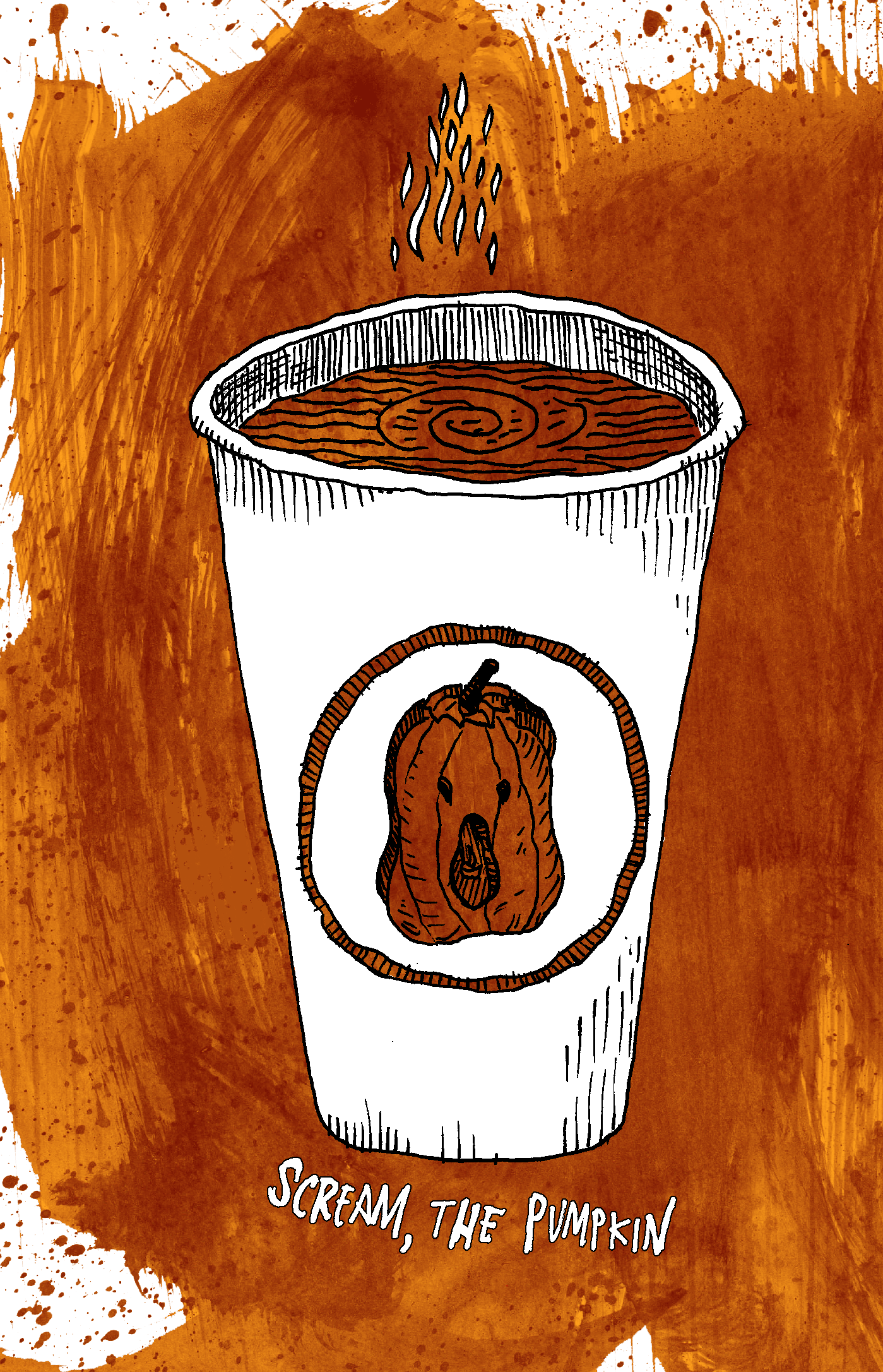
The snake that supports his head escapes from a faded red-orange sweater. The sun faded it pumpkin. The sight transports me to a particular first week of November in my childhood.

In front of my twelve-year-old self, the pumpkins sag into the concrete. Last night, I dressed like an undead Vampire. I, like all young boys, was still thirsty for the blood inside of a pumpkin. My unlucky victim would be on the front porch of the house to my diagonal left, Mr. Moore’s place.

Mr. Moore walked with a limp when he watered his pots of flowers, though actual life did not grow in the dirt. The pots had Celtic snakes wrapping around them in knots. In and out they wove themselves round the clay guarding a lack of internal life.

No one came to visit, ever, and the light never brightened the front room. My mother gave me cookies to bring him last week, right before the leaves turned and decorations unfolded. I rang the doorbell and began to dread what he would do to me for disturbing his weird routine. To the left, the window curtain receded and an eye peered at me. It shut as fast as it arrived. I rang the doorbell again and no answer returned my inquiry. I left the cookies near the dirt pots flanked by snakes and walked back home. From my front window, I spied him opening his door and scanning left to right. He stooped low and took the cookies into the house with his limp. The next day, a small pumpkin had found its way on his front porch.

He cut three sad holes into the runt of a pumpkin that adorned his porch. The two top holes were oblong slits and the bottom one elongated in a gaping mouth. It resembled Edvard Munch’s painting Scream I learned about in school. No floating arms by the ears, just a long face hollering for no one to hear. Halloween came and went without event at his place for the lights weren’t on. The next day, as I came home from school, I saw the victim in the distance.

The pumpkin, assaulted by the sun, depressed into the concrete, a mush that yelled for a young passerby to demolish it. I was that curious young passerby; I was the boy willing to end the holiday. When my faded blue vans collided with the soft orange, a vibration mirrored the sky Munch’s painting. The chunks flew everywhere and I laughed. What a mess, I thought as I ran home, Whatta genius I was for thinkin’ of kickin’ that. Mr. Moore came out of the house and stood on the front porch as I giggled behind my protective spy-barrier. The chunks were strewn across his lawn and trailed into the street. He couldn’t see the seeds dried on my shoes as they sat in the garage but I did see his face in frustration as he pushed over a snake pot. The door shut, leaving clay shards poking through lifeless innards.

12 years later, I sit staring at the bandana pumpkin sweater. His neck is the dirt pots, the celtic knots twisting in isolation. This Mr. Moore possesses the same anguish eyes when he banishes the fake beings around him. He is the Scream painting. In this suburban gallery, watching him I realize the content of the one-way conversations. They were cries for help but not even a whisper would be had over the soft hum of individual laptop housed individuals in the shop. In this cul-de-sac, we do not listen and we do not reduce his need for interaction.

The barista breaks the silence with my drink.

“Grande pumpkin spiced latte, to go!”


Thank you for reading this story! If you've got a moment, send me an email finishing this statement: The pumpkin story is...

September 8, 2015 - 1 comment.

The Wind in the Arrowhead Mountains

by Geoff Gouveia

illustration by Geoff Gouveia

illustration by Geoff Gouveia

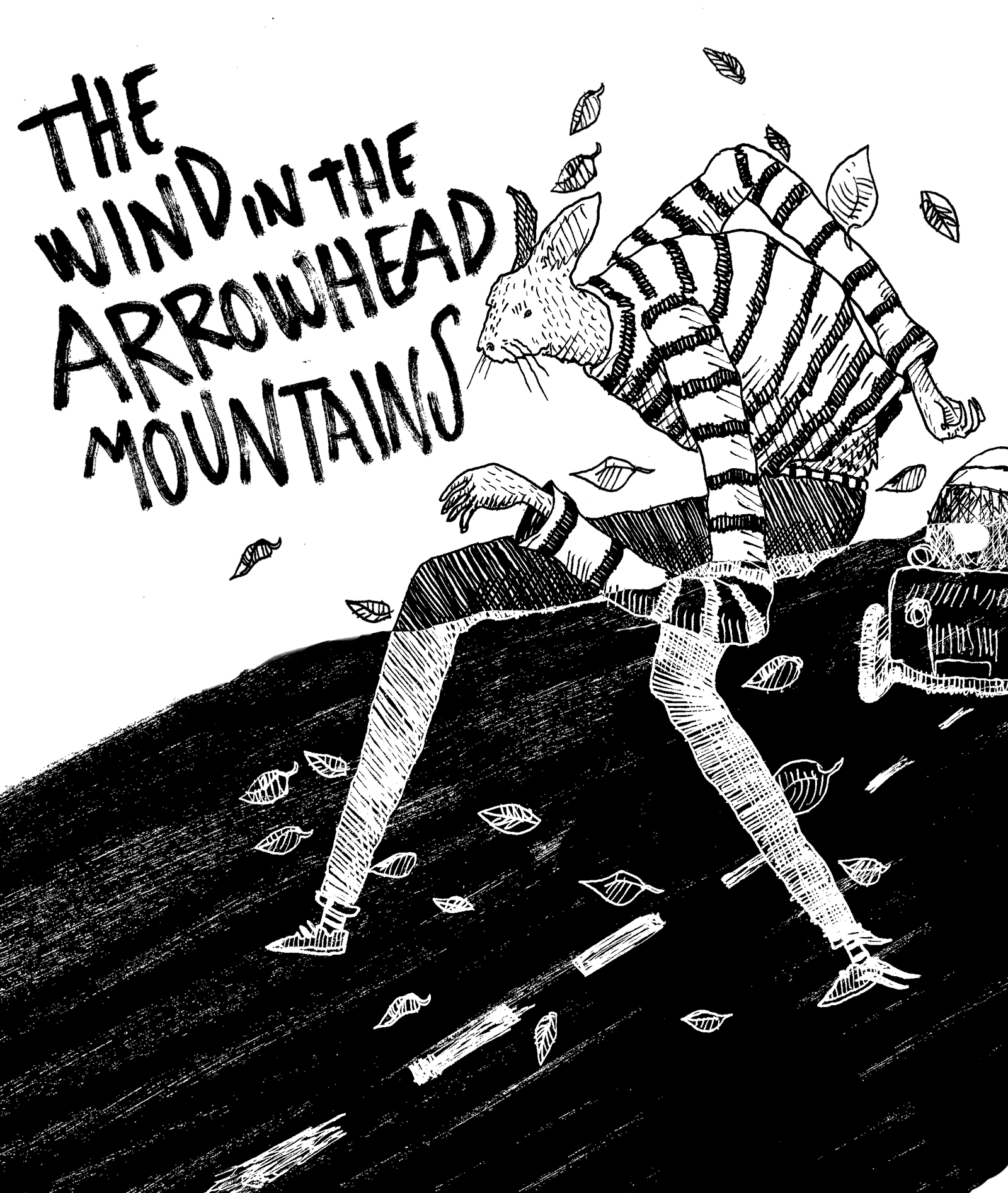
The wind in the Arrowhead Mountains sings a song that never began and never ends. It tickles the trees and spins leaves over dirt tracks that lead to paved roads and continue up to man-built houses. The wind never ceases against the polished boards, battering them with branches. Long arms, they sweep across the sky, interlocking tree to tree. When it blows through the leaves, it whispers unto itself:

Selah.

“Got any brothers or sisters?” I ask as our feet clop in near unison down the steps.

“Ya. A younger brother I see a few times a month. If I’m good at the home.”

“The home?”

“Yeah. The group home.”

“I see. Any older siblings?”

“Ya. But we don’t talk no more.” He drops the topic with a swift kick of a pinecone across the cement. It drops off the cement path down the hill.

“Didja see that? One kick. I got a good kick, don’t I?”

“You sure do, Colby. But let’s not kick anymore pine cones, ok?”

“Ok. Hey George- wasn’t that funny last night?”

“What? When you-”

YAA when I yelled at Jeremy.”

I force a laugh through my lips. Colby smiles with satisfaction. Our feet crunch leaves in a sing-song pattern. It is the percussion to the wind’s soft voice. My voice interrupts the music performing around us.

“That was funny, man. He wasn’t expecting-”

“He WASN’T expecting it, huh?”

“Yessir, just like I was going to-”

“George, question for you. What is for dinner?”

“The ability to finish one dang sentence, that’s what I hope they’re servin’ me for dinner tonight.”

“Sorry.” Colby kicks another pinecone.

“My bad, man. I didn’t mean it. I didn’t mean nothin’ by it. That was real funny last-”

His smile returns as he snatches my hat and sprints the last steps up to the cafeteria.

“Hey- George- who am I?” He motions with his hands at the hat and purses his lips together. In a mocking tone, between a half British and half Southern accent, “Colby, stop kicking pinecones.” His feet do a tiny jig and he spins around laughing at the end of the twirl.

I smile to appease him. He laughs harder and throws my hat back, spinning the bill round. The wind lifts it above my outstretched hand and lands under a bush. Pairs of tiny tracks pad the area, the telltale sign of little hop-hop woodland life.

“That was a good one, huh George?” He asks as I bend over to dust the bill off.

“It sure was Colby. Thought I was lookin’ in a mirror for a second there. Let’s sit outside today, though. Just me an’ you, yeah?”

“Yeah, Ok.” His somber answer seeps into the ground.

Tonight the salad is crisp. The balsamic dressing stings a cut in my mouth from a wayward elbow yesterday. Colby pushes the entire plate of salad to the middle of the table, focusing only on the eggrolls. Camp food never agrees with my stomach nor the campers' but Colby has yet to learn this.

Dang these eggrolls are bomb. Why aren’t ya eating yours, George?”

“Because it’s too good. You should have it. And your salad. Eat your salad and I’ll give you my eggroll.”

He pulls the salad back with a teenage paw. The paw stabs a fork through lettuce into the plate. The salad disappears in three monstrous bites with the last bits swirling around his mouth as he questions me.

Wheresmaeggroll?” A quick swallow.

“Where’s your wha-” I return with raised eyebrows.

“Where’s my eggroll?”

“Here you go. Winner-winner, chicken dinner. Chicken eggroll. Actually chicken nothing. Hey man- I meant to ask you last night. Right before we went to bed, and all the guys were talking, what did you mean?”

A crunch from the eggroll sends the crispy ends on his lap.

“What did I mean when?” Colby questions with wide eyes.

“Well, when you said, ‘everyone around me is dyin’.’ What does that mean?”

The smile falls from his face onto the plate along with his fork and eyes. Fork in hand he scratches the plate, a small metallic ringing against the porcelain. The wind struggles against my hand to lift the paper into the air, the ends blowing up around my fingers. A soft voice returns my inquiry.

“Everyone around me - they die. My sister was fine on April fool’s day. I called her. Said I was in the hospital as a joke. She got real scared and I laughed. Next day she called me and said she was in the hospital. I laughed at her. ‘Good one, Martha,’ I told her. Except she wasn’t lyin’. She didn’t ever leave the hospital. I miss her. Everyone around me is dyin’. And I wonder if it is me or what. I don’t know if God cares. I know I can’t explain why everyone around me keeps dyin’.”

The wind rustles through the trees. It is a faint whisper from heavenly lips. Colby doesn’t hear it over the scratching on the plate. The wind is all around him but the shaking of his body beats against the swift breeze. His eyes remain on the fork as he continues his story.

“Last month I got a call from Chino State. My brother got locked up there. You know sometimes you say things you don’t mean? Well he got locked up for beating my cousin. He threatened to kill her, man. And he asked me for bail. I said no. I had the money from the allowance the state gives me. But I said no. He said I was stupid and I said…”

Colby’s free hand shakes under the table. “I said he should kill himself.” The wind carries a palm-sized leaf to his shoulder. He brushes it off. I watch it float down like a raft in the river past my line of sight.

“I got a letter in the mail. He wrote me. It said By the time you read this, I’ll be gone and I hope you’ll be happy. Sometimes you say things. I didn’t mean it but I said it. Everyone around me keeps dyin’. It’s all my fault, huh?”

I shake my head. No words left my mouth. A human voice couldn’t answer now. The trees sway under the silent mighty weight back and forth like a large choir. The scraping of the fork continued against the plate, drowning out the gust ensemble.

“When I was 10, I was in the living room, right? Sitting there. Watching cartoons or somethin’ kids watch. Watchin’ with my dad. We had an old brown couch and he was on it. I was sittin’ on the floor. Well maybe my mom didn’t like that, maybe they got into another fistfight earlier. My mom shot him in the head. My dad just slouched forward and I didn’t know what to do, you know? I was 10. That’s when it began- everyone dyin’ and all.”

Near the table, the wind blows the leaves of the bush together like the sweet symphony of a cricket quartet. A rabbit peaks from a hole to hear the music. It had brown fur that held tight to his body. Bouncing out of the shrub onto the cement, he investigates newcomers in the area. My foot scuffs the ground and sends the creature scurrying towards the shack behind Colby by the road.

“I’m not gonna make it, am I?” Colby mumbles with glistening eyes glued to the table.

“Make it where?” I ask.

“Make it in life.” His deep brown eyes look into mine. The eyes turn black, the pupil undistinguishable from the retina. Colorless, they dissolve into his head. A deep black marked an absence of light and hope.

“I don’t know what ‘make it’ means. I don’t know what to say, man.” The seat creaks under my weight shifting from left to right.

“I don’t know what I mean. Make it. Like you, you know?” Colby points at my chest, “A wife. A job. Alive.”

His comment penetrates into a sectioned-off room in my head. Every aspiration I had protected on the top shelf of my mind shatters to the tune of metal on porcelain.

His fork stops and the wind increases its strength. It blows my napkin off the table, past the shack and into the street. The rabbit darts after it to a babbling rain run off on the other side. From the left, a truck speeds down the road. The rabbit jumps in quick hops towards the water. I lose sight of the brown mass under the front tire. The truck passes and nothing moves. A soft hiccup, a tiny bump and life snuffs out like a candle. The wind brushes over the flattened brown fur.

In the distance the tires from the truck spin against the road. An engine revs loud and then fades past the trees. The Arrowhead Mountains nestle in, eager to hear another verse. The wind resumes its timeless chorus:

Selah.


Thank you for reading that story! Would you mind taking a quick moment to tell me on twitter what you felt about it?

September 1, 2015 - 1 comment.

Rojo Julio

by Geoff Gouveia


illustration by Geoff Gouveia

illustration by Geoff Gouveia

“Do you have a bottle opener? I can’t get this.” He points at the beer in his hand.

“Yessir- on the back of my knife.” My hand digs through my back pocket to grasp the metal slim oblong knife. The metal is warm against my skin before I toss it to him. “Why’d you miss work the other day, Jack?” I twist the lid off my water bottle.

“You didn’t see it in the papers, George?” Jack shifts his weight forward as the bottle top clinks hollow on the ground. The knife folds in his hands and then flies through the air towards my lap.

“No- what happened?” I ask as I pocket the knife.

Jack looks into the night sky. The full moon illuminates his face. The fire from the pit flicks sparks over his hair. His eyes change from yellow to black in the movement of the flames.

“You won’t believe me.”

“Try me.”

“I killed a guy.” Jack rubbed his palm against the cool amber beer glass and then wiped the condensation across his face.

Yeah right.” I look for the grin on Jack’s face but it doesn’t arrive on the usual cue. Jack’s eyes turn from the flames. Lonely cool, black orbs reflected sharp dancing movements from the pit.

“I’m serious. He tried to cross the road. I swerved when I saw him. Too late. He was lying there already. My car was the second to hit him. I pulled over. Blood everywhere. His leg was severed. I threw up. Someone called 911. The police questioned me…”

The voice muted into the fire, the flames evaporating the memory. Ice cold from his lips, the fire warmed it into the night sky.

“That’s insane, man. You alright?”

“It’s fine. Police said he was an illegal from Mexico. They found a note in his pocket addressed to Julio. I went to his funeral, though. A small ceremony thrown together by the county two days after. I was the only one there.”

A silence hushes over the pit. Flames dance against the sides, occasional shoots of yellow knives pierced above the rim. I sit staring into the flames. They lick my skin. Jack calls my name.

George. Dude it’s ok. It happens. Well. It happened. Wonder why the first guy to hit him kept going.”

I nod. A buzz from my phone illuminates my pocket.

“I hate to run like this, Jack. This is the worst timing. I told Kylie I’d see her tonight. I’m real sorry about what happened. You’re a good man for going to the funeral.”

We clasp hands for a moment. The serious note lingers and then lifts. I walk back to the car and send a text to my girlfriend. Be there soon. The car starts with a sputter. At the end of the street I turn left and make another left towards the highway. My phone illuminates on the passenger seat. It steals my glance.

The street lay bare as I peer down. After the glow, two glints of fur race across the asphalt in the lunar light. The tires miss the first creature and grab the back end of the second animal. A sudden bump lifts the car then jerks it violent downward. The car didn't need the brakes.

My door slams loud in the remorseless night. Struggling in the street, the animal kicked for traction. It breathes heavy with wide eyes. His white mask reflects the moon and recedes into his striped fur. Bare and bloody, the life pours onto the grey asphalt. I walk to the where the animal lay.

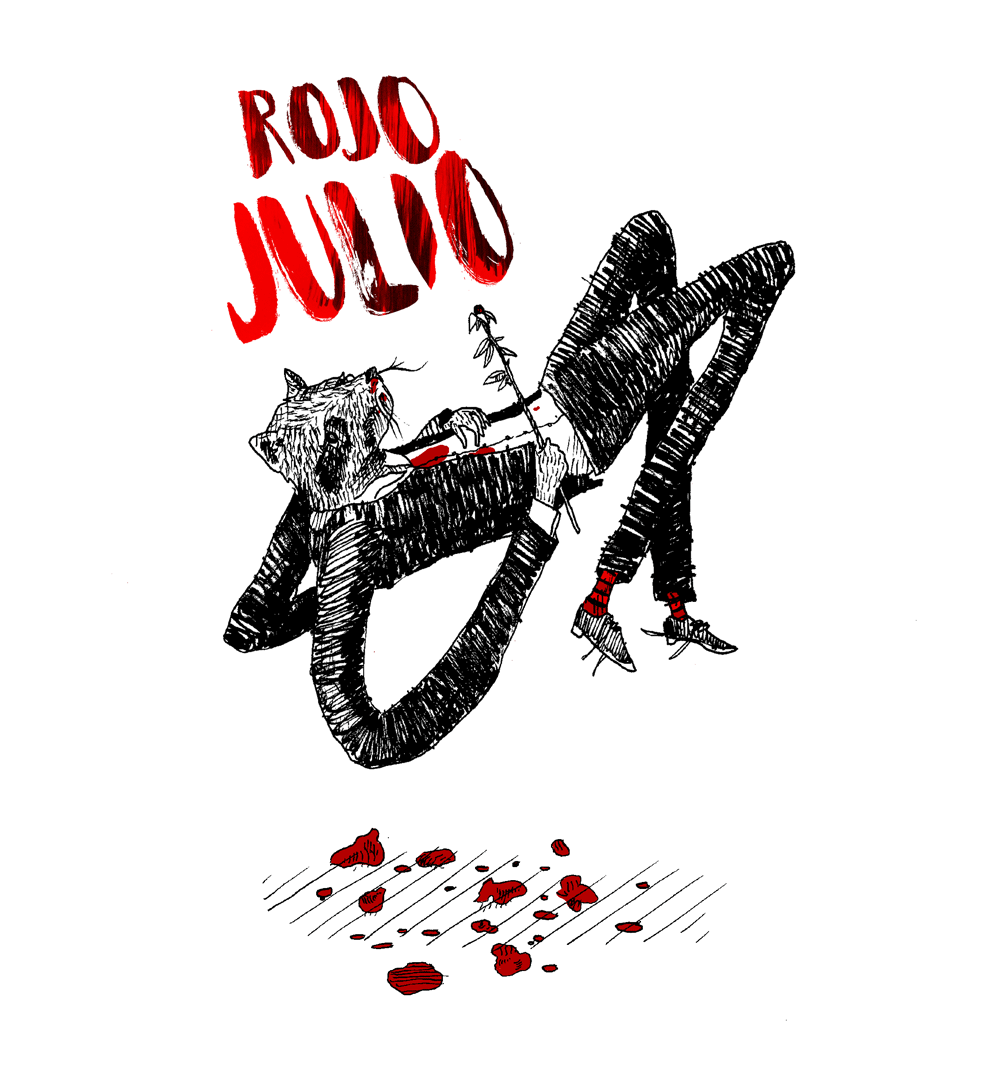
Red dripping from the nose, the raccoon twitches in the moonlight. In the street where I struck him, his right shoulder scrapes the ground. His back feet spin him round. It leaves a half moon blood trail. The arc of blood spilling in the half circle was fit for a funeral- rose rojo.

Behind me the bushes move. The red raccoon's mate peaks her head above the bush. Taking a last look at the scene, she escapes into the night. Now the crippled raccoon and I stand alone. The breathing slows as the flow of blood increases from his nose.

The raccoon’s chest heaves violently. The blood in my own veins thickens and my heart pounds hard against my rib cage. His back legs are limp while his front paws claw for more life. I stare into the moon when I stand to place my hand in my back pocket. Knife in hand, I flick it open. The moon mirrors white on the silver. The masked eyes on the ground look into mine. Instinctive, as if I owed him this much, the knife slides without resistance behind his neck. The twitching ends with both eyes reflecting only the moon.

Red blood drips from the knife, my only offering at the funeral. The blood falls like rose petals stripped from the stem. Only rojo Julio and I in the night, we dance alone under the moonlight.


This is a personal favorite of mine. I'd be honored if you left a comment below about it.

August 25, 2015 - 2 comments

The Coffee Port

by Geoff Gouveia

illustration by Geoff Gouveia

illustration by Geoff Gouveia

The coffee shop hums, a modern day port with metallic buzzes. The refrigerator and espresso machine mount in unison, climbing above the speakers playing music. Chairs scuffle and the tables creak. The tables are all occupied save for one. A press of the door from the outside, the artificial wind rushes to keep out the flies. In walks a man in a frumpy business suit.

His head shines through thin shaved hair. He is neither thin nor plump, but the suit cuts off too high on the neck. His red face betrays the true cool weather outside. A loud bang of a folder on the table, he enters the line to order.

Following behind him an older, plumper gentleman in a nicer suit sets his binder down near the strewn folder. A woman in a simple black dress, fit for a funeral, looks somber down at the seat she pulls to recline in. She checks her phone and then stares at the wall. Her eyes are empty decorations against a stone surface.

The red-faced man returns with a latte. The milk spills over the side of the cup onto the saucer. He falls into the seat with a crash. The cup clatters against the wooden table and more milk sloshes over the side. He napkins the escaped liquid with quick, sweeping motions. The woman shifts her weight to the left as he gazes through her.

“Why won’t you look at me? Why won’t you look at me and talk?”

No response prompts his lean towards the plump elder man.

“Fine. You. Listen to me. You tell her. She’s the mother of our children. I want to make this work.”

“My client does not want to talk with you at this moment, Ron.”

“Look, Fred, just ask her what happened to being together.” Ron’s eyes pan across Fred towards the woman, sitting adjacent with eyes on the floor. She shifts her weight and tilts her head to the side. 

“Good question. I’m just the client now,” she musters with as much sass as necessary for the occasion.

“Alright. I messed up. I messed up in life. I messed up as a husband to you, Melinda. But as a father-”

“Yes, as a father,too-” 

Ron’s voice escalates. “No. Listen. No. I was a good fath-”

Melinda forces a fake laugh. “You? Good?” 

“Alright, alright. Give me a minute with my client. Leave your stuff there. Just settle down. Sit down. Sit down, Ron.”

Fred and Melinda leave the table. They walk past a woman nursing a child alone in the corner. Her back is to the wall and only a thin navy checkered blanket protects the intimate scene. She looks up when a loud slam breaks the coffee city rhythm. It is Ron’s fist through an open binder onto a highlighted page next to an idle iPhone.

Ron cracks his neck sharp left and then back to the right. A nervous arm reaches out past the cuff. The time on his wrist forces him to close his eyes. Twitching, the eyelids are thin veils for the constant bulging behind them. The door opens from the outside. Fred motions with both hands, palms to the ground, as he nears the table.

“Alright, Ron. I’ve talked with Melinda. You know you can’t have full visitation because-”

“The hell I can’t! I’m tryin’. Look, I’m trying. I’m trying to make this work. But she-” 

Melinda whips her eyes from the floor, red and raging towards Ron. “Yeah? You should’ve tried harder to make this work with me. You should’ve stayed away from her.” Her voice is a wave rising on stayed and crashing on her.

“Oh wow, here we go again. You can’t-” Ron points a finger at Melinda. He holds it over his head, a signal that he is drowning.

Fred rescues him. “Come back, let’s bring it back.” 

“I don’t understand. I’m the father. How are you going to say I’m not trying as a father?” 

“Father’s stay. Where were you-”

“You know where I was! Why are we here? You won’t let it go.”

“I don’t want you to see them. 

What? It restarts, you know that? You know damn well my relationship with the boys restarts when I don’t see them.” Ron’s voice begins above water and ends below it. Only bubbles above the surface as he struggles to hold his breath. Closed eyes accept the situation.

The coffee shop continues its buzz. From the counter, the line of people swirls around the meeting like a riptide. The nursing mother finishes. The child fusses in her right arm while her left hand, sans jewelry, gathers the belongings. Fred watches the mother leave with a blank expression. Another minute passes and he sighs.

“Ok, OK. Melinda, Ron- Let’s connect tomorrow, yeah?”

Ron nods his head and Melinda rolls her eyes. The only audible response to his request is the metallic doldrums of the working mechanical units in the shop.

No one watches them leave.


Thank you for reading that story. If you found value in it, please leave a comment below about it!


August 18, 2015 - 1 comment.

Pencil Shavings

by Geoff Gouveia

illustration by Geoff Gouveia

illustration by Geoff Gouveia

“He’s come in here before.”

My mouth points at the man gathering his belongings on the table in the corner.

“He gets the same thing every time- a cappuccino – and asks for a small piece of dark chocolate.”

I wipe the counter and purge the steam wand. A momentary hiss of hot water rushes towards my skin. It stings for a second. I continue wiping the basket under the portafilter.

“He always leaves the plate with pencil shavings on it, too.”

I walk out to the table where he sat.  The pencil shavings don’t bother me. It’s my way of supporting his dream and his drawing.

“I draw, you know,” I say to my coworker. She looks up from counting the coffee on the shelf and nods her head.

A customer walks to the counter and I hurry to serve him. The pens in my pocket clack together with my frenzied pace. My right hand leans on the counter while my left palms my back pocket to check for a small moleskine notebook. The customer, a slender man with a white pressed shirt and blue-checkered tie, makes eye contact. He orders a macchiato and asks me to keep the change. I begin his drink with a nod and look back as I prep the shots of espresso. His mouth moves and sounds escape it.

“What?” I question while flicking the grinder switch to cease the loud whirring.

"I used to draw." He drums on the counter with quick fingertips.

"Oh, yeah?”

"Drawing never got me where I wanted to go, though. How could it?"

I steam the milk as a response. The whoosh sound deepened with prolonged contact against the steam wand. The crema of the espresso tiger striped in the glass. The colors spun together into muddy amber. I swirled the milk and tapped the bubbles away, pouring a small rosetta. He smiled at the art on top, but sipped it as his feet swayed. He thanked me and left the saucer on the counter.

My head shook at the man as he walked out. The saucer was clean, not a single pencil shaving to be found.


Thank you for reading that short story! This link will take you to another coffee related one 🙂


August 11, 2015 - No Comments!

Burger, Fries and a Strawberry Shake

by Geoff Gouveia

illustration by Geoff Gouveia

illustration by Geoff Gouveia

The line reaches back towards the cement blocks, cutting off the street. We wait there, inching forward. The smell of burgers wafts through the air.

My back is to the street. An excuse me floats from behind. The inquiry came from a sun-scorched man with long hair. A thin scar hooks over the top of his nose, following down the base and onto the cheek. His eyes are moist against a dry desert of a face. A muddy horseshoe mustache hides an otherwise empty expression. His weak chin puffs near the bottom, escaping into a thin neck that attaches his head to a wired frame. His shirt was blue, now it is sun-bleached gray. Two small holes are above the top sleeve. A thin spotted arm escapes the large shirt. Both hands, with dark clawed fingernails, clutch the handlebars of a cobalt blue mountain bike.

“Would you be able to help me get a burger? I’m almost there.” A claw held up a pile of mix-matched change.

My friend and I shrug. “Sure. Yeah, what would you like?” His dark skin is leather. It shifts in sheets, the darkness burned against each other.

“Oh wow. Thank you. A burger with fries. A shake would be amazing, too.”

“Ok. A burger with fries and a shake, then.”

“A strawberry shake.”

“Strawberry. You got it. I’m George, this is my friend Brian.” I reach out my hand. Brian matches. He returns the gesture with a Robbie and a nod, Robbie and a nod.

“Where are you from, Robbie?” Brian asks.

“Here. Been around the area. Used to have a beautiful wife and two kids. Threw that away. It was my fault.” Robbie shifts his hands on the bike, inching forward and then reversing in rhythm - a nervous fidget. When he talks, he makes eye contact and then turns his head to the right. He looks down to finish his statements. The street lights on the road shine in the night. He locks the bike to a nearby fence.

“I live near here. I’ve got a sweet tent. I’m addicted to painkillers. I ain’t gonna lie to you. I won’t lie to you. I used to be in a band and then I broke my back in a motorcycle accident. I got addicted after that point.”

I nod. The word addicted brings me back mom’s voice at the dinner table. She mentions my cousin and cries about his relapse. I wondered where my cousin was and if someone bought his meal tonight.

“This, too, shall pass. You know? It’s a season. I just wish I didn’t push my wife away. Stalked her, really. She doesn’t want me. Hell, I wouldn’t want me. I’m sober. I’m not clean, though. I’m still stuffin’ holes. I just got that bike the other day. Nice bike. Other one got stolen, you know? Thanks for the burger today guys.”

“No problem, man.” Brian wipes away the gesture with a hand. All three smile. The line shrinks into the window. Brian begins his order and Robbie hides against the wall. The girl at the register looks nervous toward Robbie, than at Brian. “ A number 1, double double, animal style only on the burger and a strawberry shake.” Robbie flies through his order as if it held no substance unless it was quick. Brian paid for the meal. We waited on the concrete slabs for the order.

“I just want my wife back, you know?” Silence. The soft roar of a far off engine. The murmur of the crowd. The close proximity of our feet betray our true stance in society.

Robbie produced a comb from his beaten blue backpack. He combs his mustache.

“What’s the plan tonight boys? What are you up to?”

Brian points at my shoes, “We just finished playing soccer.”

“Soccer, eh? You know what? Beckham. I hate ‘im. All I ever seen him do was model.” Laughter from the three of us connects in midair. We look up to watch it float away into the dark night. The intercom behind us sputters to life with our number, 22.

I retrieve the food. I thank the girl behind the counter and grab the items. They sag in my arms as I distribute it to each person. I pick a table and invite Robbie with a gesture. He declines.

“I have to get back to my tent. Thanks, though.” He undoes the bicycle lock with a click and secures it in the bag. Long hair over his backpack straps, it falls to his chest. Brian and I unwrap our meal. We watch him back the tires towards the road. He stops right near us to make sure the food is in tow.

“Hey!” he calls out.

Our heads turn to meet the sound.

“Thanks for listening. Nobody ever listens.”

His feet pump the pedals. The bike lurches forward. We watch his long hair disappear around the corner.


Geoff Gouveia


Thank you for reading! If you enjoyed this story, here's another about a time I saw a homeless man pass away outside of a coffee shop.