All Posts in Short Story

August 4, 2015 - No Comments!

The Seat

by Geoff Gouveia

illustration by Geoff Gouveia

illustration by Geoff Gouveia

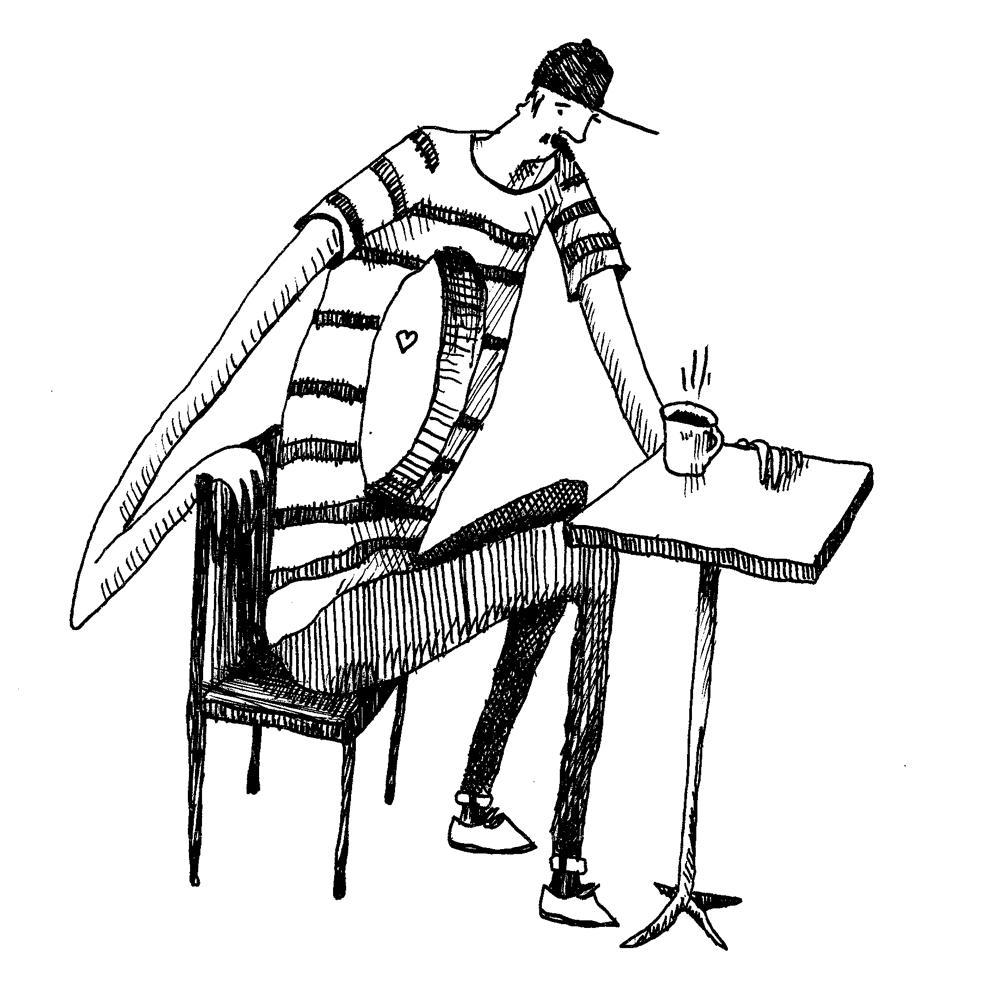
The seat Eric sat in was the seat he always sat in. Eric picked the seat by accident and a healthy dose of divine grace. The seat itself was not special.  Its power lay in the positioning to wait for her to come in.

The first time Eric saw her, he had happened to pause from his sketchbook. A momentary glance and his eyes bounced off the page back towards her. Her blonde hair shone angel white. She stood under the soft luminescent glow- amber around her but vibrant on her. The hair was vivid and California sun-tainted. California had soaked into her roots and then shot out golden beams from the top of her head to her shoulders. Shoulders tanned, her fair arms moved when she smiled her thank you to the barista. Eric saw her and knew, finally, the feeling of longing.

Hidden from her view, Eric could stare at the golden halo without suspicion of social awkwardness. She had the perfect proportions needed to be both wonderful to look at and to touch. How Eric wished he could do more than the first. Always in his mind it played out the same way.

He would walk to her and remark at her scarf color. She would smile. He would laugh a nervous laugh reserved for these moments. It stopped at the laugh, the laugh that lasted forever because his feet never moved towards her. Fate intervened once.

Eric doctored his coffee at the cream station when she walked in that day. A dollar, his green opportunity, dropped from her purse. Eric jumped at it.

“Miss! You dropped your dollar,” he spoke and in his mind, I love you.

She turned.

“Thank you,” she replied aloud while asking silent of herself, how could I drop that?

Geoff Gouveia


Thank you for reading that story! Here is another one about love and longing.

August 1, 2015 - 2 comments

Tome Lo

by Geoff Gouveia

illustration by Geoff Gouveia

illustration by Geoff Gouveia

Two rings in my ear. A weak hello? on the other end. When I tell her who it is, she doesn’t recognize the words. I tell her soy Geoffrey. No recognition. She asks if it is one of my brothers, younger or older. I decline. She finds her way to my name. Having processed that, she tells me she is lonely. Her day is not good and her shoulder has a lot of pain. This last part is in Spanish. I am the only one in the family who knows the other language.  She is not well; she doesn’t hide this fact.

I hate the situation. I hate the pain that causes her to cry out. I hate the time that slips like sand through a hand. Her life is water dripping between the fingers of a cupped palm. This is not the woman I visited as a child.

This is not the woman who kissed us when we cried. This is not the woman who prepared Spanish rice for Thanksgiving. This is not the woman who laughed at me when I lied about combing my hair. This is not the woman who chased my older brother through the house with a leather paddle. This is not the woman who protected her garden from age. This is not the woman who woke us to make omelets. This is not the woman who taught us the importance of dignity and strength. Collective blame replaced her with a fragile imposter.

It is her fault. It is also mine. It is the fault of time. It is the fault of my family. It is the cultural divide, the one that exists in her mid 1900’s Spanish mind. It is the fault of a 2015 Southern California driving culture. Autonomy is the highest price of entrance into our society. She doesn’t have this. If she did, it wouldn’t cure her loneliness. She'd spend it cleaning the house to her exact standards. Like I said, it’s her fault. But also mine.

When I visit her, I cut the flowers off the bushes in the front yard. Her eyes do not see the front yard anymore. The flowers will make her smile. She does when I place them on the table but then tells me she is nervous. Unaware of the context, I shrug my shoulders and kiss her on the cheek.

Thinking back to that moment, it is age tapping her shoulder. He reminds her of the ticking she has left. Mentally she has left- when I give her pills to take, she pushes them away. Twenty years prior, I am four and I don’t want to take my medicine. A consoling mijo, a rub on the shoulders, tome lo – and I do, I take it. The reverse occurs now; she is frail and hunched over. The hand I place on her back is light, lifted above the deteriorated absent muscle strength. Tome lo I whisper and she pushes away the pill.

If I were up there, pulling strings, I’d have pulled Yaya’s after her fall, right after her hair turned all white. That wasn’t up to me. My job is to cut flowers and watch her cry, to kiss her on the cheek and tell her I love her, to hold her hand and calm her cry, to write words like this and wish I never did.


Thank you for reading this short story! If you enjoyed this, you'll like this story.


July 25, 2015 - No Comments!

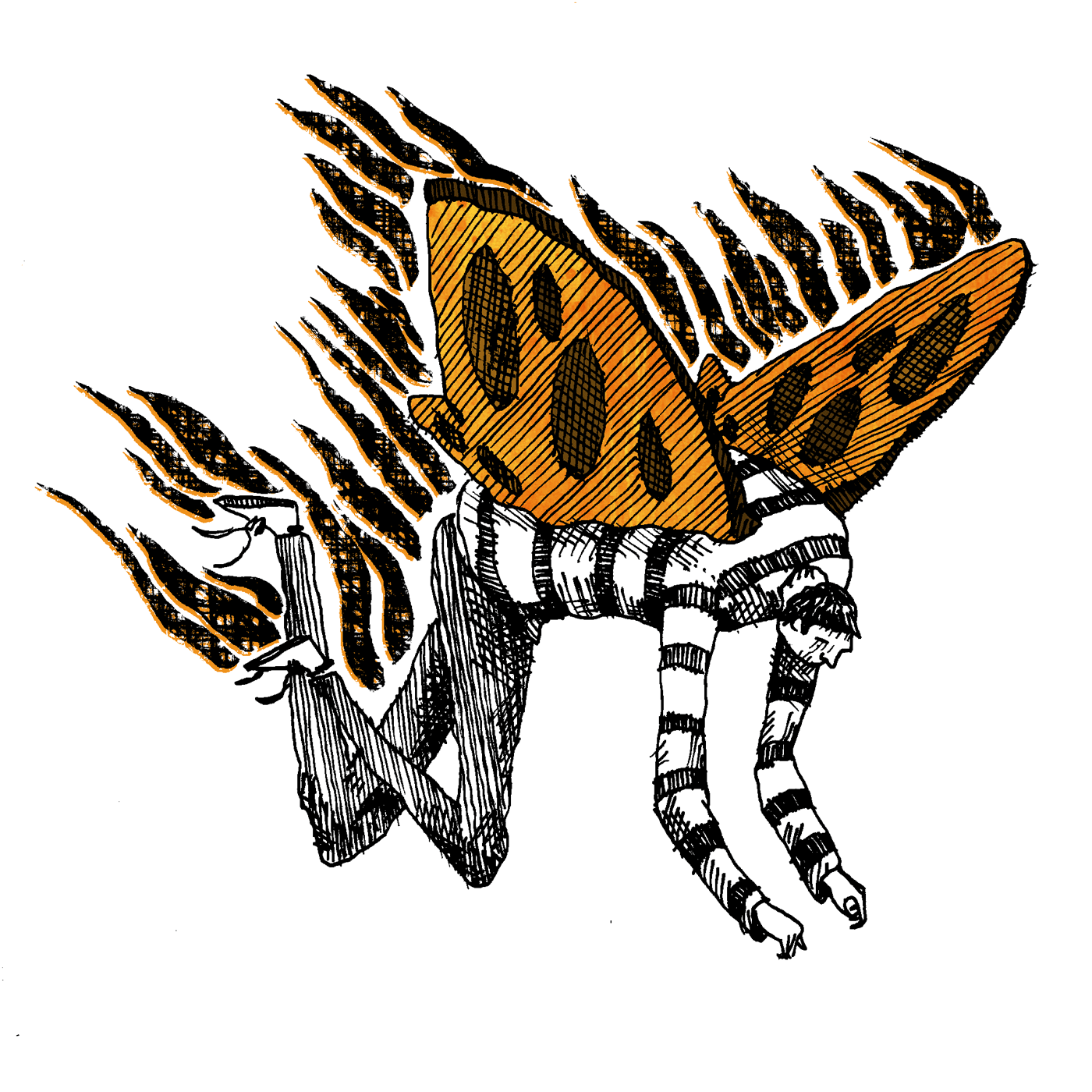
The Butterfly Kiss

by Geoff Gouveia

illustration by Geoff Gouveia

illustration by Geoff Gouveia

The monarch rests atop the windowsill. Through my glass window, the great wings folded together. Ochre yellow with muddled red, the wings form an abstract shape fit for a Picasso painting. The delicate organic colors contrast against the white fabricated wooden perch. When it beats the wings down, a gentle propelled wind raises it heavenward. These wings slice the air off the windowsill and into the day.

The kitchen door slams when I walk outside to catch a glimpse of the flight. The butterfly knew its course. It floated on gusts around the yard, stopping at branches and on pieces of furniture. It never rested for too long, touch and go throughout the backyard. When the wings neared a landing, the soft flutter slid them across the surface.

This is the butterfly kiss.

A nearby cushion sank as I collapsed into it. My outstretched arm willed the wings to kiss me. The butterfly landed near, but never graced my skin. Dangling its delicate body near my fingertip transported me back to a warm evening in July seven years prior.

A girl is sitting close to me on the cement and her legs draped over mine. I want her; I want to be in love with her. I lean in close to her soft skin, the subtle perfume heaven's own fragrance. She’s perfect and I wish she’d tell me her secret. I lean in to be near beauty. My eyelashes scrape against her cheek, the wings on the end of my eyelids flapping soft and she smiles. 

The backyard sun singes the seat I’m sitting on. I wish for the shade but am desperate for the touch of the butterfly. It eludes me; the delicate touch never gifted. The warm seat carries me to my grandmother's house.

She remarks “hace calor” and I turn on the fan to relieve her. Her voice is frail and her ancient eyes release mojado, enojada tears. She’s upset and I wish I knew how to console her. I kiss her forehead with my lips. She reaches out to hold my hand: I grasp it and release. I tell her I love her. The screen door flutters for a moment as the wind blows hard against the mesh. 

Against the green ivy the flickering contrast of red bounces around the yard. The sun blinds my vision. My interior eyelids burn deep clay red. The ivy returns to pure green when they open. A gate blows rhythmic taps against its starting position, an elemental ticking clock.


Thank you for reading this story 🙂 Short and sweet, eh? How about a story longer and bitter?

July 18, 2015 - 1 comment.

Blue-Eyed Hiker

by Geoff Gouveia

illustration by Geoff Gouveia

illustration by Geoff Gouveia

Dressed in all camouflage, his tiny frame collapses on itself when he sits forward. A camouflage hat adorns his small head, with large ears that poke out of the side. His curly hair escapes underneath the hat. Long fingernails with a black wristwatch fold back and forth on his lap as he spins a stick. The stick met the ground where his boots did, thick brown ones that shined brighter than the rest of the outfit. They fit like oversized blocks. No socks were visible above the ankle high boots. Thin legs shoot out towards knees that fold like an accordion into the body.

I smile when I introduce myself as George. A soft Logan returns my inquiry, the word escaping his mouth on accident. He turns with sun-glassed eyes away from me. Amidst the other campers, he sits off to the side, drifting out to the right with his head down. He plays with the stick, drawing circles into the dust. The leaders huddle in the front, debating where to go next. The campers besides Logan speak to one another in the fashion appropriate for high school aged youth. They yell loud, discussing which of them present were theirs for a weekend crush.

My nametag is grey and it held round my neck with a small white string. The wind blew it to the side when I walked. Flipping it around, I ask Logan, “Where are you from?”

“Colorado.”

“Whadja say?”

“Colorado.”

“Ah. Colorado. Never been there. You like sports?”

“Not really.”

“Whadja say? Here, turn this way.” I say with my hands.

“Not really.”

“Not really, eh? What do kids in Colorado do?”

“I’m from Colorado. I live here. I don’t know. I like hiking.”

“What about talking- ya like talking?”

Logan smiles and the dust rises from where the stick hits the ground. His hands are larger than his arms allow, big paws with awkward limbs supporting them. The stick snaps in half under the pressure from the top, folding into the dirt. Logan chucks the stick and looks at me before finding comfort in eyeing the trees.

“I like hiking.” He responds again.

“What kind of hiking?”

“The regular kind. The walking kind.”

“Oh ya? Where have ya walked?”

“Nowhere, really.”

“So I’va hiker who doesn’t hike on my hands?”

“Ya, I guess so.”

“Those are the best kinda hikers in my opinion. Hiking doesn’t make too much sense to me. Before breakfast tomorrow, we can go on the hike if ya like? Say…that rhymed!”

“Ya. We can do the hike. I don’t care.”

“You don’t care? Well I care. I love hikin’ with hikers who don’t hike. That’s the bell for dinner. No, leave the dirt there. This way, kid. Pick up your feet, I’m tryna breathe here.”

The trees surrounding us begin their evening shift in color. The dark green softens, a heavenly creator tainting his canvas with a wash of blue. Logan’s hands rest in the middle of his frame with his slow feet flaring out to walk. They stumble over the small items on the forest floor. He walks with his eyes straight ahead, forcing me to ask his ear questions.

“Ya from Colorado. You live here?”

“I live in La Habra. My grandparents live in Whittier. My mom lives in Colorado.”

“How long has your mom been in Colorado?” I see the lateral movement of his eyes, scanning the road ahead while we walk.

“Six years. In August, it’s been five since she last called me.”

A tiny blue jay swoops across the path. His wings cut the conversation. I step over a nearing hole.

“And that makes you…35?”

Another smile forced on the lips, he turns to me with a head cocked to the side. Peach fuzz on the lip is starting to darken. It meets the slower growing hair on the side of his face. My beard reflects in his sunglasses.

“I’m 12. I’m almost 13 if you must know.”

“Nice. I’m 14.”

“Ya right. You’re like 27 or somethin’.”

“Ok , ok. You caught me. I don’t tell campers this on the first day but I’m a hundredan’ten. I have a piece of Mexican pottery straight from the hills of Michoacán that I rub every nigh-“

“Pottery- what the-”

“What the what? Ya never heard of the medicinal properties of Mexican pottery? Wow this weekend is gonna change your life. Watch your step. The cafeteria is coming up. No, let’s sit on the left. Find a seat faster, grandpa. What? Is it too bright in here for ya? Take off your glasses.”

Logan finds a table amongst the other campers. Logan’s camouflage works in reverse against the campers’ street clothes. My chair scrapes the floor as I sit on it. Logan’s hands bunch neat together, folded as if a prayer were about to spontaneously combust out of him. He plays with the napkin in front of him. The water slips out of the jug quicker than I judge it, spilling some on the table near his hands. Dabbing the water, the long nails scratch against the faded white plastic table. Logan bobbles his head to the right and then back to the left. The light blue spheres rest straight ahead, fixing on the pitcher of water - blue on blue.

“What were ya looking for, Logan?”

“Nothing. I’m not hungry.”

“You’re not hungry? All that talking earlier wore you out?”

“No. I’m not hungry. I don’t want to eat.”

“Fine, fine…but what has that got to do with my question?”

“What question?”

“What were ya looking for?”

“Oh. No one.”

“No one? Does No One have a pretty face? Where’s she at?”

“No where. I’m not tellin’. And I’m not eatin’, neither.”

“Logan, ya gotta eat. Stop picking at the sandwich they gave us. Put a bite in your mouth. I don’t get paid to be here and I don’t get paid to take care of dead kids. Eat.”

“No.” Logan then hesitates with a brush of hot air through the mouth, “hhhhhhhhOk.” A tiny bite of the sandwich slides down his throat. He holds the sandwich close to his mouth. His eyes are twenty feet away on the back table with the girls. Another small bite and he closes his eyes.

“Ya know what is sad about me?” He starts.

“What? Swallow your food ya animal.”

A swallow with closed eyes and a question with open ones, “Ya know what is sad about me?”

“What? That you don’t believe in Mexican pottery?”

“I can’t talk to girls.”

“So there is a girl. What’s her name? She’s not your sister, is she?”

“No. I’m not tellin’ where she is. But it doesn’t matter. Each time I walk up to her my mind goes blank. I’m dumb. I can’t talk to girls.”

“Wanna know the secret to the elusive creature that is ‘woman’?”

“What?”

“Ya gotta ask her a question. Worked well on my wife. She tries to turn the tables and ask me questions, but I answer with questions. Makes ‘em talk and they like that.”

“Ya I guess. Girls like my eyes. They say I’ve got nice eyes.”

“They’re right. Blue sky eyes. And yer a hiker. Don’t forget that.”

He smiles with another bite from the sandwich. I want to tell him to change out of his camouflage. His posture indicates it isn’t a garment of clothing. Small bites finish the sandwich and his chair creaks when he leans into it. A rounded back touches near the bottom. His narrow shoulders hold arms like two mirrored lopsided tulips with uncontrollable buds on lanky stems.

“You finished? I’ve got a meeting with the other counselors soon.”

“Ya. Told you I wasn’t hungry.”

“Don’t start. My goodness you do have blue eyes. Why don’t you point them elsewhere- away from the honeys. Staring isn’t going to help you.”

“Nothing is going to help me. I’m terrible with girls.”

“No, you’re fine. Just bat those blue eyes. Ok- I have to leave now. I’ll see you at the cabin later tonight?”

“Ya. Sure.”

The table widens with Logan sitting alone. The back of his neck scrunches down, a turtle with long limbs. A soft amber glows from the light fixtures on the porch of the cafeteria. The forest silhouettes against fading blue violet sky. Pine wafts through the air and the dirt paths kick up dust, swirling into the night sky. Cool colors around, they contrast heavy with the picture of Logan in my mind. His discordant outfit is at odds with the pseudo urban environment. Scared animal, half reptilian, full-blooded boy - we’d just met but he’d be stuck in my head forever not as an individual but as a stereotype. The counselor meeting passes like the night and the room shuts black when the door closes for everyone to shuffle to their cabins. The smooth wood railing brings me towards the cabin.

Inside the door, I nod to the nearest camper with the green sleeping bag. He smiles and points towards the back, recognizing my face. Two doors press open and Logan is sitting on the top bunk with feet dangling heavy. They kick the bed stand with soft melodic thumps in the night. I smile when I see him and he meets my gaze and then turns away.

“Hey blue eyes- how were the activities after dinner?”

“Ya. Ok. I guess.”

“Ok? So you had the time of your life?”

“No.”

“Ok Ok. Did you talk to her?”

“Talk to who?”

“The girl in the cafeteria- the love of your life.”

“Oh. She’s talking with another guy now.”

“Life is rough, man. Better stick to hiking.”

He laughs, a small hiccupping laugh with large teeth. The blue eyes sparkle off the light. They are deep wells with hidden mysteries at the bottom. I wish at once I could help him. I wish I could protect him from the world that would try to soften his blue eyes, dulling them into a cerulean gray that was muddy and apathetic. He was still a child here but when we spoke, I could see the blue begin to fade.

“Let’s go to sleep now kid. Brush your teeth. Shoot. I forgot toothpaste, can I borrow some of yours?”

“Yeah,” he responds with outstretched claw, tube dangling between forefinger and thumb.

“You gotta cut those nails tomorrow, man.”

“I know. Are we hikin’ tomorrow morning?”

The faucet drowns the question.

“What?”

“Are we hikin’ tomorrow morning?”

“So my hiker who doesn’t hike wants to hike- well I guess. I guess we can go hike.”

“If you don’t want to…”

“I’m teasin’, I’d love to go. I brought shoes for it. You’re already wearing your boots. Take em’ off. You got top bunk? Well too bad ‘cus I call bottom bunk.”

Heavy pulls on the ladder shake the bunk and I see his feet disappear up top. The bunk rattles from side to side. The under part of the bunk is a deep brown. A claw appears over the side and paws a switch. Darkness wraps the room. The soft glow from outside seeps in through the window.

“George?”

“Ya?” I turn the pillow under my elbows and peer up at the under part of the bunk. It is black now.

“I’ve never been hikin’ before.”

“That’s ok. It’s fun. You’ll like it.”

“Ok.”

“Yeah ok, let’s go to sleep ya hiker.”

Small insects fly into the outside light, buzzes halted by sharp electric blue claps. The dark world beat against the luminescence.

“George?” a light fabricated blue paints the ceiling.

“Ya?”

“I don’t have service on my phone.”

“So?”

“What if my mom tries to call?” A clap breaks the blue. A dark, dark gray replaces it. The bunk sways and shakes loose, above the buzzing and under the grayness, a whisper:

If you were a mom, wouldn’t you call?”


Thank you for reading this story! If you have some time, why not consume another?
July 11, 2015 - 2 comments

Three More Weeks

illustration by Geoff Gouveia

illustration by Geoff Gouveia

Outside the eleven-story window, the city nestles against the hills. The favelas in the distance cut against the large buildings. A late afternoon breeze fills the apartment with the smell of rain. The air conditioning breaks the humidity on the threshold of the windowpane. The first pitter-patter of rain drops on the plastic covering above the window, protecting the drying clothes underneath it.

The drops are loud and the pace builds to a gradual downpour. Outside the window, liquid sweeps across the city in gray blankets against mismatched earth toned roof tiles. The breast pocket of my beige bomber jacket bulges as I jangle the keys. The keys, cut last month like all keys in Latin America with crude spidering edges, clank as they lock the door.

To the left, an old elevator rattles to life with a press of its small brownish buttons that illuminate faint yellow. The rattle cage finds its way to my floor and the scissor gate collapses. No one is inside; the dusty ceiling met the 3-mirrored walls and the scissor beginning. The 1 glows soft white and the elevator descends, a lurch towards the bottom. The numbers pass before the small window near the scissor door lets light into the elevator from the halls. A small bump and the elevator halts while the scissor releases. A woman in the hall with a small dog whispers to him, “Vai, Batman, Vai” and I laugh at the name familiar at home with tights and costumes and villains. Bom dia I greet her and she returns it and I smile at the bellman. Another Bom dia and I’m through the door out to the exterior awning.

Wet sheets fell and swept the street. Some heavenly being holding the hose down and pinching it, kinking the line and letting it halt for a moment in rhythmic prolonged swoosh followed by a short slap. The sheets fell in unison on taxis packed with passengers. My destination isn’t far, only 3 blocks from the entrance of the apartment and I head off in the correct direction.

Both hands in pockets on either side of the jacket, I pinch them closed and keep my head down. My back was the first to become soaked, the light beige darkening towards a mud color. It began to soak through to my red shirt. At first, it dripped on the back of my neck, and then the top of my head started to run with water. The drops slid down my face when I lifted my eyes to see the street signs.

The homeless are dry under the long awnings near the Praças. My shoes slap with loud wet sloppy steps as I pass from awning to awning. A digital clock that reads 14:30 doubles my stride. I jumped the slow emerging river near the gutter into the street. The socks I wore squished in my shoes. My jeans became wet on the backs of the calves, then joined at the ankle and crept under the thighs.  A hunched back kept a ring of dry beige on my chest.

A block away, the destination pushes my pace to a jog over the cobblestoned surface. The mix-matched stones juxtaposed to a pooling body of water. In it, a small yellow and green plastic flag rests half submerged. The blue globe in the middle half against the rain and half against the street. The taxi from my right swerves and a large puddle rises from the tire. My hands shoot out from my pockets and I straighten my chest, bending my hips towards the wall. The car rolls forward as cascading water crashes only on stone. The rain spoils my last remaining area of dryness. Inside the jacket, the letter is dry to the touch, but the breast pocket is damp. Four steps more and the door is in reach.

Something is different today about the door, though. The light is off and the door is dark and there aren’t any people checking for mail. An unfamiliar Portuguese word dangles on a string in the window. I tilt my head back, the windows reflecting the gathering clouds. My face is numb against the dropping rain. The breast pocket soaks and my mind wanders past the windows up into the clouds. It wanders to my wife sitting in the California sun. Her angel white body glistens near the pool and her laughter is melodic in my ears. My ring finger burns warm and steams against the outside. Water runs down the nave of my neck, down over my chest. The rain seasons my smile when I whisper into the sky, “Three more weeks.”

July 4, 2015 - 2 comments

The Red Vase

illustration by Geoff Gouveia

illustration by Geoff Gouveia

The margins filled with small sketches, I remembered by letting the pen move free. Art class held my attention and I chose to sketch what was in my head. Sketching the contents of my head didn’t come easy and I chased it throughout my high school career into my college one.

While studying art, I found a position as a barista. Working the bar came easy and I loved it. Easy interactions with the customers gave me great joy. To stand and talk was easy and I loved it. When the customer laughed and we shared a smile: it didn’t matter whether I understood chiaroscuro or color theory. I enjoyed it until the day I did not.

That day came after a session in my studio. My hands had red paint under and on my fingernails. Two tufts of hair poked out of my head like antennae. Claws appeared on my hands when I pinched my fore finger and thumb around the key to unlock the front door. Lobster-like when I scurried from the back to the register, I knocked over a drink sitting on the pickup bar. The sales floor was the bottom of the Pacific. Frigid in reacting, I drifted in the current of people and drinks and thoughts. Fluorescent lighting gave a cerulean hue over the counter and my hands burned bright red with the paint. My exoskeleton, caked with espresso grinds, had formed like all small crustaceans’ do. Without observation I busted through it: one day content and the next day a reverse Kafka-like metamorphosis.

I began painting as a result of the metamorphosis. My smile waned at the register and I sketched on the backs of receipts. I wasn’t there. The vision in my head that began as a sketch would flood with color, saturating and swelling and I’d lose sight of it. The fleeting thoughts were my younger brother in the field. I’d take him with me and he’d run off the trail out of sight. My heart pounded with quick pitter-pattered beats: I told Ma I’d watch after him. All senses on high alert: The smell of grass moist then sun scorched, the crunch on a dirt path under foot, the circling hawk casting shadow flicker. My brother darts through the crisp ochre colored grass. I convince myself he will come back; he had to come back. One foot in front of the other, methodical in my journey towards finding him again, finding the vision of my art again.

I became better at realizing the vision in my head and then became worse at it. It was the carrot in front of the horse, the matador’s red cape in front of the bull. I ate popcorn while watching a documentary at my grandmother Yayas house about matadors. The thin matador in his extravagant bright teal satin traje de luces and rose pink socks walked into the middle of the ring. His red cape, the muleta, at his side began to make graceful passes, veronicas, stoic whilst watching the bull. In appeasement of the crowd, he goaded the bull to pass through the flickering red muleta. The bull, with eyes red and hating the red flicking muleta, charged. A last second razor flick from the horn sent the matador into the air. My thumb soft over the veins of Yaya’s frail hand, I smiled at her que peligroso, no? The blood of the matador spilled in the ring, crouched low as the aids rushed to distract the bull. The blood soaked into the teal suit and muddled it, the complementary colors vibrating against the soft yellow sand around him.

After watching the soft yellow taint red, I wanted to practice painting a vermillion vase. I began with the basic shapes and then filled it in with gradual steps. Taking my eyes off the piece, it finished quick and disproportionate. I learned to break this amateur habit 4 years back when my professor chimed in my ear to keep my head up. After the professor walked past my station, I cursed and knocked over the drawing easel. Sitting on the curb, I’m furious. The setting sun splashed violet against a red-orange and I remembered feeling alone.

The studio was silent, broken only by the lone scratch of the brush on the page. I looked at the paper and back at the vase and how it curved and back at my paper and how it didn't curve.

Look up. LOOK up. LOOK UP. LOOK UP.” Each word producing a shake from my head.

I knew that. I was the bull. I palmed the vase and threw it to the ground. The vase flew from my grip and regret was a rushing warm arrow that pierced my torso. Deep breaths followed a rip and my painting fluttered to the ground. Retrieving the broom, I swept the pieces into the white chipped pan. A sliver of red ceramic cut my finger. The blood dripped silent onto the concrete. It hadn’t come easy and I hated everything I had chosen to become. Staring at my finger drip, it dripped blood and sweat and thoughts and fears and aspirations.

The aspirations ran through my veins and it wasn’t blood I missed when it spilled. I picked what I became in life and it crushed me. It crushed me inside to know that the vision in my head would take nothing more than time to realize and even then time couldn’t heal all failures. They stung like red ceramic cuts on soft artist skin; they sat with you in the shop when you drank your morning coffee. When you pulled out your notebook and began to draw, the thoughts of who you wanted to be plagued who you actually were- you’re never the one in your head. Now in a coffee shop, my notebook invited me in, dared me to try again- I peered up right before beginning and saw another soul sitting 10 feet away.

His elbows sat heavy on the table and his eyes dazed straight ahead. A small pastry wrapped in a brown paper bag, scrunched tight to form around the muffin. It lay on the edge of the wooden surface. His left eye gazed more open than the right. The left one had a red tint on the side of it. The night wore it thin, saturating the white sclera to a warm magenta. He was absent and the world was silent and his mind was loud and he stared ahead. I was thankful I wasn’t him. I was sketching. At least my thoughts weren’t in my head anymore. Perhaps he saw me and was thankful he wasn’t me: thankful that his thoughts never made it out of his head onto the paper. The grass was green where we were; content to never cross the line, to tackle our demons alone in our heads or on our pages.

The ink flowed from my right hand to the notebook pages while my left hand fingered two official white sheets underneath. Ink ceased for a moment when, out of my peripheral, I noticed him stand. He gathered his pastry and coffee the barista had called out. A slow pace with slow moving feet complemented his slow face that scowled when he unwrapped the bag as he drank the hot beverage. A knuckle had a scab on it. His shirt was charcoal grey with the local pub’s insignia on the back: he had the look.

I’d seen the look in the reflection of my blank iPhone screen two years back right before a shift. The pre-shift contemplation of why I still worked while the red-eye-red-knuckle stung. A flash of confidence, an upswing in artistic commissions and I had the courage to leave. I became thankful for not having to have the look, to attempt something for money that was counter to the culture I desired to rebel against.

Except the money didn’t - and hasn’t - come easy. Now I sit here in the shop, fast-forwarded from my two years of flying solo. The tattered wings I built on the way down from my initial leap propped behind me on the wall. Shifting from red-eye to the red-knuckle and then back at my own hands, sore from hours of holding the brush. My back is stiff from painting but I anticipate the different stiffness that comes with standing at a register. I close my notebook and take the two pages to the counter.

Will my face be like his?

Will my pastry taste sweet?

Will I even notice I’m consuming something?

Right now I was present but I knew behind the register I’d be absent. I would be in my studio, cussing out the painting I messed up while picking up pieces of a broken red vase.


Thank you for reading this short story. Would you like to read another?


June 26, 2015 - 4 comments

Where’s Carl?

illustration by Geoff Gouveia

illustration by Geoff Gouveia

The line at the shop was out the door. With each new customer, the shots of espresso hissed into their new homes in to-go cups. The chill December air flooded inside. Outside the shop dazzled lights lit up for the Christmas festivities in the town. This ritual drew large crowds; crowds that swelled around the doors and asked for hot chocolates and coffees and spilled both on the floor. After watching the lights, the crowds were eager to become customers of liquid heat.

Nighttime provided the chance to watch the customers. Only the morning shift had the reciprocation of contact. At night, while pulling the shots of espresso and the stocking of the cups, I’d watch the people. Most were talking and there would be smiles. Others would stand as far apart as they could to signify an issue occurring in their lives- they ordered with terse voices and curt sentences. Still others came with their kids and their kids’ kids and those kids’ friends: too many kids and too many hot chocolates to serve. The ones in the line I noticed easiest were the ones alone. They spent the moment on their phone, huddled over the soft glow. After a scan of the line, I continued from right window to middle trashcan to the bar on the left.

Over on the left bar we limited the amount of contact one could have with the sugar packets and chocolate powder. We did this to combat the making of homeless hot chocolate during the winter. The drop in temperature inversely related to the homeless population buzzing around. The homeless who came in every day asked for hot water or a chance to use the bathroom. We granted these small requests to alleviate their status for a few moments. We had to watch the ones who asked for hot water, though. Not that we minded giving the easy beverage: we watched what they did with it afterwards.

The problem individuals walked the hot water over to the bar and created a mixed concoction of sugar, vanilla and chocolate. The ingredients they left made a large mess. The paying customers complained about the stickiness. It was a real hassle, but I understood why the homeless wanted a drink like that. It wasn’t the norm and  they could take a small step towards dignity in drinking a pseudo-seasonal beverage. When I saw individuals making the homeless hot chocolate, I started my walk from behind the bar to halt their efforts. The chocolate smelled like the cheap coco mix I spilled on my shirt as a kid. Tears streamed then but now nothing comes to my eyes. I fulfilled my role as a barista to keep the shop clean.

We, the baristas, enjoyed the presence of the homeless  but hated the awkward conversations they created. Being one of the only males on staff, it was my duty to pat the homeless man on the shoulder who had fallen asleep on the table. I wondered where the individual would go and if he would ever sleep more than 20 minutes at a time. The regulars, the homeless we knew by name, had their quirks that came with a counter balanced demon. Jerry laughed with a heavy wheezing laugh, but he was too loud and talked to no one in particular. We used to give the homeless our leftovers from the bake case but then Harry hit Robb over a cheese Danish. Big Joe was pleasant, gracious for the smallest items but, like Jerry, ranted about a lost love or a conversation he had years back. My favorite was Carl because he told me once he used to draw. He told me when I put a sleeve on his hot water, sliding it over the bar and our fingertips touched for a second.

Carl's demon was the scratch. A fidgeting nervous neck twitch that took precedent over the pen. I gave him a small red notebook, the ones with 40 small vanilla pages. I asked him about the drawings, looking up from my trash runs to watch him scribble and then scratch. The red notebook creased in his back pocket, hours of sitting in the same clothes gave no rest to the cover.  I winced when I kicked him out for using the tables when he didn’t order anything.

Tonight, a sea of people swirled around the tables like kelp, tangled nearby. The lone bystanders were glowing iPhone driftwood, drifting apart from the buzzing crowd. One man in particular caught my eye; I had recognized him but knew not why.

He had white hair that hung neat, combed to the side and swooped across the back. It contrasted against his black windbreaker. He check the time with his glowing hand, a mannerism befitting the younger generation’s loners around him. Shifting his eyes from the bake case, to the register and to the bar, we made brief eye contact and I smiled and he did not. The line shuffled close. He ordered his drink. I heard the call for the drink and saw him walk in deliberate short steps towards the pickup area. With a heavy sigh and tired eyes, he leaned over the counter and said, “Hey, where’s Carl?”

Baggy pants and a grey sweater with a brown stain and a red notebook come to mind (in that order), “The homeless guy?”

“Yeah. Sure. Have you seen him lately?”

And that’s when I began to worry.  Two weeks ago he snorted a packet of sweet and low off the table. He dropped his red notebook and I grabbed it off the floor and pushed into his chest and out the door. The next day, Carl came back and smacked a lady on rear end. We eased her worries with a free drink and shook our heads as Carl limped past the furthest left window. Since then, the shop hadn’t had an episode. We also hadn’t seen Carl, either. I was nervous to ask. I wasn’t sure what Carl had done to the man. As an employee I wanted to hear the man, as a human I wanted to protect Carl.

I lowered my voice and tilted my head to the side with eyes in an apologetic stance. “Look, sir, if you have a problem with him, I’ll be sure to take care of it later.” The man closed his eyes with another sigh and opened his jacket. He tilted his head towards his interior breast pocket.

Raising his chin up with eyes at the ceiling, I remembered where I had seen his face before. Only it wasn’t his face I’d seen before. He pulled out an envelope.

“Would you mind giving this to him when you see him next? It’s been a bit. Thanks.”

After the weak request, he laid the envelope on the counter. He turned and ran his hand through his hair, back and forth and walked towards the door. I grabbed the drink I just made in my hand to run after him. He disappeared into the crowd. The warm beverage in my right hand began to burn. I bumped into a festival bystander and dropped the beverage on the ground near the planter. The contents went into the potted plants. On my hands and knees with the towel from my apron, a tattered piece of red reflected the holiday lights. I dug back through the plants, a small worn out red notebook now covered in coffee. I wiped it on my apron and pocketed it.

When I walked back into the shop, the rush of cold bitter air swept my back. It fought against the harsh sound of the crowd. The notebook felt warm against my thigh, nestled right next to my keys. With each step the keys slipped against each other and jangled like a metallic metronome. My feet brought me back to the espresso machine and I eyed the card on the counter. Around me the crowd roared and my manager motioned with a large sweeping hand to get back in place. I slowed my pace and read the top of the card.

Handwritten in simple black ballpoint pen were the four words: To Carl, Love Dad.


Thank you for reading the story.  If you have a moment, please consider reading another.

June 20, 2015 - 4 comments

Long Shirts and Outside Feelings

illustration by Geoff Gouveia

illustration by Geoff Gouveia

I miss the left turn and curse at the next street possessing a red circle with a red line through the black left arrow. One more street passed that and I circle back. The car inched against the others, bumper to bumper on asphalt mirrored by pedestrian to pedestrian on concrete. I lean to my left and rest my head on the window.  Straining my eyes up towards the buildings, I notice in my peripheral the vehicle in front of me has crawled forward in unison with the pack. After my next right turn, I cut quick right into the parking structure after taking my ticket.

The car door opens when I push it slight ajar and the exterior rush of the hustle and bustle outside floods into the car. It soaks me in it, the noise of movement of progress of commotion of activity of humanity. They combine and the noise rises like tall buildings nearby. Sprawled script, the graffiti tags written in haste juxtaposed to equally difficult to read Chinese and familiar Spanish. I know half of what I look at and I jockey for position on the sidewalk towards my caffeinated destination.

When I walk into the downtown coffee shop to finish my drawing: I know I’m out of place. I'm not a city kid. My shirt is regular length and I notice I would have had the correct fashion years ago. The same people who wore what I wear now shifted, they’ve evolved and I’ve been slow to do the same. Not in an overt manner, nor in a way that leaves me isolated, but one that forces me to remember the brand names on the tags of the shirts, the long ones, the ones that go past the waist. The same ones I’d tried on a few months back at a store in the mall in my town and felt that the fabric was too long and my torso too short. Now, I second guessed the mirror as social proof worked against my memory to understand what occurred in that dressing room. I ordered my coffee and the barista cracked a small joke that I didn’t get and I smiled regardless because I don’t want to offend her. Something about my name and I don’t care, I don’t think about it as I turn to find my seat.

I found one in the back corner, near the glass panes divided to haze the contents, to hide them in a way you can’t see the insides. I’m near the wall and I position my view forward. To my left a couple sits perpendicular to each other, interviewed by a  woman with a planner and papers strewn everywhere. The planner-woman asks questions and the woman in the relationship answers, the man looks between both parties and nods his head. He begins to answer a question and his partner interrupts him. I remember this process with my own wedding, not adding anything but trying to catch up with a vision I didn’t have. A brief smile creeps onto my face as I think of my wife's concerned face when I told her not to worry about our wedding years back. My wife didn’t join me on the trip to the downtown shop today; she was more vocal on not tolerating the outside feeling in the city.

I knew this feeling and my wife wouldn't call it this, but I will: it was a feeling of phoniness, this Catcher in the Rye personality that sat within you. When you spoke with others you wondered if they cared and they didn’t but you didn’t care either. You’d be around more people than you’d ever been around, yet you'd be alone. Maybe we all took turns looking over our shoulders, wondering why we chose the colors we did and why we didn’t know the correct fashion and why our computers didn’t light up with apples on the back or why our shoes had no socks in them or straps or sandals or pants cuffed at 2 inches instead of one roll or wished our tattoos had more significance. We wondered all these things and then tried to hide them as natural. This was the city: a strategic game of hide and seek, we wanted to be apart of the city but we wanted to also other to look at us, to desire us and to make us the leader.

I couldn’t turn off my chameleon brain here. I wrote down the brands I wasn’t wearing and would note to research them later.  I drank the coffee and sat near the window but I wasn’t content. I was insecure in my thoughts and I wondered if those next to me were. If they wondered about their life choice, to plan here in a shop under the potted plants that hung like the gardens of Babylon and near the voices mumbled together in the ruins of the tower of Babel. Maybe I wished that scattering never happened. Maybe I wished that I chose to live in the city and maybe I wished my wife would like it, too. But these were just wishes and they would drown out among the roar and rising tide of people in the shop.

June 13, 2015 - 2 comments

Apron Thoughts: A Short Story

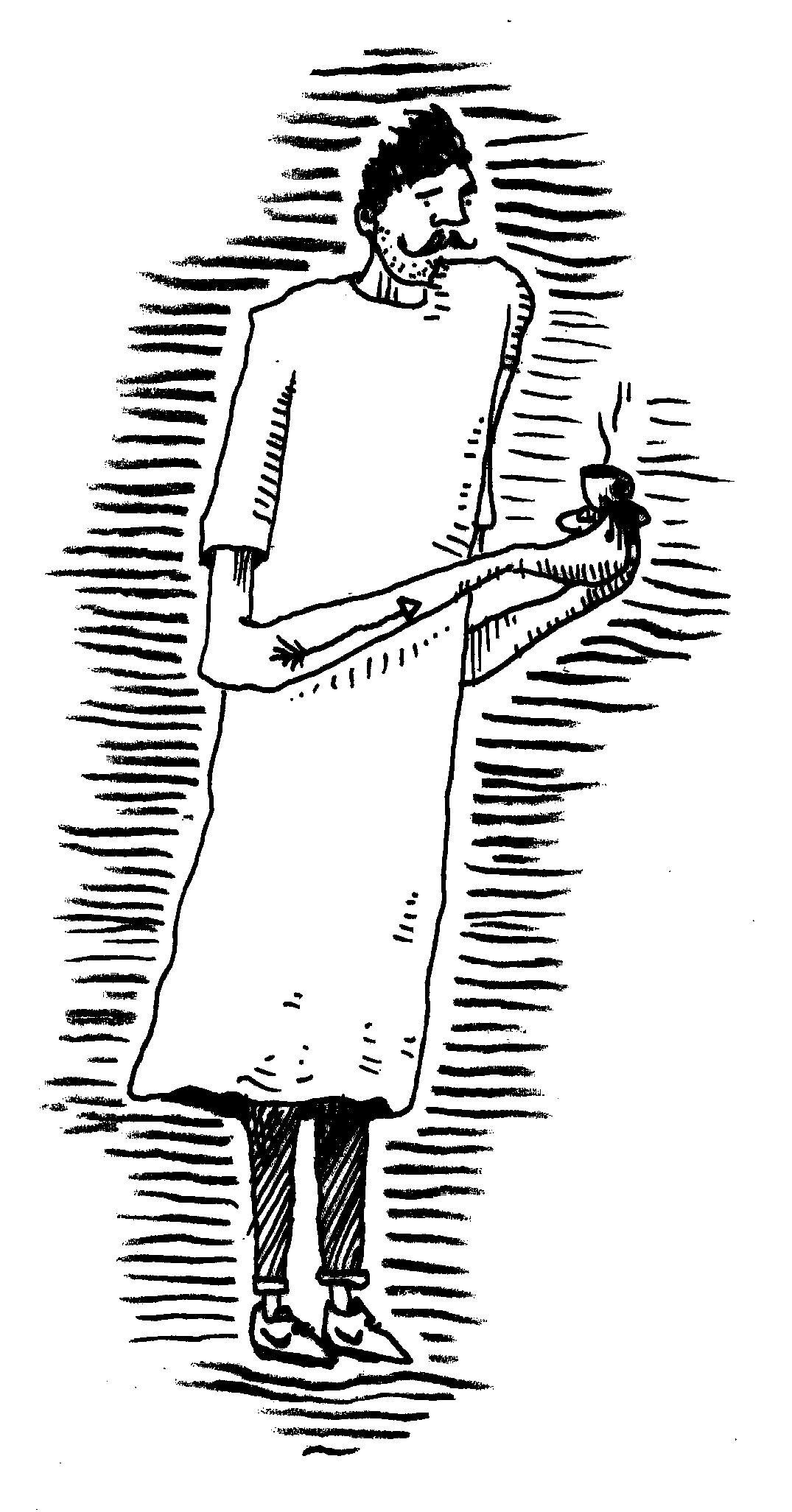
Apron Thoughts illustration by Geoff Gouveia

Apron Thoughts illustration by Geoff Gouveia

The amber light reflected off the polished concrete, wiped away for a moment when my broom swept the dust clear from the floor. I moved a wooden chair, the deep brown scratched against the ground and I swept underneath there, too. My apron hugged my abdomen when I bent over, the waxed leather folding hesitant against an irregular motion. Forward on the balls of my feet, the heels on coffee stained boots lift off the ground. Through my legs I see the laces touching the floor, the crease behind the toe wrinkling the leather with a worn look. Lowering the heels, I stand using the broom as a cane. I grab the porcelain cups on the table left by the customer before my cleaning.

I cleaned when the shop went still, when the music played slow and the air swirled inside. I cleaned to keep occupied and when I cleaned I thought. I thought about my wife at home, wondering if she missed me when I went to work. I thought about the next morning, if I would be able to pick up the brush and work or sit there and stare at the canvas like I had today. I thought about my degree, a piece of paper I received a few months prior and how my apron felt heavier than my graduation gown. I thought about the friend I had seen in the shop, asking what I was up to and smiling as an answer. I couldn’t explain everything I was up to and he couldn’t care about anything I was up to. My thoughts rambled behind every sweep, the broom erasing them.

I thought about quitting and pursuing what I wanted to. I thought about being afraid and understanding that I was and that it didn’t matter but it should. I thought about choosing something different four years ago and I thought about why I couldn’t now and why I didn’t then. I thought about wishing I could sit and read again, that my 30-minute break wasn’t enough to learn from the great Saul Bellow. I thought about all these things while my body picked up the cups.

I enjoyed the job; I talked with people and made the drinks. I enjoyed the thinking it allowed me and the small hourly wage was enough to think and be present with my own thoughts for hours. I’d sketch pieces in my head and when the customer asked me a question I’d have to ask them to repeat it because I wasn’t there at that moment. I did not mind the questions, but I hated when the groups arrived. Today, the arrival of a large group cut my thinking time short. They fill the shop with voice and body heat, neutralizing the cold December air that rushed in with them. I hate them because they are a group.

A group won’t befriend the barista, a group won’t tip and a group won’t leave early. They will order the same drink, one after another after another and laugh about it like it is a funny joke.  When they laugh it rips the thought I had in half. They move the chairs with loud scrapes and put the sugar packets into their drinks after they finish. When they ask me a question it shakes me back to the body I tried to leave while it cleaned and made their drinks.

The group won’t let me think while I make the drinks and I won’t be able to ponder whether I could actually leave this place. I made the drinks and then cleaned their table. The group left to their own devices, content to make a mess and have a loud chat. I motion to my coworker I’m taking out the trash. I leave my apron in the back and gather the black bags. My sleeves rolled up to my elbows while I hold the bags tight in my left, using my right to press open the door. The crisp air stings on my cheeks and they turn red and I don’t care. I don’t feel the wind but my body does. I walk to the trash and throw it in, waiting for the metallic sound to signify the toss arrived. The shop glows amber in the night and I look up at the night sky, pleading with myself to pick up the brush in the morning and try one more time.


Thank you for reading the story. If you have some extra time, why don't you read this one as well?

June 6, 2015 - No Comments!

Cobblestones and Bitten Foam Cups

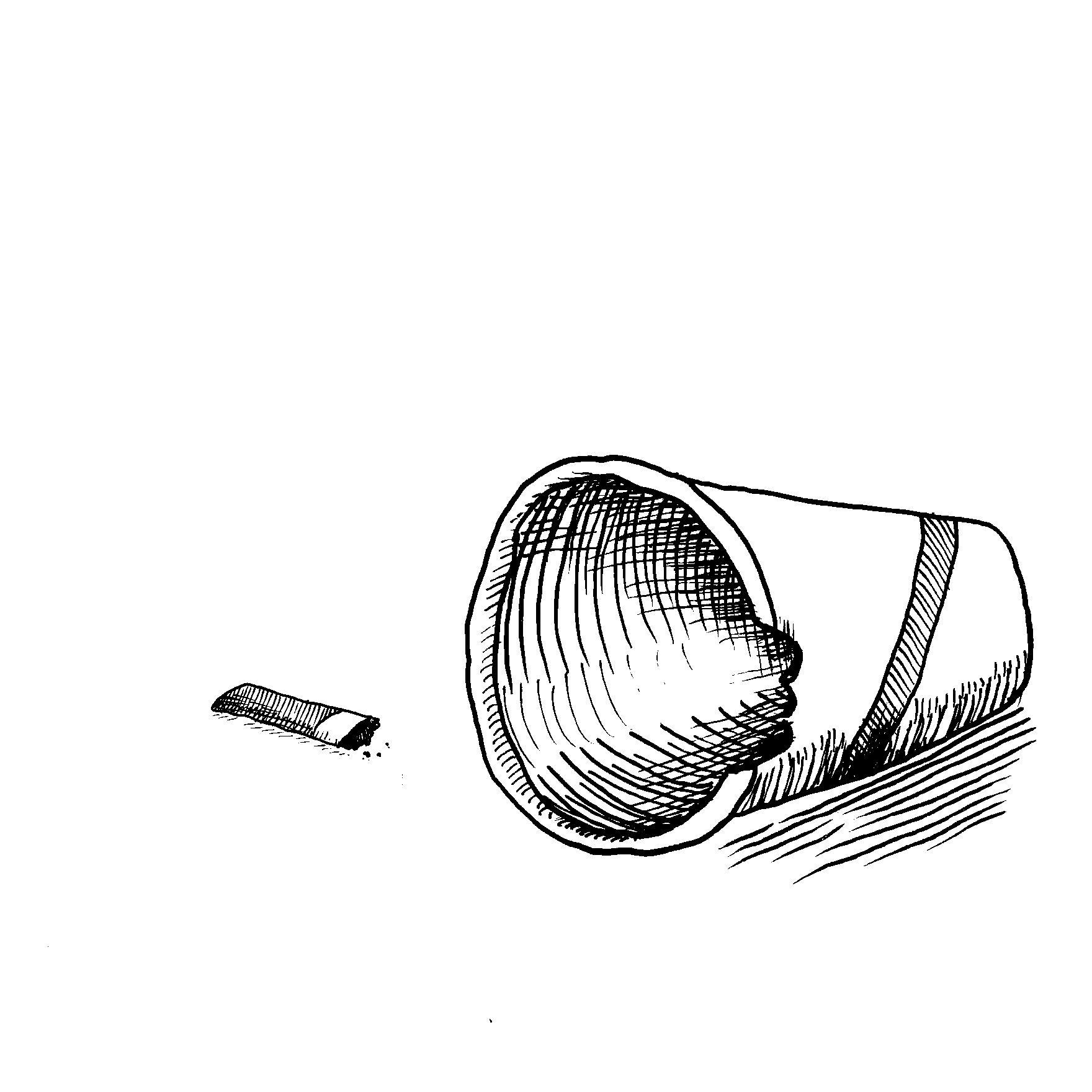
Bitten Foam illustration by Geoff Gouveia

Bitten Foam illustration by Geoff Gouveia

My feet slipped on the mat above the black and white tile. I stepped in a puddle walking in, noticing a paper on the sidewalk when I looked down at my shoe. The paper stole my glance and then held my attention after entering in the shop. Ordering my coffee, with honey to subdue my sweet tooth, I take a seat near the window. The paper flickers in the wind. A light teal banner wrapped around the page.

The invitation picked up with the breeze, shoved closer to the street and then swept onto the asphalt. A white car drove over it- the paper bent back and then followed the motion of the vehicle. A man on worn out bicycle with large filled blue tarp wrapped up on the handlebars - his life on the move. The tire sagged in the back. He had red skin that burned against the cool outside world. No sun had come out today but  it had licked his skin the week prior.

When he whizzed past the window, he looked at me and I glanced up. I lifted my gaze from the paper and we locked eyes for a second. His cigarette bounced on his lips and I blinked with slow heavy lashes. We didn’t care about each other. Without the sun to mirror our images, we saw right through each other. As he rode away, a cup dropped from his bike. An orange striped the rim with a bite mark near the top.

The bite mark reminded me of the times my father would take my brothers and I to the local market for slurpees. The foam cup would dissipate its contents as I sucked them down. Furious at the loss of liquid, I’d bite the cup in juvenile frustration. My dad would smile and I wished inside he’d bought me a larger one. Here the orange striped cup sat bitten and the wind spun it round until a woman stepped on it. The crunch came under her light brown flats. She had a slate blue open cardigan on, with indigo pressed jeans. Large glasses covered her eyes and her soft blue blouse fluttered. The cup lay crunched, her gaze shifted down and then up as she continued her journey past the corner towards the court.

At the corner, a man in a wheelchair rolled near. His name is Richard- we’ve talked before. He used to draw and he drew well. He’d had pictures hung in the galleries down the street in the 80’s, Native American portraiture. He used to be Native American, but now he was old. His thumbs worked enough to make the motorized wheelchair take him place to place. His hands shook when we talked and I wondered if his black backpack contained the graphite medium he used to master. My own pen rolled off the table and I bend to pick it up.

When I lifted my head, I noticed the shop has one occupant other than myself. A woman dressed younger than she was but not in a bad way. Her hair possessed youth. She sat like a young girl: bunched elbows on the table and feet swung above the ground. It was her eyes that betrayed her; they pierced, showed age in a way that let you know she’d seen life. Her shoes were white, with white socks cut off by the ankle and pants rolled well above that. She had ordered a latte in the for-here cups, the ebony porcelain ones with matching midnight saucers with inset rings for the cups to rest on. When the barista called her drink out, her white shoes swung from near the wall to outside of the chair to stand and collect her drink. When she stood, she arched her back and her shirt lifted, a touch of skin shown and vanished as she walked towards the counter. Thanking the barista, she turned with both hands on the cup and eyes fixed ahead, stoic in concentration to ensure the contents reach their destination.

Now back to her spot, she retrieved from her pocket a phone with bright cobalt rubber casing rimmed on the outside. She laid it on the table. Her fingers poised above  the screen in slow sweeping motions. The content scrolled with her finger as she slouched towards her left, her hand resting on her face. Her other hand lifted the latte off the black saucer and brought it slow to her mouth, a sip to check for heat and then a gulp for satisfaction. Her eyes in a trance towards the screen were broken by a screech outside. Her head lifted and I matched her gaze to the exterior.

Outside the window, before the cup with the bitten foam spun endless towards the gutter, a white truck edged violent backwards. An irate driver, bald with a beige jacket, had his hand higher than the roof the truck. A jeep pulled behind and mistook the edging for leaving. The man in the truck motioned wild and the man in the jeep looked up and then down. The jeep man scowled. In truth, the jeep had been the wrongdoer, but he became the victim. Life happened like this: it wasn’t a matter of first or last but of perception and current perception was king over true perception. A man in large rolled pants, tucked into his long white socks, with a bald monk haircut chuckled idle to himself on the corner. His clothes were ragged when he bumbled past them. Possessed with a liquid fire drunken jolly, his movements betrayed his mental state.

When he walked past the truck, he twirled with his hands in the air and pointed towards himself. He shouted, “See!” and sidestepped the drivers. A musical of one and he danced despite the baggage carried with him. He had all the clothes he owned on him, dusted and baggy. His hands kept his pants from falling down. His head moved with small quick lateral movements that mirrored the reptile it reminded me of. Upon exiting the street, he stooped low on the concrete to pick up a cigarette bud and placed it into a small cup of other cigarette buds. He took one out of his secret stash and put it into his mouth. I repulsed at the thought of doing that myself and remembered viewing this in Rio de Janeiro during the World Cup.

My mates and I were walking back from a game and the party was happening all around us. The beer flowed from the cobblestoned sidewalk onto the streets and the empty cans were thrown next to the curb.

Two types of men picked up the refuse in that moment: Those carrying large bags with downcast eyes and those with sunken eyes carrying nothing. The downcast-eyed-large-bag men picked up the cans and kept moving. These men I respected despite their low position deep into the night. They collected trash to provide pão for their filhos before school the next day. These men we gave the cans when we walked by, hoping to add weight to the bag behind them. The addition of weight to their load was liberating them, one can at a time.

The sunken-eyed-bag-less men found liberation in the near empty cans in the refuse. Pouncing on the can before the bag-men, they were content to drink the remnants. These men lost my respect. They ran away from their problems into a disgusting state of garbage and refuse, seeking to extend their buzz for as long as possible. I turned my back as I watched the man stoop low for more cigarette buds. He was at once cleaning the streets and polluting himself in a dog-like manner. An absence of self-respect created a self-perpetuating cycle of degradation and absent reality.

The cobblestoned streets of Rio fade as the cigarette stower continued down the street, past the window broken up by the panes. Woken late, the sun shone on the passerby. The light hit the stower’s front side and cast a shadow on the opposing interior.

The flicker of shadow washed over the businessman’s briefcase, tinted sepia in the light and burnt in the shadow. A green striped tie with yellow small diagonal stripes rested below the Adam’s apple in a half Windsor knot. His arms crossed on the table, one hand just over the other. He peered outside, past the cigarette stower and past the bitten foam cup. A thick ring weighted his left ring finger, the phone on the table highlighted and he sprang to answer it. With a loud hello and a smile, he lifted the remnants of the coffee cup. His head nodded and the phone bounced in his hand, sliding from the top of the ear to the middle. He looked straight ahead and the smile began to wane as his eyes glossed. His brow furled and his hand reached across the table to dig out a paper from his briefcase. When he found it, he shook his head and his expression changed once more, terse and now resolved to finish the conversation. A stifled call me later ends the call. Hand still on the bag, he clasped down and walked out the door with a sigh. The mug lay off center of the table; the contents empty with a half crunched naples yellow sunlit napkin to the side.

My own mug fits in the palm of my hand while my other hand cups the top for warmth. I feel the steam lick my hand, slow rising in temperature and humidity. The liquid is not delicious but refreshing on the tongue based on habit alone. Not like a gin and tonic nor an old fashioned – it sits on the tongue much like you’d sit on your grandmother’s couch and hold her hand. There wasn’t excitement in the encounter that made it worthwhile. The familiarity was warmth and not deliciousness, it was not new and that made it worth pursuing in the morning.

This morning, with its characters and lifestyles were the cups of coffee we’d all had. We'd spin them in different directions, different mixtures and ratios of the ingredients we enjoyed most. We liked it that way; we were individuals when we stopped at 50% milk, 10% sugar in a way that made our coffee ours. Only we were in our heads, much like the men on the street. Spinning around cars and biting foam cups, casting shadows on business suits and grey cardigans. We loved what we loved and that made us unique, mismatched human cobblestones fit together in close proximity.


Thank you for reading this short story. If you have some time, consume another!