All Posts in Short Story

May 30, 2015 - No Comments!

Let’s Go Fishing

Fishing illustration by Geoff Gouveia

Fishing illustration by Geoff Gouveia

Blake's short, round frame set him apart from my thin body. I met Blake my freshman year of high school and we hit it off real well together. He was loyal in admiration and affectionate in sharing, he lied to protect and kept my feelings above his own. In those days, I walked the streets in my navy blue Vans, the ones that all good California boys walk the streets in, and he in his black ones. Blue was classic and the black was the cry from the public for more options.

I remember our first encounter, it happened on the schoolyard. Blake had heard that I liked to skate – and to this day- I don’t know why he chose that topic to start the conversation. But he started it. He walked up to me and asked me about the activity, asked if I ever wanted to skate with him. It was a bluff, he knew that I knew that he did not know how to skate, but I bit anyways. I’d developed a reputation for hanging out with those who were desperate for conversation. I liked this reputation; I agreed to hang out with Blake.

The next Thursday I arrived in my skating blue vans, the ones I had before my walk-the-streets kicks, and board with dings and scratches to prove its use. Blake’s shiny sneaks and new ball-bearing wheels were a dead giveaway: this boy would get hurt. He would try to match me on the hill, I’d been skating longer and the smooth passes on my board were graceful. His thick legs were not good at working together, and his attempt at the same hill ended with a fresh raspberry on his elbow. The flesh left on the street and the sting to the pride on him.

Things were always like this with Blake: he would find out what I liked and asked to do those things with me. Soon we did everything together. We surfed, listened to music, stayed out late and painted. We did it all together, and by together, I mean I continued to do what I had always done and he would try those for the first time. He lied to gain my trust, and I knew this. It was endearing, but I knew it would be fickle. I never asked what he wanted to do- I learned not to ask that because he would repeat what I had already said we should do. It was uncanny, and by the third year of knowing him, it annoyed. By then he had assimilated into the group I created, the group of friends curated due to their ability to create a good time. Blake did what the group did, but not as authentic. Over the course of the years I knew him, I didn’t know him at all. I knew what I liked doing and what he did was what I suggested. I never intended for that to happen but he never asserted himself in any situation. We as a group did not bash his ideas: he never had any.

Four years into our friendship, comical replaced endearing and then Blake became the brunt of the joke. His personality matched the title. We thought that by making fun of the absurd things he said- the lies to remain within the group-that he would snap out of it, become someone, anyone, other than us. He took the jokes from Carey, the confidence from Joe, the sports enthusiasm from Quinn. He was a seed picker, fabricating himself to become a part of each of us. To be fair, we all had a piece of each other within us. We saw something in the other that reminded us of ourselves, and we sought to find our identity together. The problem with Blake was that he didn’t contribute anything; he took and did not come up with any original content. He was the running joke.

The jokes we used to exploit him shifted from passive to confrontational. It was acceptable within the group to break him, like a small dog learning where and where not to piss. It was our duty, the duty of our group, to make Blake a man. We knew this nonsense of pretending and lying would only alienate him further; we were doing him a favor. Blake’s constant hijacking of personality wore on Carey. Carey lost all sensitivity and called bullshit on everything Blake said. Joe gave up in pretending to relate to Blake and Quinn stopped engaging him in conversation. Blake and I drifted. It was trying to be friends with a transparent shell: Reflective but see through, an invisible entity that never washed away. We were not taught as children how to deal with the identity-less, we only knew as children how to be ourselves.

I had seen Blake at home many times, his father a man with a frail grip on humanity. Blake’s father’s items created him. Whenever Blake expressed himself, his ideas dissipated at home under his father’s eye and constant correction. We as a group knew the one true activity he liked to do was to fish. We were waiting to go fishing, but we also waited for his initiation. At the end of that fourth year, Blake stated for the first time he wanted to go fishing with us. I had work and the rest of the group had equal responsibilities.

Blake did not go fishing that day; he drank a little too much whiskey and jumped off the bridge near the pond. One of the neighbors near the water found his black vans propped against an empty bottle, overturned and dripping small drops of amber liquid-fire into the pale blue below.


Thank you for reading this short story. If you have time, please consume another by clicking here!
May 23, 2015 - No Comments!

San Clemente Albatross: A Short Story

Sketchbook Flight illustration by Geoff Gouveia

Sketchbook Flight illustration by Geoff Gouveia

The man walked into the bagel shop seeking his usual asiago with cream cheese. Inside the hustle and bustle swallowed him. It was a Saturday morning and on Saturday mornings the business always picks up. The crowd swelled inside the tiny shop, packing the man against the rack holding the bagels. They smelled fresh, the dough puffed with holes in the middle. Asiago cheese, strawberry, blueberry, Swiss- they were all here. The man glanced at each one, knowing his asiago would end up in his hand. Shoving his way to the front, the man purchased one. The cashier asked for his name and he responded Gerard.

Gerard grabbed the bagel when his name called and exited onto the street. The beach town lay unprepared on the cold morning, for the sudden glimpse of false spring weather. The temperament of that town, and all towns two seconds from the shore, are above 70 the entire time. It has weather that allows for one to wear whatever they please. The women wear their interior level of modesty while the men adhere to a strict code of high socks, boardshorts and shirt. Gerard wore his socks pulled up and down at the same time, a sign that he could not care less about the uniform. He was the age of 24 and 2 years removed from college. He walked the street like a 24 year old would, still observing the surroundings but knowing where his foot would land next. There was confidence in the step but uncertainty in where it would arrive at the end of the day.

Gerard carried a black sketchbook with him wherever he went. People asked to see the insides and Gerard obliged. He knew they wanted evidence of craft and evidence of his superiority over themselves. People looked in seeking their own inner satisfaction- if they saw something superior, they validated their own intentions of never continuing the artistic talent they once held.

The sketchbook was a mysterious time capsule in itself, a place where Gerard would let the frustrations out while seeking to conquer them. Each day, he drew with fervor and the things he drew did not make sense to everyone who asked to see the book. How could they? They didn’t understand what went on inside the brain of the man, let alone the heart. As all artists know, the pen flows with ink pumped from the heart. The heart is a fickle beast, beating irregular in unpredictable intervals. Gerard’s was no different. Inspiration made the organ beat uncontrollable; it beat three times what it should and with that excess pump so too the ink spilled on to the page. In times of desperation the heart slowed itself, beat once or twice an hour and when Gerard went to draw the pen scratched the page as it ran dry. He would curse the pen but knew the source as empty, like a grill operating on its’ reservoir of propane, depleted low. Most of the time the heart ran at its predetermined pace, a pace that allowed for inspiration and desperation to co-exist within the moment. The extremes were not met alone; they met in ebbs and flows, like the tide in which this San Clemente town worshipped.

Gerard walked, bagel in hand, to the coffee shop he would draw at for the next few hours. El Camino Real was a street unlike any other, the cars signifying its importance. Money was here and the residents liked to show it. The homeless here were darker in complexion, they had sat in the sun a tiny bit longer. Hats were commonplace and comfort was the highest commodity worn by all. The women wore jeans to look like they could have worn anything they had in their house at the moment, you just happened to catch them at that time.  This was San Clemente. Gerard was here, without his wife, and he would walk alone on El Camino Real, watching the girls pass by who betrayed their craving for attention. Gerard could not avoid their gaze nor what they wore, but he had no interest in their desperation.

He arrived at the shop, after passing many try-too-hard females, and found his place in the corner. The lighting was darker than most shops. He loved this best; he could exist without the bothersome spectacle he worried himself to be. In reality, no one cared whether he drew or not. They envied his ability to partake in a hobby all the time, or so they thought. Brave elder gentleman would ask Gerard what he was drawing and the response disappointed them. It made no sense to the older generation why he drew in the coffee shop rather than down by the docks like all the other artists depicting the wonderful scenery around them. “That was art!” they would exclaim and seeing what Gerard was drawing would mention in their head how they could have done that if they had persisted in drawing all those years ago. More times than not, some mention of another family member or friend who appreciated art came at this moment. It was a small connection, a reason for conversation to ensue. This was peculiar to Gerard, but he accepted the polite attempt at finding a common bond. Gerard would extend the politeness back to the individual, asking what they did. Always some answer that confused Gerard, real estate or lawyer or broker.

After one such instance, Gerard drew a picture of a young boy playing in the sand down at the beach. The boy was crafting a huge sandcastle with a giant wave mounting, unbeknownst to the boy, behind him. This drawing was well received by the beach community, they remarked at how their own children played at the beach. The wave, thought to be disproportionate- a common mistake- and that the boy elevated to a much higher status than the composition hinted at.

Finished with his coffee, Gerard packed his pencil into his small messenger bag and left the shop. A flutter of wind disturbed his hair and made Gerard peer slight left. On the corner of a streetlight, a large albatross sat perched. It was alone. A king atop the streetlight, it looked down at the passerby. Gerard remarked at the length of its’ bill and walked on towards the shore. He took a left on Mariposa and followed it down past the park and to a series of steps that lead to the beach. The albatross left his perch and floated silent behind Gerard as he walked. Gerard would step and the albatross would flap, united in movement and nothing more. It was a silent connection, Gerard unaware of the flying beast behind him. He reached the bottom and crossed the railroad tracks. It was mid afternoon and the sun was still hidden behind the fog. The sun never hid long enough in the afternoon, burning a hole through it to find pale skin to singe.

Gerard, in boating shoes and jeans, descended the final steps onto the sand. He placed his sketchbook on the rocks near the sand and removed his shoes. He sat with his back to the houses and faced the moving water. It was in turmoil, the rip tide swishing right, sucking the undertow back towards it in a rhythm only the ocean knows. The albatross circled twice and this time Gerard saw it. He knew by the bill that it was the same one from the street light. The albatross ‘ wingspan was great and Gerard noticed something new to draw when rendering a bird’s wing. The interlocking feathers were not perpendicular to the actual wing- they were woven. In the midst of noting this difference, the albatross snapped its wings to its body and dove towards Gerard. It swirled downward and Gerard had to duck even further to avoid the great bird’s bill. Gerard looked up and noticed that the albatross had something in that great bill, something black and flat. He swiveled behind him and the sketchbook was gone.

The albatross flew out over of the tumultuous sea, noticing the weight of the book as false food. The bill opened and the sketchbook hung in the air for a moment, the sun glinted off the white pages. Gerard saw this in unison with the albatross, the pages flew for a minute with smaller wings, but its weight sunk it into the sea.


Thank you for reading this short story. Surely you have time to read one more?! Don't click here if you have to run.

May 16, 2015 - No Comments!

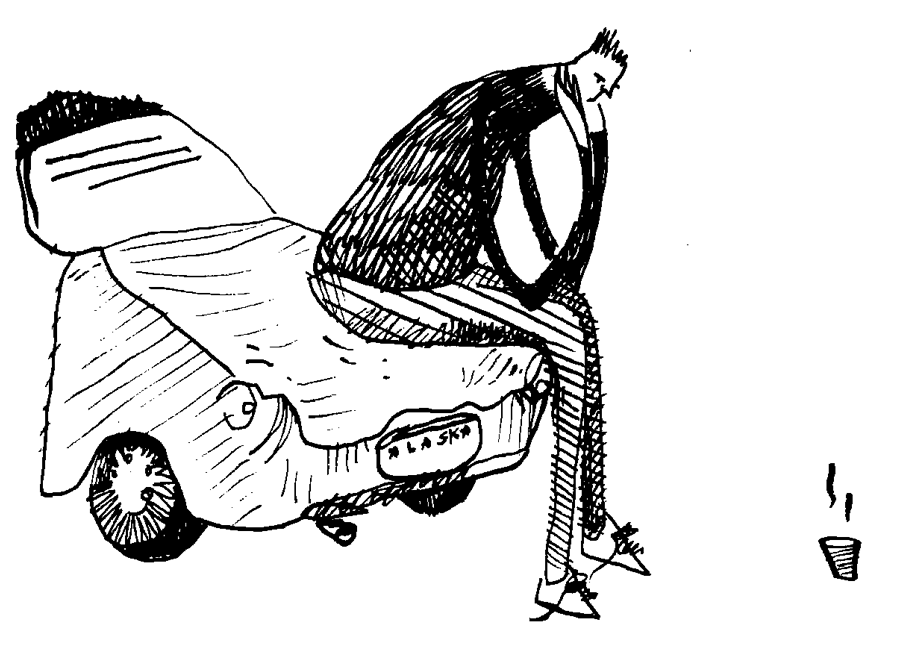
Alaskan Corvette: A Short Story

Alaskan Corvette illustration by Geoff Gouveia

Alaskan Corvette illustration by Geoff Gouveia

The coffee shop is not far from George’s house and the drive took him less than a minute right before dusk. A purple fought against the orange sky, streaks of pink prevailing right before a deep deep blue swallowed everything into the night. George parked his car, hurrying inside while noticing the man sitting atop the hood of a yellow-orange Corvette. George entered the shop and the barista brought him his usual cup of black coffee. He drank it while reading Death in the Afternoon, sketching in his notebook in between bouts with the terse prose. An hour passed -George’s wife would begin to wonder of his location- he left the cup on the table with a dollar. George smiled to the barista as he left the shop, saying he’d see them tomorrow – which he would- and that he wanted to hear about the story then – which he didn’t. Glancing at his phone, the screen lit fierce against the night in the outside world.

Peering up, George made eye contact with the man sitting on his Corvette. Smiling, George walked to his car, content with no conversation and the ability to walk away. The man intervened, asking him what kind of car George was getting into. George replied “A simple Corolla, it’s my wife’s..” Unsure of why he needed to justify the choice, George took a deep breath and laughed nervous. The man waited for a return question, as in those awkward encounters where one breaks the silence only for reciprocity. George asked the same question of him and the man shifted his weight on the car. “Corvette. Got ‘er a few years ago - runs like a dream. I drove it down from Alaska…” George checked the plates, the plates validated the statement. Above the plates in the back, George could make out a soft red sleeping bag and a jet black pillow above that.

“…I took this trip and now I’m here. My daughter lives in California, she’s an adult now.” The man wore a grey shirt, untucked and trying hard to cover the plump body. His shoes had molded to his walk, an apparent drag of the right foot. The pants had faded with use, worn for purpose and not fashion. Wild hair shot out the top of the man’s head like the tall grass that grew in the field near George’s childhood home.

George had enough of the encounter; he was finished and opened the door to his car. “My wife is calling, hope you have a good trip in California.” The man smiled weak. Just before George closed the door, he thought he heard the man say, “why did I even come?” George smiled at the man one last time and then put the vehicle in reverse. Driving away, George looked out of the rear view mirror. The Corvette glinted in the artificial light and faded when the night took it over. George pulled into the driveway, halted at the spot marked in the driveway by the oil slick. He shut the car off and walked into the small house. His wife had made a chicken dinner, the caramelized onions greeting him before his wife could. George smiled, closed the distance and kissed her. Sitting down at the table after taking his coat off, he looked towards the kitchen and then back at the table. He stared at the wood grain and remarked, “Let’s never go to Alaska, ok?”


Thank you for reading this short story. Want to read my personal favorite short story? Click here!

May 9, 2015 - No Comments!

Sea Snakes


illustration by Geoff Gouveia

illustration by Geoff Gouveia

My hands twist the wheel slight right and I break. The car halts in the zone next to the curb designated for free parking. I turn the keys and pull them out of the ignition, a tiny bell chiming before the release. My backpack sits in the front seat and I grasp it and exit the vehicle. A thump closes the door and I walk towards the curb. A gust of chill creeps onto my chest, I tighten my beige bomber jacket closed. My black beanie sits snug atop my head and my shoes are black as they click on black asphalt. The light is red, now it is green and the white man in the black box is beckoning me to walk within the white lines across the street. It is a block before the café is in sight.

The red familiar Coffee sign, protruding over the street, signals where to stop every morning. I like to arrive as the baristas are unlocking the door: I want to be the first customer to begin drawing. Today I’m running late; I forgot to turn off the heater in the house and had to turn around to switch it off after driving a mile down the road.

Most mornings my two-block walk is solitary. One morning, I saw a couple fighting as they hurried towards the court. His brown shirt spilling out of his pants, his hands fumbling around the waste to tame the escaping apparel. This morning, in the February chill, I notice a man lying on the ground next to the red Coffee sign. Half a block out, the brown paper bag lies crumpled, a glass bottleneck peeping over the top. His sleeping bag is a muted cerulean, a blue ocean on a foggy morning when peering out over a bay.

He lay motionless, his sleeping bag around him. He had tucked his head under the bag, no pillow just a pale blue bag to lift off the still paler blue concrete. Matted hair escaped like tiny garden snakes, tiny snakes trying to find shelter and warm their blood. These snakes didn’t swarm; they lay tangled above the blue.

I pull out my phone to check the time and break eye contact with the scene. 10 steps from the bag and I pull the handle to enter the shop. I notice someone left a small white cup with steaming coffee coming out of it. I know now I’m not the first customer today, but the cup lay untouched near the paper bag. I walk into the shop and wipe my feet three times as a courtesy to the shop. I’m greeted with a smile, the barista wearing a red and white striped button up, the top button buttoned up. We exchange pleasantries, a healthy good morning banter and I order my usual cup of black coffee. He poured it by pressing on the valve to release the morning liquid. A split second while the coffee spilled out of the container into my cup, the white light of the above bulb tinted my coffee from black to a neutral muddled gray; I repulsed slightly. It was gone in a flash and I accepted the cup for a payment of $2. I was about to turn when the buttoned up barista sighed real loud and remarked it was a shame that they always picked the worst places to sleep at night. That they didn’t have any regard for the coffee shop’s customers- who wants to see him sleeping like that? I smiled and nodded and responded with an assured yeah, right? and sat down.

I looked over at the blue bag on the blue slate and it reminded me of the bay again. The bay moved but the man didn’t. The ocean bobbed and flowed, the man stayed motionless. His sea snakes were frozen- a reverse Medusa. Still, they spellbound me and I stared for a few minutes. I broke my gaze by sticking my hand into my backpack, retrieved a grey notebook with pages half filled with black sketches of important ideas and thoughts. I began to draw, placing one headphone then another in my ears to listen to something other than the slow jazz in the shop. 10 minutes pass and I look up, taking a mental break from a rendering of my coffee cup and I notice the stares of passerby on the stiff sea snakes.

A woman, dressed in a tight skirt in powerful black heels, the ones that women wear to tower over men, clacks past him. A binder hugged tight to her chest with her left arm, the same hand holding a cup of coffee and her right hand raised in a loud conversation over the phone. A man carrying a plastic white bag peers over to the left to catch a glimpse of the skirt moving up and down to the rhythm of the female walk, is interrupted by a glance at the bag pushed by the wind on the sidewalk. The sidewalk sleeper more and more a mirage, a pond that sucks people into it and then releases their vision once they decide it does not exist to them.

Behind me, the door is pressed open and I hear the red buttoned barista walking, now to the side of me and outside. Through the window I see him stoop down and nudge the sea snakes- I see the barista’s mouth move and a frown, followed by him pulling out a phone and a dialing of numbers. He walks back inside and calls to the other barista that he’s just notified the downtown patrol to come clear the sidewalk of what the “tide brought in.”

It reminded me of a time when I walked the bay and I saw drifting some ways out a red object in the surf. Each wave that crashed brought it closer to the sand and in my head the waves were black but the shore was a light blue. The fog messed with my memory but I waited for the red object to finally land. I picked it up out of the surf when a final swoooosh shot it towards me. It was balloon that had the words happy birthday on it, striped yellow and red, sadly written as the weather withered it down in the water. I put it in my pocket and threw it away when I found the nearest receptacle.

The sea snakes were now drawing a crowd; passerby of tattooed youth and loose-tight fit business suits walking hurriedly to their destination peering down and around the bag. A shaking of the head and an increased pace were the appropriate response of the morning. A few minutes passed before the black and white cruiser rolled up and an officer in an olive green exited the patrol car. He stooped over, a hand on his holster as he shoved the snakes. They didn’t hiss, nor swarm or contort in any way - frozen in the same place. The officer look annoyed, like when the teacher tells the student to put away the crayon but the student giggles and pretends to not hear, annoyed like that. He shoved the snakes again, with no response and further annoyance on his face. He stood up and took a step back, knocking over the paper bag bottle.

He called on his radio and then kicked the bag, gentle at first, then into a ruder call to wake. The snakes remained still, the pool of concrete around him still and the bag tossed about by the kicks and not the form underneath. Paramedics arrived, now a large scene formed as people continued to walk by, amazed at how many officers were in the area. The paramedics piled out of their vehicle and took away the bag. The sea snakes had a home on top of a pale blue sunburnt face. The lips puckered tight, drug use speckled the skin and years of street wandering forced his brow to furl on a permanent scowl. When the paramedics picked him up, it reminded me of Caravaggio rendition of David and Goliath: Caravaggio’s own head hanging in the hands of a young boy. The blackness of the chiaroscuro in that painting mirrored the coldness of the man’s eyes. They were open.

The paramedics checked his vital signs, shook their head and shrugged. They loaded him on stretcher, pulling a blanket over him. The officer cleared the roads and the crowd went on their way as the paramedic sped off, sea snakes in tow. The blue bag, cloth folded neat, brushed slightly by the wind. A strong gust swept the ground and pushed the bag open, revealing a striped red and yellow lining. The officer picked up the bag and stuffed it into the bin.

I resumed drawing, sipped my coffee and remarked at how it had cooled during the commotion.


Thank you for reading this short story. I understand it was a bit sad. Click here and I'll send you some stickers to cheer you up!


May 2, 2015 - No Comments!

Yellow-Black Buttoned Coats: A Short Story

Bee Ball illustration by Geoff Gouveia

Bee Ball illustration by Geoff Gouveia

The ice plant lined outside of the concrete, out from under the shade and next to the red fence that we later painted green. The ice plant was dull for the majority of the year, dormant with its honeydew melon complexion, crisp with the crunch of little boys’ feet treading on it. My mother yelled at us for playing in the ice plant, it was a ground covering and not a playground. We were infatuated with the way the leaves broke and the moisture stored inside hit cool on your feet on the hot summer day- my brothers and I never paid attention to how hard we stepped on any of the plants in the backyard. The only time we saw the plant for what it truly was, a breathing organism, was during the spring months of Southern California March, April and May.

During those months the plant became an ecosystem and the colors of spring were fully flaunted in this stretch of the yard. The bees in their buttoned-up yellow and black coats buzz from flower to flower, busily pollenating. They were the real culprits behind the bright flush of fuchsia, the inch-wide bursts of color against the desaturated blue-green. The ice plant was alive, and when it lived, it was respected. My brothers and I treaded lightly around the area in which it rested during the night and awoke during the day. The bees were dually respected. One boy, unfortunate enough to forget the boundaries of the plant, remembered after the bees guarded their territory with fierce stings.

The month of May would roll around and the flowers would change, the heat would wilt them and by July they were a glimmer of what they once were. The bees moved on, taking their bright colors with them inside of their yellow-black coats. I would kick the ball over the plant in those late months and charge headfirst for it. Rogue bees, forgotten by their tribe, their stripes would flash the sign before giving me the telltale mark of trespassing. I knew better than that, but to go into the bush was to reclaim what was yours and no combination of colors could deny a young boy his ball.

April 25, 2015 - No Comments!

Boys and Grapefruits: A Short Story

Fragile Grapefruit illustration by Geoff Gouveia

Fragile Grapefruit illustration by Geoff Gouveia

The grapefruit tree had branches extending over the back right section of the yard. In the summer, the shade from the branches was a place of refuge for a young boy. A low trunk combined with the extension of multiple thick branches gave it the unique characteristic of climbable. Yellow, a soft Naples yellow ascribed to those grapefruits, peppered the tree in season. As boys, we picked and threw them at one another. The fruit would explode when it missed the target brother and crashed into the wall. Large pieces of fruit flew and the sticky juice ran down our fingers. Hearing the thud – thud and subsequent laughter, our grandmother would come outside in a fury. She respected the natural fruit and we did not. To us the tree was a jungle gym in a backyard stale from being built in the 1960’s. Rambunctious children: we were brothers and boys.

The tree’s starting branch was taller than our tallest brother; we had to work together to climb it. The youngest would go first, as his strength was quite minor. Then competition would ensue between the next two. During these scuffs, grapefruits were ripped off the stems and thrown. It did not help that grapefruit, as a species, fit perfectly inside of a small boys hand. There is no other thing that breaks with harmless consequences the size of a grapefruit. It is the most prized fruit for throwing: it does the most damage but remains fruit after being thrown. Grandmother had lemons in the backyard, along with pomegranates and limes, but we never threw those. To be specific, we used the lemons as baseballs and the limes as golf balls. The pomegranates we mutually left alone, as the evidence of smashed pomegranate remained on the clothes forever. Pomegranates had an extremely pleasant taste and the boys knew that eventually the fruit would ripen and they could eat it. Grapefruits were sworn trajectories, the sourness of the fruit itself a conviction to this kind of treatment. While grandmother did not enjoy the taste of grapefruits as much as the others she had in the yard, it was a living plant.

I remember coming to her house with my other two brothers and noticing the flowers in the front yard frazzled. I asked her about this and her face darkened into a scowl. She knew the culprit. “Los gatos… son diablos!” Sprinkling spicy peppers near the flowers, she set the trap for the cats to eat them. When the cats did eat the peppers, unusual diarrhea would plague their bowels. From then on, the cats would know where our Yaya lived.

Yaya’s backyard was the place where we as boys could escape the elder woman’s eye. She had a keen one and knew exactly when my older brother had spilled the sugar on the table. When younger brother dropped popcorn on the carpet, Yaya could smell it from three rooms away. We spent the night there on a frequent basis growing up, and in the morning, Yaya would shake my toe to get up. I hated that shake because it meant I would have to make the bed to impossible Spaniard standards. She wouldn’t feed us before making the bed -sometimes I would hide the sheets under the comforter to satisfy my hunger. I always forgot Yaya had x-ray vision and would see straight through the sheets. Her tiny body would bend over and straighten the bed. “Why don’t you put over here,” she would ask, but it was not a question. Gentle words and tiny daggers, she got us into line quick. That was inside of the house.

Outside, the backyard had a glass window separating us from her. With all of the rules and tidiness of the house, that is why we threw the fruit. I made my younger brother cry from a well-placed lemon to the ear. Older brother brought justice on me in the form of a move he learned from watching the wrestlers on television. Much yelling and fighting happened in that backyard, but the quarrelling was settled in climbing the tree. In that back corner of the yard, the tree was hidden from the watchful eye of my grandmother. We prayed she would not come back while we were throwing the grapefruit, but she walked softly in the grass. A predator pouncing on her prey, she would catch us every time. Boys would be ordered inside and she would stand near the branches, bending low to pick up the fruit. Those grapefruit intact sat on the ground, the black decay crawling over the soft yellow. She knew the time for that fruit came too early but she could not stop the boys from doing what they were born to do. When she turned to walk back towards the house, she could smell the sweet zest of the grapefruit, the sour of its’ spoiled innards.